Walk through any home improvement store or browse online water treatment products, and you'll quickly notice that the terms water filter and water purifier are often used interchangeably. At first glance, they sound like the same thing. After all, both are designed to make water cleaner.
But here's the truth: a water filter and a water purifier are not always the same thing.
Understanding the difference can help you avoid spending money on a system that doesn't solve your actual water problems. Some homes only need basic filtration to improve taste and reduce chlorine. Others require advanced purification to address microorganisms, heavy metals, or dissolved contaminants.
If you're trying to decide between the two, this guide will explain how each system works, what contaminants they remove, and which option may be the better fit for your home.
Why Clean Water Means Different Things to Different Homes
"Clean water" isn't a one-size-fits-all term.
For one family, clean water may simply mean removing chlorine taste from city water. For another household, it may mean eliminating bacteria from private well water. Some homeowners are concerned about sediment and rust, while others want protection against dissolved contaminants or heavy metals.
That's why understanding your water source is always the first step before choosing any treatment system.
The right solution depends on:
- Your water source
- Local water quality
- Specific contaminants present
- Household water usage
- Whether you're treating drinking water or the entire home
Once you know what you're trying to remove, choosing between a filter and a purifier becomes much easier.
What Is a Water Filter?
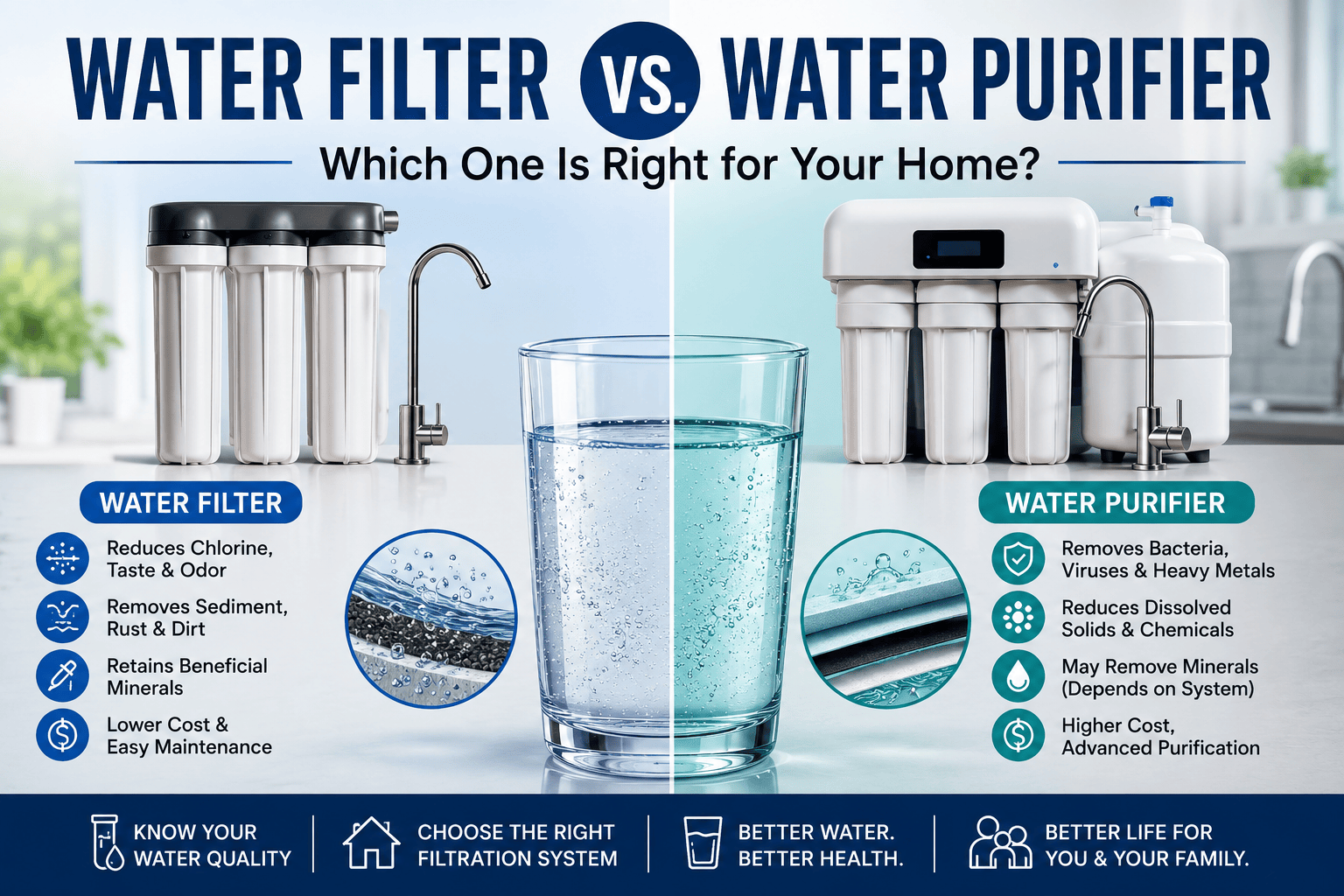
A water filter is designed to reduce or remove specific contaminants from water while allowing clean water to pass through.
Different filters use different technologies depending on the contaminants they target.
Common filtration methods include:
- Activated carbon
- Sediment filtration
- Catalytic carbon
- KDF media
- Mechanical filtration
- Ion exchange
- Water softening media
Most water filters focus on improving water quality by reducing unwanted substances while often retaining naturally occurring minerals.
What Does a Water Filter Remove?
Depending on the filtration technology used, water filters may reduce:
- Chlorine
- Chloramine
- Sediment
- Rust
- Dirt
- Sand
- Volatile organic compounds (VOCs)
- Bad tastes
- Odors
- Certain heavy metals
- Pesticides
- Herbicides
- Hard water minerals
No single filter removes every contaminant, which is why many systems combine multiple filtration stages.
What Is a Water Purifier?
A water purifier generally refers to a system that provides a higher level of contaminant removal, often targeting microorganisms and extremely small dissolved impurities.
Purifiers typically use advanced treatment technologies such as:
- Reverse osmosis
- Ultraviolet (UV) treatment
- Distillation
- Ultrafiltration
- Multi-stage purification systems
Purification systems are designed to remove or neutralize contaminants that standard filters may not fully address.
What Does a Water Purifier Remove?
Depending on the purification method, a purifier may reduce:
- Bacteria
- Viruses
- Cysts
- Heavy metals
- Dissolved salts
- Fluoride
- Arsenic
- Nitrates
- Lead
- Total dissolved solids (TDS)
- Certain chemicals
- Microorganisms
Purifiers often provide broader contaminant reduction than standard filtration systems.
Water Filter vs. Water Purifier: What's the Main Difference?
The easiest way to understand the difference is this:
Filters reduce specific contaminants. Purifiers aim to remove or neutralize a much wider range of contaminants.
Think of a filter as selective treatment and a purifier as more comprehensive treatment.
That doesn't automatically make a purifier better. The best choice depends entirely on your water quality and your needs.
Water Filter vs. Water Purifier Comparison
| Feature | Water Filter | Water Purifier |
|---|---|---|
| Improves taste and odor | Yes | Yes |
| Removes sediment | Yes | Yes |
| Reduces chlorine | Yes | Yes |
| Reduces microorganisms | Some systems | Most systems |
| Removes dissolved solids | Usually no | Often yes |
| Removes fluoride | Rarely | Some systems |
| Removes heavy metals | Certain filters | Often yes |
| Retains beneficial minerals | Usually yes | Not always |
| Lower initial cost | Typically yes | Usually higher |
| Maintenance required | Yes | Yes |
Which System Is Better for City Water?
For many homes using municipal water, a high-quality filtration system is often enough.
City water is already treated before it reaches your home, but homeowners may still want to reduce:
- Chlorine taste
- Chloramine
- Sediment
- Odors
- Lead from aging plumbing
- Certain chemical contaminants
In these situations, filtration systems are commonly chosen because they improve taste and water quality without necessarily removing beneficial minerals.
Which System Is Better for Well Water?
Private well owners often face different challenges.
Well water can contain:
- Bacteria
- Iron
- Sulfur
- Sediment
- Hard water minerals
- Manganese
- Nitrates
Because well water quality varies greatly, treatment often requires multiple stages of filtration and purification.
Some homes may need only filtration, while others may benefit from UV purification or reverse osmosis depending on water test results.
Reverse Osmosis: A Filter or a Purifier?
Reverse osmosis often creates confusion because it's technically a filtration process.
However, because reverse osmosis removes a very broad range of contaminants through a semi-permeable membrane, it is commonly classified as a purification system.
RO systems can significantly reduce:
- Fluoride
- Lead
- Arsenic
- Nitrates
- Sodium
- Dissolved solids
- Heavy metals
- Many chemical contaminants
For homeowners seeking advanced drinking water treatment, reverse osmosis is one of the most effective solutions available.
Does Purified Water Taste Better?
Not always.
Taste preferences vary.
Some people prefer purified water because it has very few dissolved substances. Others prefer filtered water because naturally occurring minerals often contribute to a fresher and more refreshing taste.
Minerals such as calcium and magnesium can influence the flavor profile of drinking water.
Which Option Costs Less?
Water filters generally have:
- Lower upfront costs
- Simpler installation
- Lower maintenance expenses
Water purifiers often involve:
- Higher equipment costs
- Additional filter stages
- More maintenance
- Professional installation in some cases
However, choosing a cheaper system that doesn't address your water issues can cost more in the long run.
Questions to Ask Before Choosing
Before deciding between a water filter and a water purifier, ask yourself:
- What contaminants are present in my water?
- Am I on city water or well water?
- Do I want better taste or maximum purification?
- Do I need whole-house treatment or drinking water treatment?
- What's my budget for installation and maintenance?
- Have I tested my water?
A professional water analysis can provide valuable insight and help you choose the right system.
Can You Use Both?
Absolutely.
In fact, many homeowners already do.
Examples include:
- Whole house filtration combined with reverse osmosis drinking water systems.
- Sediment filters paired with UV purification.
- Water softeners combined with carbon filtration.
- Multi-stage treatment systems that use several technologies together.
Layering treatment methods often provides the most comprehensive water quality improvement.
Frequently Asked Questions
Is a water purifier better than a water filter?
Not necessarily. A purifier may remove more contaminants, but a filter may be all you need depending on your water quality.
Does a water filter remove bacteria?
Some specialized filters can reduce certain microorganisms, but not all filters are designed for that purpose.
Does a purifier remove chlorine?
Many purification systems reduce chlorine, although activated carbon filters are especially effective for chlorine taste and odor.
Which is better for drinking water?
Both can provide excellent drinking water. The best choice depends on your water source, contaminant concerns, and personal preferences.
Final Thoughts
When comparing water filter vs. water purifier, there isn't a universal winner. The right system depends entirely on your water quality, household needs, and treatment goals. Some homes only need basic filtration to improve taste and remove chlorine, while others require advanced purification for broader contaminant reduction.
The most important step is understanding what's in your water before investing in any treatment system.
At Spring Rain, Inc., we believe better water starts with better information. Whether you're exploring whole house filtration, reverse osmosis systems, water softeners, or advanced purification solutions, our team can help you find a customized water treatment system designed specifically for your home's water conditions.