Choosing the right water for a fish tank is one of the most important decisions an aquarium owner can make.
A beautiful aquarium isn't just about choosing colorful fish, attractive plants, decorations, and a good filtration system. The water itself is the environment your fish live in every minute of every day.
Water that looks perfectly clean to you may not necessarily be appropriate for your fish. Tap water, well water, bottled water, distilled water, reverse osmosis water, and deionized water all have different characteristics. Some may work well for certain aquariums, while others may need to be treated or adjusted before they are added to a tank.
The right choice also depends on the type of aquarium you have.
A freshwater community aquarium has different requirements than a saltwater reef tank. Some fish prefer softer water, while others do better in harder water. Some species require specific pH conditions, and sensitive fish may be affected by sudden changes in water chemistry.
So, what is the best water for a fish tank?
There isn't one universal answer.
The best aquarium water is water that is clean, stable, free from harmful contaminants, and properly adjusted for the particular fish and aquatic environment you are keeping.
Let's look at the most common water sources and how to prepare them for an aquarium.
Why Water Quality Matters in an Aquarium
Fish don't simply drink aquarium water.
They live in it.
Water surrounds their bodies, passes over their gills, and interacts with the microorganisms, plants, substrate, and decorations inside the tank. Because of this, even relatively small changes in water chemistry can affect the aquarium environment.
Poor water quality can contribute to problems such as:
- Fish stress
- Difficulty breathing
- Poor appetite
- Unusual swimming behavior
- Increased susceptibility to disease
- Algae problems
- Unstable pH
- Poor plant growth
- Fish loss in severe situations
This is why aquarium maintenance involves much more than simply replacing cloudy water.
Clean Water Isn't Always the Same as Suitable Water
Water can look crystal clear and still have chemical characteristics that aren't appropriate for your fish.
For example, tap water may look perfectly clean but contain disinfectants used by the municipal water supply.
Likewise, distilled water can be extremely low in dissolved minerals, which may not provide the mineral content an aquarium needs without proper adjustment.
The goal isn't simply to find the "purest" water.
The goal is to create stable water that matches the needs of your aquarium inhabitants.
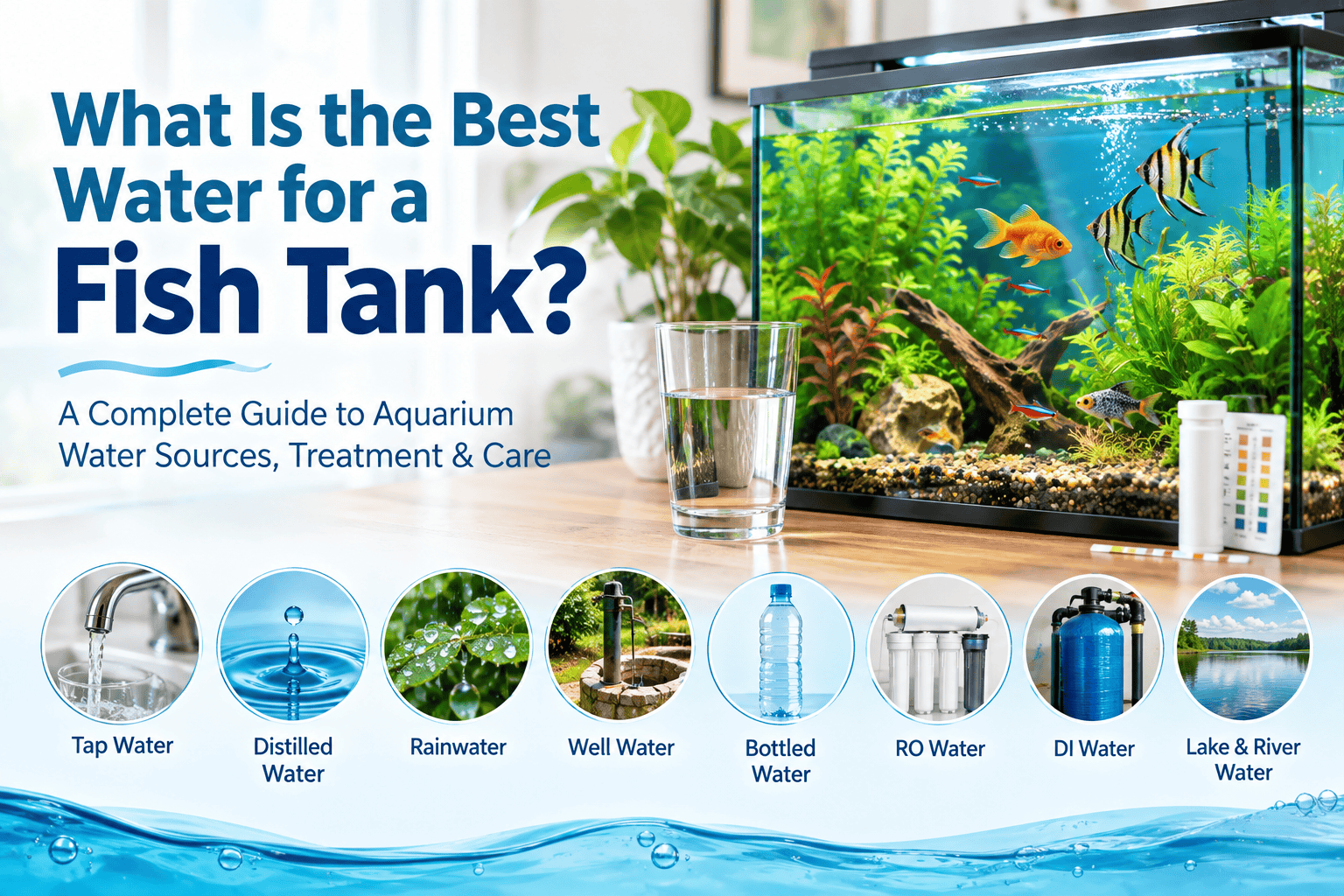
What Is the Best Water for a Fish Tank?
For many home aquariums, properly conditioned tap water can be a practical choice.
However, some aquariums benefit from purified water such as reverse osmosis water, particularly when the source water has undesirable characteristics or when the aquarist needs greater control over water chemistry.
The Best Water Depends on Your Fish
Different fish evolved in different aquatic environments.
Some freshwater species naturally live in soft, slightly acidic water. Others come from environments where the water is harder and more alkaline.
Saltwater fish have completely different requirements.
This means that choosing aquarium water should begin with the fish and aquatic organisms you plan to keep.
Think About Your Aquarium Type
Before choosing a water source, determine whether you have:
- A freshwater aquarium
- A planted freshwater aquarium
- A species-specific aquarium
- A breeding aquarium
- A saltwater fish-only aquarium
- A reef aquarium
Why Aquarium Type Changes the Water Requirements
A basic freshwater community tank may tolerate properly conditioned tap water, while a sensitive breeding setup or reef aquarium may require much more precise control over water chemistry.
Water Testing Should Come Before Treatment
Rather than automatically choosing distilled or RO water, test your existing water first.
Knowing the starting point makes it much easier to decide what needs to be removed, added, or adjusted.
Common Water Sources for Fish Tanks
There are several water sources aquarium owners commonly consider.
Each one has advantages and limitations.
1. Tap Water
Tap water is one of the most convenient choices for freshwater aquariums.
It's readily available, inexpensive, and generally contains dissolved minerals that can be useful for maintaining aquarium water chemistry.
However, tap water should not normally be added directly to an aquarium without appropriate treatment.
Municipal water may contain disinfectants such as chlorine or chloramine. These substances are useful for treating drinking water but can be harmful to fish and beneficial aquarium microorganisms at concentrations intended for tap-water disinfection.
How to Prepare Tap Water for an Aquarium
If you use municipal tap water, test it first and use an aquarium water conditioner designed to address the disinfectant used by your water supplier.
You should also understand whether your water is:
- Soft or hard
- Acidic or alkaline
- High or low in alkalinity
- Consistent throughout the year
These characteristics can affect the stability of your aquarium.
Tap Water Can Be a Good Starting Point
For many freshwater aquariums, conditioned tap water can be perfectly practical.
The important point is consistency.
If your tap water is relatively stable and suitable for your fish species, using the same prepared water during regular maintenance can make it easier to maintain consistent aquarium conditions.
2. Reverse Osmosis Water
Reverse osmosis, commonly called RO water, is produced by forcing water through a semipermeable membrane.
The membrane reduces many dissolved substances and produces water with much lower mineral content than the original source water.
RO water is popular among aquarium enthusiasts who want greater control over their water chemistry.
Why Aquarium Owners Use RO Water
RO water can be especially useful when source water has:
- Very high hardness
- High dissolved solids
- Unwanted mineral content
- Inconsistent chemistry
- Other characteristics that make aquarium management difficult
However, RO water isn't automatically ready for every aquarium.
RO Water Is Extremely Low in Minerals
Many of the minerals removed during purification can be important to aquatic life.
For freshwater aquariums, RO water may need to be remineralized before it is used.
Remineralizing RO Water
Aquarium-specific remineralization products can add controlled amounts of minerals back into purified water.
The appropriate product depends on the species you keep and the target water parameters.
Don't Add Minerals Randomly
Adding minerals without testing can create unstable conditions.
Instead, determine your target hardness and other parameters first, then adjust the water gradually.
3. Distilled Water
Distilled water is produced by heating water and collecting the condensed vapor.
The process removes many dissolved minerals and impurities, producing water with very low mineral content.
It can be useful in certain aquarium applications, but it shouldn't automatically be considered the best water for every fish tank.
Can You Use Distilled Water in a Fish Tank?
Yes, but distilled water often needs to be remineralized before being used as aquarium water.
Fish require a suitable mineral environment, and completely mineral-free water isn't necessarily appropriate for maintaining a stable aquarium.
Distilled water may be useful when an aquarist needs a very low-mineral starting point and wants to control the final water chemistry.
Mixing Distilled Water With Tap Water
Some aquarium owners mix purified water with tap water to achieve a desired mineral level.
However, this should be based on actual testing rather than an arbitrary mixing ratio.
Your tap water and another person's tap water may have completely different mineral concentrations.
4. Well Water
Private well water can be an interesting option for an aquarium because it generally isn't treated with municipal chlorine.
But that doesn't mean untreated well water is automatically suitable for fish.
Well water can contain naturally occurring minerals and other substances picked up as groundwater moves through soil and rock.
What Can Be Found in Well Water?
Depending on the location and geology, well water may have elevated levels of:
- Hardness
- Iron
- Manganese
- Sulfur compounds
- Sediment
- Certain minerals
- Other naturally occurring substances
Agricultural or environmental conditions can also affect groundwater quality.
Test Well Water Before Using It
If you're considering well water for your aquarium, testing is especially important.
A basic aquarium water test may not reveal everything you need to know about the source water.
Well Water Can Vary From One Property to Another
Two nearby homes can have noticeably different well-water chemistry.
This is one reason you shouldn't assume that well water is suitable simply because another aquarium owner successfully uses it.
Treat the Water According to the Test Results
If your well water has high hardness, iron, manganese, or another characteristic that isn't appropriate for your fish, treatment or purification may be necessary before it enters the aquarium.
5. Bottled Water
Bottled water can seem like a convenient aquarium solution.
After all, if the water is packaged for human consumption, it may seem like it should automatically be appropriate for fish.
That's not necessarily the case.
Different bottled waters have different mineral compositions.
Some contain relatively low mineral levels, while others are naturally rich in minerals.
Is Bottled Water Good for Fish Tanks?
It depends on the specific water.
Rather than choosing bottled water based on the label alone, look at its mineral content and test it when necessary.
Bottled Water Can Become Expensive
Using bottled water for a small aquarium may be manageable.
For larger aquariums, however, transporting and storing enough bottles for regular water changes can become inconvenient and expensive.
For many aquarium owners, a suitable home water treatment system can be much more practical.
6. Rainwater
Rainwater may seem like an attractive natural option for an aquarium because it generally contains relatively few dissolved minerals.
However, that low mineral content can also make it unsuitable without careful preparation.
Rainwater can collect substances from the atmosphere, collection surfaces, roofs, storage containers, and surrounding environments.
Should You Use Rainwater in an Aquarium?
It can be used in some specialized aquarium setups, but it requires careful collection, storage, testing, and treatment.
For most beginner aquarium owners, there are simpler and more predictable water sources.
7. Lake or River Water
Natural lakes and rivers are home to fish, so it may seem logical to collect water from them for a home aquarium.
In practice, this can create significant risks.
Natural surface water can contain microorganisms, parasites, organic matter, pollutants, and other substances that aren't appropriate for a closed aquarium environment.
Why Natural Water Isn't Automatically Better
Fish living in a lake or river are part of a much larger ecosystem.
A home aquarium is a small, enclosed environment.
Introducing untreated natural water can introduce organisms and substances that quickly disrupt the tank.
For this reason, using water directly from a lake, stream, or river is generally not recommended for a typical home aquarium.
8. Deionized Water
Deionized water, often called DI water, is treated to remove many dissolved ions.
Like RO and distilled water, DI water has very low mineral content.
That can be useful when you need greater control over the final water chemistry.
Is DI Water Suitable for Aquariums?
DI water can be useful as part of a controlled aquarium water-treatment process.
However, it generally shouldn't be poured directly into a tank without considering the mineral requirements of the fish.
DI Water Usually Requires Remineralization
Because the treatment process removes dissolved ions, aquarium owners may need to add appropriate minerals back into the water.
The target depends on the aquarium.
What Water Is Best for Freshwater Fish?
There isn't one water type that is perfect for every freshwater species.
For many community aquariums, properly conditioned tap water is a convenient starting point.
However, RO or RO/DI water may be preferable when the source water doesn't match the desired parameters.
Match Water to the Fish
Before selecting a water source, research the natural environment of your fish.
Consider:
- pH preference
- General hardness
- Carbonate hardness
- Temperature
- Mineral requirements
- Breeding requirements
- Compatibility with other species
Stability Matters More Than Chasing a Perfect Number
Aquarium owners sometimes become overly focused on achieving a specific pH number.
In many situations, stable water that is appropriate for the species is more useful than repeatedly making large adjustments to chase a particular reading.
Sudden changes can stress fish.
Make Changes Gradually
When adjusting aquarium water, make changes slowly and monitor the results.
Consistency Is a Major Part of Aquarium Care
A stable aquarium environment makes maintenance easier and reduces unnecessary stress on aquatic life.
What Water Is Best for Saltwater Aquariums?
Saltwater aquariums require a different approach.
Marine fish and reef organisms are adapted to seawater chemistry, so simply filling a tank with freshwater isn't enough.
RO/DI Water Is Commonly Used as a Starting Point
Many marine aquarium owners use purified water as a starting point and then add a marine salt mix.
This allows the aquarist to control the mineral and salt composition more precisely.
Reef Aquariums Require Greater Control
Reef aquariums may contain corals, invertebrates, and other organisms with more specialized requirements.
Water quality can therefore become even more important.
For these systems, aquarists often pay close attention to:
- Salinity
- Alkalinity
- Calcium
- Magnesium
- Nutrients
- pH
- Dissolved substances
The exact targets depend on the animals and reef system being maintained.
Important Aquarium Water Parameters to Monitor
Choosing a water source is only the beginning.
Once water is in your aquarium, you need to monitor its condition.
pH
pH indicates how acidic or alkaline the water is.
Different fish species have different preferences.
Rather than assuming every fish needs exactly the same pH, research the natural environment and requirements of the species you're keeping.
General Hardness (GH)
GH relates primarily to dissolved calcium and magnesium.
It can influence the suitability of water for different freshwater species.
Carbonate Hardness (KH)
KH reflects the water's buffering capacity.
It plays an important role in helping prevent sudden changes in pH.
Ammonia
Ammonia is one of the most important parameters to monitor in an aquarium.
It can come from fish waste, decomposing organic material, uneaten food, and other sources.
A properly established biological filtration system helps process nitrogenous waste.
Nitrite
Nitrite is another important parameter, particularly in newly established aquariums.
The biological filtration process converts ammonia into nitrite and then into nitrate.
Nitrate
Nitrate is generally less immediately toxic than ammonia or nitrite, but it can accumulate if aquarium maintenance is inadequate.
Regular water changes and proper filtration help manage nitrate.
How to Prepare Water for a Fish Tank
Once you've selected your water source, preparation becomes the next step.
Step 1: Test the Source Water
Before adding water to the aquarium, test its relevant parameters.
At minimum, understand the characteristics that matter for your fish.
Step 2: Remove Harmful Disinfectants
If you're using municipal tap water, use an appropriate aquarium water conditioner to address chlorine or chloramine as applicable.
Step 3: Adjust Mineral Content
If you're using RO, distilled, or DI water, determine whether remineralization is required.
Step 4: Match the Aquarium Conditions
Try to make replacement water reasonably close to the aquarium's existing conditions.
Large differences in temperature or chemistry can stress fish.
Step 5: Add the Water Carefully
During a water change, add prepared water gradually rather than creating a sudden environmental shift.
Can a Home Water Treatment System Help Aquarium Owners?
Yes.
If your home's source water consistently creates problems for your aquarium, treating the water before it reaches the tank can make aquarium maintenance easier.
Whole-House Water Treatment
A whole-house system can address certain water-quality characteristics throughout the home.
Depending on the water chemistry, treatment may involve filtration, softening, or other technologies.
Reverse Osmosis Systems
An RO system can provide low-mineral water that can then be adjusted for aquarium use.
This can be particularly useful for aquarists who need greater control over water chemistry.
Drinking Water and Aquarium Water Can Have Different Requirements
An important point is that water that is excellent for people isn't automatically perfect for fish.
Human drinking-water standards and aquarium requirements are different.
Aquarium owners should consider the needs of the species rather than simply choosing the water that tastes best to humans.
How Spring Rain, Inc. Can Help With Aquarium Water Quality
If your home's water is making aquarium maintenance difficult, Spring Rain, Inc. can help you better understand your water quality and explore appropriate water treatment options.
Hardness, iron, manganese, sediment, chlorine, and other characteristics can affect how water behaves in your home and how suitable it is for certain aquarium applications.
The right solution begins with testing.
Instead of guessing whether tap water, well water, RO water, or another source is best, understanding your existing water chemistry gives you a much stronger starting point.
Depending on your home's water conditions, a treatment solution may include filtration, water softening, reverse osmosis, or another combination of technologies.
Common Mistakes to Avoid When Choosing Aquarium Water
Even experienced aquarium owners can run into water-quality problems.
Adding Untreated Tap Water
Municipal tap water may contain chlorine or chloramine.
Always prepare tap water appropriately before adding it to your aquarium.
Assuming Purified Water Needs No Treatment
RO, distilled, and DI water may be very low in minerals.
That doesn't automatically make them ready for every aquarium.
Changing Water Chemistry Too Quickly
Large changes in pH, hardness, temperature, or other parameters can stress fish.
Adjust water gradually.
Using Water Without Testing It
Don't assume water is suitable because it looks clean.
Clear water can still have chemical characteristics that aren't appropriate for your aquarium.
Copying Another Aquarium Owner's Water Recipe
Your neighbor's water isn't necessarily the same as yours.
Two homes can have different source-water chemistry, even when they're relatively close geographically.
Frequently Asked Questions About Aquarium Water
What is the best water for a fish tank?
The best water depends on the fish species and aquarium type. Properly conditioned tap water works well for many freshwater aquariums, while RO or RO/DI water may be useful when greater control over water chemistry is needed.
Can I use tap water directly in my fish tank?
It is generally better to treat municipal tap water before adding it to an aquarium. Depending on the local water supply, tap water may contain chlorine or chloramine that needs to be neutralized.
Is distilled water safe for fish?
Distilled water can be used for aquarium applications, but its very low mineral content means it may need to be remineralized before use.
Is RO water good for a fish tank?
RO water can be an excellent starting point for many aquariums, particularly when the source water has undesirable mineral characteristics. However, RO water may need remineralization depending on the aquarium.
Can I use well water in my aquarium?
You can use well water in some aquariums, but it should be tested first. Well water can contain elevated hardness, iron, manganese, sulfur compounds, or other substances that may affect fish.
Is bottled water good for fish tanks?
It depends on the specific bottled water. Mineral content can vary considerably, so bottled water should not be assumed to be appropriate simply because it is sold as drinking water.
Can I use rainwater for my fish tank?
Rainwater can have very low mineral content but may collect contaminants during collection and storage. It should be carefully collected, tested, and treated before aquarium use.
Should I use RO or distilled water for my aquarium?
Both can provide low-mineral starting water. The better choice depends on your aquarium, source water, equipment, cost, and desired level of control over water chemistry.
Does aquarium water need to be remineralized?
RO, distilled, and DI water may require remineralization because their mineral content is very low. The exact approach depends on the fish and aquarium setup.
What is the best water for a freshwater aquarium?
For many freshwater aquariums, properly conditioned tap water can work well when its chemistry is suitable for the fish. RO water may be useful when the source water needs substantial adjustment.
What is the best water for a saltwater aquarium?
Many saltwater aquarists use purified RO or RO/DI water as a starting point and then add an appropriate marine salt mix to achieve the required salinity and chemistry.
Can hard water hurt aquarium fish?
Hard water isn't automatically harmful to all fish. Some species naturally live in hard water, while others prefer softer conditions. The important consideration is whether the water parameters are appropriate and stable for the species you keep.
Final Thoughts
Choosing water for your aquarium isn't simply about finding the cleanest-looking water.
It's about creating an environment that matches the needs of your fish.
Tap water can work well for many freshwater aquariums when it is properly conditioned. Well water may also be suitable, but it should be tested before use. RO, distilled, and deionized water can give aquarium owners greater control over mineral content, but they may require remineralization.
The most important rule is simple:
Test first, understand your water, and then treat it according to the needs of your aquarium.
If your home's water contains excessive hardness, iron, manganese, chlorine, sediment, or other characteristics that make aquarium maintenance difficult, Spring Rain, Inc. can help you explore water treatment options suited to your home's specific needs.
Good aquarium care starts with good water—and good water starts with knowing exactly what's in it.