Water may look the same no matter where it comes from, but its composition can vary significantly depending on how it's treated. One type of highly purified water that often raises questions is deionized water.
You'll find it in laboratories, manufacturing facilities, automotive applications, and even certain household products. But what exactly is deionized water, and should you drink it?
Many people confuse deionized water with distilled water or reverse osmosis water. While they share some similarities, each is produced differently and serves different purposes.
In this guide, we'll explain what deionized water is, how it works, where it's used, its advantages and disadvantages, and whether it's the right choice for everyday use.
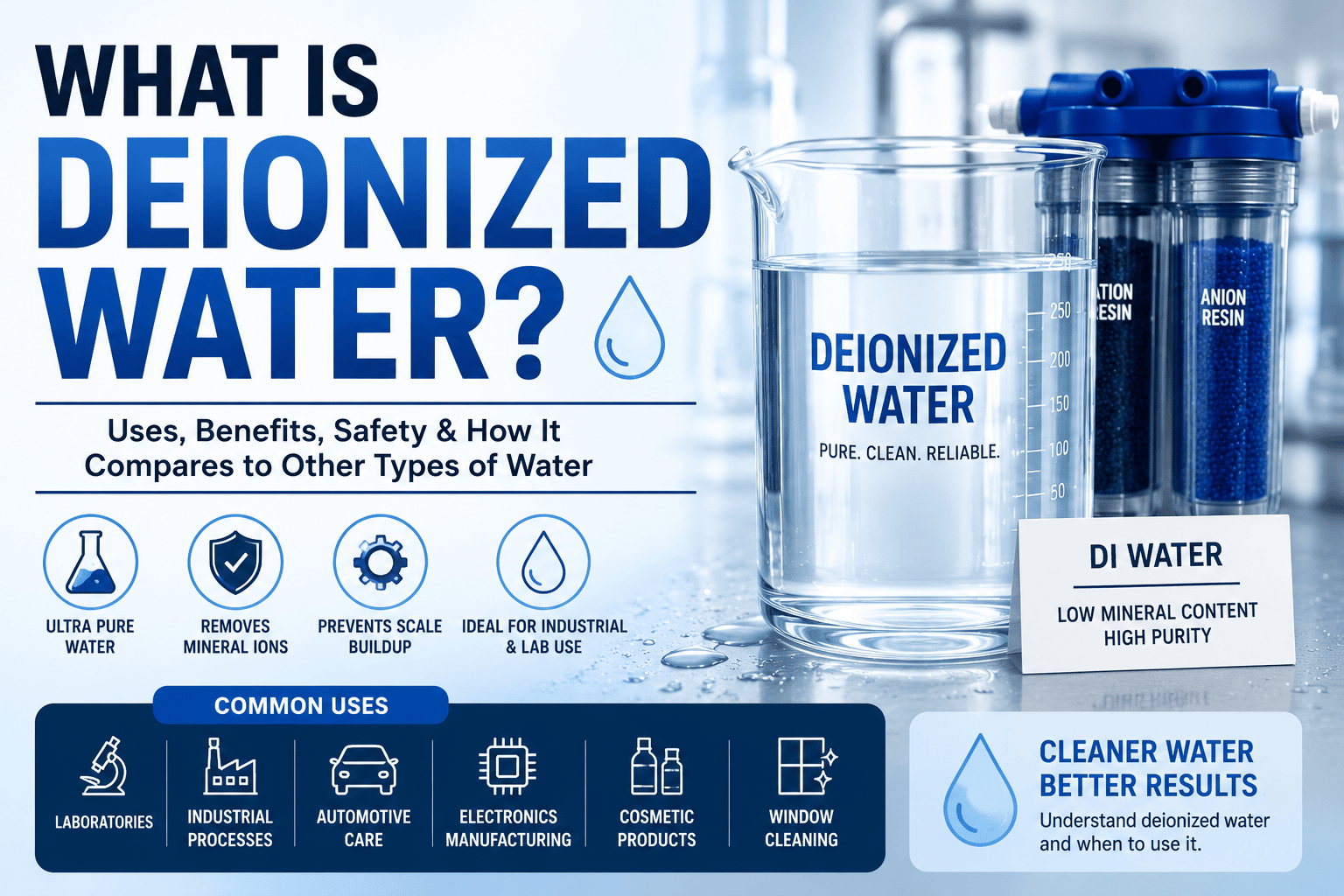
What Is Deionized Water?
Deionized water—often called DI water—is water that has had most of its dissolved mineral ions removed through a specialized purification process.
These dissolved ions commonly include:
- Calcium
- Magnesium
- Sodium
- Potassium
- Iron
- Copper
- Chloride
- Sulfate
- Nitrate
Instead of removing contaminants through boiling or membrane filtration, deionization removes electrically charged mineral ions using ion-exchange resins.
The result is water with very low mineral content and excellent purity for many industrial and technical applications.
How Is Deionized Water Made?
Deionized water is produced using ion exchange technology.
During the process, water flows through two types of specialized resin:
Cation Exchange Resin
This resin removes positively charged minerals such as:
- Calcium
- Magnesium
- Sodium
- Iron
These ions are exchanged for hydrogen ions (H⁺).
Anion Exchange Resin
Next, the water passes through another resin that removes negatively charged ions, including:
- Chloride
- Sulfate
- Bicarbonate
- Nitrate
These ions are exchanged for hydroxide ions (OH⁻).
The hydrogen and hydroxide ions then combine to form pure water (H₂O).
What Does Deionized Water Remove?
Deionization is highly effective at removing dissolved mineral ions.
It can significantly reduce:
- Calcium
- Magnesium
- Sodium
- Potassium
- Iron
- Copper
- Chloride
- Sulfates
- Nitrates
- Many dissolved salts
However, deionization does not automatically remove every contaminant.
Depending on the system, some bacteria, viruses, organic compounds, or particles may remain unless additional filtration methods are used.
Is Deionized Water Safe to Drink?
Technically, yes.
Deionized water is generally considered safe to drink occasionally. Since it contains very few dissolved minerals, it is not toxic.
However, it is not usually recommended as your primary source of drinking water.
Because nearly all naturally occurring minerals have been removed, deionized water may taste flat compared to regular drinking water.
For everyday hydration, many people prefer filtered water that reduces contaminants while retaining beneficial minerals that contribute to taste.
Benefits of Deionized Water
Although it isn't intended primarily for drinking, deionized water offers several advantages.
Extremely Low Mineral Content
Its greatest strength is the removal of dissolved mineral ions that can interfere with equipment or manufacturing processes.
Prevents Scale Buildup
Without calcium and magnesium, deionized water leaves behind little to no mineral deposits.
This helps protect:
- Laboratory equipment
- Medical devices
- Industrial machinery
- Steam systems
Ideal for Sensitive Applications
Many industries rely on deionized water because even tiny mineral impurities can affect performance or product quality.
Consistent Water Quality
Properly maintained DI systems produce water with highly consistent mineral content, making them valuable in manufacturing and testing environments.
Drawbacks of Deionized Water
Despite its purity, deionized water isn't ideal for every situation.
No Beneficial Minerals
The deionization process removes naturally occurring minerals that many people appreciate for taste.
Limited Contaminant Removal
Deionization primarily targets dissolved ions.
It may not adequately remove:
- Bacteria
- Viruses
- Organic chemicals
- Certain pesticides
- Sediment
Unless additional treatment stages are included.
Resin Maintenance
Ion exchange resins eventually become exhausted and require regeneration or replacement to maintain performance.
Flat Taste
Many people describe deionized water as tasting bland because it lacks the minerals that give natural water its characteristic flavor.
Common Uses of Deionized Water
Because of its purity, deionized water is used across many industries.
Common applications include:
Laboratories
Scientific testing often requires water free of dissolved minerals.
Pharmaceutical Manufacturing
Many pharmaceutical processes require highly purified water to maintain product consistency.
Automotive Industry
Deionized water is frequently used in:
- Cooling systems
- Batteries
- Vehicle detailing
- Radiators
Because it helps minimize mineral deposits.
Electronics Manufacturing
Electronic components are extremely sensitive to mineral contamination.
DI water is commonly used during cleaning and production.
Cosmetic Manufacturing
Many skincare and cosmetic products incorporate deionized water to improve consistency and reduce impurities.
Window Cleaning
Professional window cleaners often use deionized water because it dries without leaving mineral spots.
Deionized Water vs. Distilled Water
These two water types are often confused.
While both are highly purified, they are produced differently.
| Feature | Deionized Water | Distilled Water |
|---|---|---|
| Removes dissolved minerals | Yes | Yes |
| Produced by boiling | No | Yes |
| Uses ion exchange | Yes | No |
| Removes many bacteria | Not necessarily | Yes |
| Removes many viruses | Not necessarily | Yes |
| Common industrial use | Yes | Yes |
| Drinking water use | Limited | Limited |
Distillation removes contaminants through evaporation and condensation, while deionization removes dissolved ions through resin exchange.
Deionized Water vs. Reverse Osmosis Water
Reverse osmosis (RO) uses a semi-permeable membrane to reduce a broad range of contaminants.
Compared to deionized water:
- RO removes many dissolved contaminants and particles.
- Deionization specifically removes mineral ions.
- RO is commonly used for drinking water.
- DI water is more common in industrial applications.
Some advanced systems even combine reverse osmosis with deionization for exceptionally pure water.
Should You Drink Deionized Water Every Day?
Most experts recommend using deionized water for its intended purposes rather than as your everyday drinking water.
If your goal is healthy hydration, filtered drinking water is often the preferred choice because it provides excellent contaminant reduction while maintaining a more natural taste.
Ultimately, the best drinking water depends on your local water quality and your household's specific needs.
Frequently Asked Questions
Does deionized water contain minerals?
Very few. The deionization process removes most dissolved mineral ions.
Is deionized water the same as distilled water?
No. Both produce highly purified water, but they use different purification methods.
Can you cook with deionized water?
You can, but most people prefer filtered or purified drinking water because of its improved taste.
Is deionized water better than filtered water?
They serve different purposes. Deionized water is designed primarily for technical applications, while filtered water is generally better suited for everyday household use.
Final Thoughts
Understanding what deionized water is helps you choose the right type of water for your home, workplace, or specialized applications. While deionized water is exceptionally effective at removing dissolved mineral ions, it isn't always the best option for everyday drinking. The right choice depends on your water quality, intended use, and filtration goals.
At Spring Rain, Inc., we help homeowners find water treatment solutions that match their specific needs. Whether you're interested in whole house filtration, reverse osmosis systems, water softeners, or customized drinking water solutions, our experienced team is committed to helping you enjoy cleaner, safer, and better-tasting water every day.