Choosing the best water filter for your home can feel overwhelming when you consider how many options are available. From simple faucet filters and water filter pitchers to reverse osmosis systems and whole-house filtration units, every product promises different benefits. But how do you know which one is actually right for your household?
The truth is that there is no single water filter that works best for every home. The right choice depends on your water source, the contaminants present, your household's water consumption, and the type of treatment you need.
For example, a home dealing with chlorine taste may benefit from an activated carbon filter, while a household with hard water may need a water softener. Private well owners may require a combination of filtration and other treatment methods depending on their water test results.
At Spring Rain, Inc., we understand that choosing a water treatment system is an important decision for homeowners. In this guide, we'll explain how to choose the best water filter, compare common filtration technologies, and discuss the factors you should consider before investing in a system.
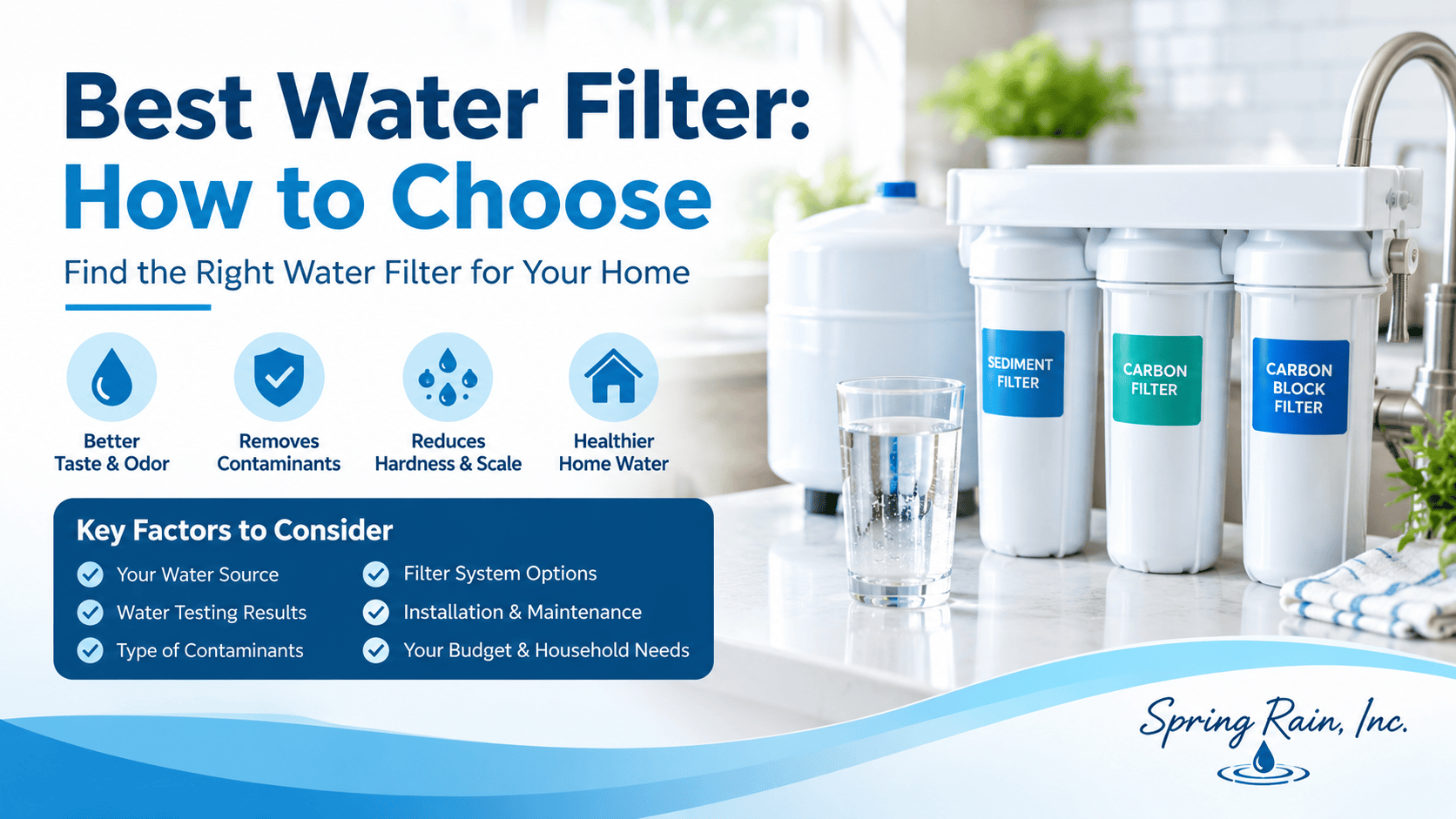
Why Choosing the Right Water Filter Matters
Water quality can vary considerably from one household to another. Even homes in the same neighborhood may experience different water concerns because of plumbing materials, local water conditions, and the source of their supply.
Municipal water providers treat drinking water before distributing it to homes. However, water can still pick up substances from distribution pipes and household plumbing. Private well owners have additional responsibilities because their water supply is not routinely regulated and monitored in the same way as public water systems.
Some common water quality concerns include:
- Chlorine taste and odor.
- Sediment, sand, and rust particles.
- Hardness minerals such as calcium and magnesium.
- Iron and manganese.
- Lead and other potentially harmful metals.
- Certain chemicals and industrial contaminants.
- Bacteria and other microorganisms in private well water.
Different filtration systems are designed to address different problems. Buying a filter without understanding your water quality may result in spending money on equipment that does not solve the issue you are experiencing.
The best starting point is to understand your water before choosing a filtration system.
How to Choose the Best Water Filter for Your Home
Before comparing brands, prices, or product features, consider the following steps. They can help you narrow down your options and choose a system that matches your household's actual requirements.
1. Understand Your Water Source
The first step is identifying where your household water comes from.
Most homeowners receive water from either a municipal water supply or a private well. These sources can have different water quality characteristics and treatment requirements.
Municipal Water Supply
Municipal water is treated before it reaches your property. Treatment facilities generally use processes such as filtration and disinfection to meet applicable drinking water standards.
However, some homeowners notice chlorine taste, sediment, mineral buildup, or concerns related to aging household plumbing.
Reviewing your water provider's Consumer Confidence Report can help you understand the quality of the supplied water. If you suspect a problem with your home's plumbing, additional testing at the tap may be necessary.
Private Well Water
Private well water comes directly from groundwater beneath your property. Its characteristics depend on local geology, groundwater conditions, and the construction and maintenance of the well.
Depending on the location, well water may contain iron, manganese, hardness minerals, sediment, bacteria, or other naturally occurring and human-introduced contaminants.
A laboratory water test is particularly important for private well owners. It helps identify which treatment technologies are appropriate instead of relying on assumptions about what the water contains.
2. Test Your Water Before Buying a Filter
One of the biggest mistakes homeowners make is purchasing a water filter without first understanding their water quality.
A filter that works well for chlorine may not effectively reduce dissolved metals or other contaminants. Similarly, a sediment filter cannot remove every substance that may be present in drinking water.
Testing helps you identify the specific water quality issues that need attention.
What Should You Test For?
The appropriate testing panel depends on your water source and potential local risks.
Some common testing parameters include:
- pH: Helps evaluate whether water is acidic, neutral, or alkaline.
- Hardness: Measures calcium and magnesium minerals that contribute to scale buildup.
- Iron and manganese: Can cause staining, discoloration, and other water quality problems.
- Total dissolved solids (TDS): Measures the concentration of dissolved substances in water.
- Chlorine: Helps evaluate disinfectant levels in treated municipal water.
- Coliform bacteria and E. coli: Important indicators when evaluating private well water.
- Nitrate: An important parameter for private wells, particularly in agricultural areas.
- Other contaminants: Testing may be appropriate for lead, arsenic, PFAS, or other substances depending on local conditions.
A certified drinking water laboratory can help determine which tests are appropriate.
Remember that a basic TDS reading does not identify individual contaminants or establish whether water is safe to drink.
3. Decide What You Want Your Water Filter to Remove
Once you understand your water quality, the next step is matching the filtration technology to the problem.
Not all filters work in the same way. Some remove suspended particles, others use adsorption to reduce certain chemicals, and some rely on membranes or ion exchange.
Here are some common water quality concerns and the treatment options homeowners may consider.
| Water quality concern | Treatment option |
|---|---|
| Chlorine taste and odor | Activated carbon filtration |
| Sand, dirt, and sediment | Sediment filtration |
| Hard water and mineral scale | Water softener |
| Iron and manganese | Specialized iron and manganese treatment |
| Certain dissolved contaminants | Reverse osmosis or specialized filtration |
| Certain bacteria and microorganisms | Appropriate disinfection, such as UV treatment |
| Multiple water quality concerns | Customized multi-stage treatment |
The important thing is to select a system based on the contaminants identified in your water test.
A filter marketed as a multi-stage system is not automatically capable of removing every contaminant.
4. Choose the Right Type of Water Filtration System
Water filters come in several configurations. Some treat water at a single faucet, while others are installed where the main water line enters your home.
Understanding these differences will help you decide which system makes the most sense.
A. Whole-House Water Filtration Systems
A whole-house water filter is installed at the point where water enters your home. This allows treated water to reach multiple fixtures, including kitchen sinks, bathroom faucets, showers, and laundry connections.
These systems are commonly considered when homeowners want to address water quality concerns throughout the property.
Depending on the filtration media and system design, whole-house filtration may help reduce sediment, chlorine, and other targeted substances.
Benefits of whole-house filtration:
- Treats water before it reaches household plumbing fixtures.
- Provides filtered water at multiple locations.
- Can address certain water quality concerns throughout the home.
- May help reduce sediment and other targeted substances entering plumbing equipment.
Things to consider:
- Installation generally requires a connection to the main water line.
- System capacity must match household water demand.
- Filter media and cartridges require maintenance.
- The correct treatment technology depends on water testing.
Explore Spring Rain's whole-house water filtration systems to learn more about available treatment options.
B. Reverse Osmosis Water Filtration Systems
Reverse osmosis, commonly called RO, uses a semipermeable membrane to separate many dissolved substances from water.
During the filtration process, water passes through the membrane while many dissolved contaminants are rejected and carried away in a waste stream.
Reverse osmosis is commonly used for drinking and cooking water, particularly when water testing identifies contaminants that an appropriately certified RO system can reduce.
Benefits of reverse osmosis:
- Can reduce many dissolved substances.
- Can improve drinking water taste and quality.
- Provides treated water for drinking and cooking.
- Can be combined with additional filtration stages.
Things to consider:
- Many systems require installation beneath the kitchen sink.
- Replacement filters and membranes require maintenance.
- Some systems produce wastewater during operation.
- RO also removes some naturally occurring minerals.
- Performance depends on system design and the specific contaminants being targeted.
Before purchasing an RO system, check its performance data and certifications to confirm that it is suitable for your water concerns.
Learn more about residential reverse osmosis systems.
C. Water Softeners
Hard water is one of the most common water quality concerns for homeowners.
It contains elevated levels of dissolved calcium and magnesium. These minerals can contribute to scale deposits on plumbing fixtures, water heaters, and appliances.
A water softener generally uses an ion exchange process to replace hardness minerals with sodium or potassium ions.
Benefits of water softeners:
- Helps reduce hard water scale.
- Can improve soap lathering.
- Helps reduce mineral deposits on plumbing fixtures.
- May help protect water-using appliances from hardness-related buildup.
Things to consider:
- A softener is designed to address hardness, not every drinking water contaminant.
- It requires periodic regeneration and salt or potassium replenishment, depending on the system.
- Water hardness should be measured before selecting equipment.
- Some households may benefit from additional drinking water filtration.
If hard water is a concern in your home, explore Spring Rain's residential water softener systems.
D. Sediment Water Filters
Sediment filters are designed to capture suspended particles as water passes through the filtration media.
These particles may include sand, dirt, rust, and other visible debris.
Sediment filtration is frequently used as a pre-treatment stage to protect other water treatment equipment.
Benefits of sediment filtration:
- Helps capture suspended particles.
- Can reduce visible sediment in water.
- Helps protect downstream filters and equipment.
- Can be useful for certain private well applications.
Things to consider:
- Sediment filters do not remove dissolved chemicals.
- They do not soften hard water.
- Cartridge replacement or cleaning is necessary.
- The filter rating should match the size and amount of particles present.
E. Activated Carbon Water Filters
Activated carbon filters use a porous carbon material to adsorb certain substances as water passes through it.
They are commonly used to improve chlorine taste and odor and can reduce other substances when the specific filter has been tested and certified for those claims.
Activated carbon is available in different forms, including granular activated carbon and carbon block filters.
Benefits of activated carbon filtration:
- Helps improve chlorine taste and odor.
- Can reduce certain organic chemicals.
- Available in pitcher, faucet, under-sink, and whole-house configurations.
- Can be combined with other treatment technologies.
Things to consider:
- Not every carbon filter removes the same substances.
- It does not automatically remove dissolved minerals or every heavy metal.
- It should not be assumed to disinfect microbiologically unsafe water.
- Filter replacement is necessary to maintain performance.
5. Check Water Filter Certifications
Product advertisements often include statements such as multi-stage filtration, advanced purification, or removal of up to 99% of contaminants.
However, these claims do not tell you exactly which substances the product has been independently tested to reduce.
Third-party certification provides a more reliable way to evaluate a water treatment product.
Common NSF/ANSI Standards to Understand
Here are several standards homeowners may encounter when comparing filtration systems:
| Standard | General purpose |
|---|---|
| NSF/ANSI 42 | Aesthetic effects, including chlorine taste and odor |
| NSF/ANSI 53 | Health effects claims for specifically listed contaminants |
| NSF/ANSI 55 | Ultraviolet microbiological water treatment systems |
| NSF/ANSI 58 | Reverse osmosis drinking water treatment systems |
| NSF/ANSI 44 | Residential cation exchange water softeners |
| NSF/ANSI 401 | Certain emerging or incidental contaminants |
Certification to a particular standard does not mean a product removes everything covered by that standard. Always check the exact model and the specific contaminant reduction claims on its performance data sheet.
You can also verify product listings through recognized certification organizations such as NSF and the Water Quality Association.
6. Consider Your Household Size and Water Usage
A filtration system must be capable of handling the amount of water your household uses.
A small drinking water filter may be sufficient for one person who only needs filtered water for drinking and cooking. A larger household with multiple bathrooms may require a whole-house system with greater treatment capacity and flow rate.
When comparing systems, consider:
- Number of people living in your home.
- Average daily water consumption.
- Number of bathrooms and water fixtures.
- Peak water demand.
- Required filtration flow rate.
- Available installation space.
Choosing a system that is too small may result in reduced water pressure or inadequate capacity during periods of heavy use.
A properly sized system should meet household demand while providing the required treatment performance.
7. Compare Installation and Maintenance Costs
The purchase price is only one part of owning a water filtration system.
Before making a decision, consider the ongoing costs of operating and maintaining the equipment.
Important Costs to Evaluate
Initial equipment cost: Compare the price of the system based on its treatment capacity and capabilities.
Installation expenses: Some filters are simple to install, while whole-house systems and more complex treatment arrangements may require professional plumbing work.
Replacement cartridges: Find out how often filters need replacement and whether replacement cartridges are readily available.
Membrane replacement: Reverse osmosis systems may require periodic membrane replacement in addition to pre-filter and post-filter changes.
Operating expenses: Some systems require electricity, salt, regeneration water, or other supplies.
A lower-priced filter may become more expensive over time if its replacement cartridges are costly or difficult to obtain.
Compare the estimated cost of ownership over several years rather than focusing exclusively on the initial purchase price.
8. Choose a System That Fits Your Water Quality Goals
The best water filter is not necessarily the one with the most filtration stages or the highest price.
It is the system that addresses your actual water quality concerns without unnecessary equipment.
For example:
- If your main concern is chlorine taste, an appropriately certified carbon filter may be sufficient.
- If you have hard water, a properly sized water softener may be the right solution.
- If you have sediment in your well water, a suitable sediment filtration system may be needed.
- If your water test identifies certain dissolved contaminants, an appropriately certified reverse osmosis or specialized treatment system may be worth considering.
- If testing identifies bacteria in well water, appropriate disinfection should be evaluated.
Some homes require more than one treatment technology because a single system may not address every water quality concern.
Which Water Filter Is Best for Different Household Needs?
Now that you understand the different types of filtration systems, let's look at how they may fit common household situations.
| Household situation | System to consider |
|---|---|
| Municipal water with chlorine taste | Activated carbon filter |
| Hard water and scale buildup | Water softener |
| Sediment in well water | Sediment filtration |
| Drinking water treatment | Reverse osmosis or certified under-sink filtration |
| Water quality concerns throughout the home | Whole-house filtration |
| Certain bacterial concerns in well water | Appropriate disinfection system |
| Multiple identified contaminants | Customized multi-stage treatment |
These are starting points rather than universal recommendations. Water testing and equipment specifications should guide the final selection.
Common Mistakes to Avoid When Choosing a Water Filter
Even a good filtration system can be the wrong purchase if it does not match your household's water quality.
Here are some mistakes worth avoiding.
Buying a Filter Without Testing Your Water
Without knowing what is in your water, you cannot confidently determine which filtration technology is appropriate.
Start with a water quality report or laboratory test.
Assuming Every Water Filter Removes the Same Contaminants
A sediment filter, carbon filter, reverse osmosis membrane, and water softener work differently.
Do not assume that a product removes a contaminant unless its performance documentation supports that specific claim.
Choosing Based Only on Price
A cheaper system may have limited filtration capabilities or expensive replacement cartridges.
Compare performance, installation, maintenance, and long-term ownership costs.
Ignoring Filter Replacement Requirements
A filtration system requires regular maintenance. Delayed cartridge replacement can reduce performance and may compromise the treatment process.
Follow the manufacturer's replacement and servicing instructions.
Buying an Oversized or Undersized System
A system that is too small may not handle household demand. An unnecessarily large system may increase installation and operating expenses.
Choose equipment according to your water conditions and expected consumption.
Confusing Water Softening With Water Filtration
A water softener treats hardness minerals. It does not automatically remove bacteria, lead, chlorine, or every other contaminant.
If your home has multiple water quality concerns, additional treatment may be necessary.
Why Professional Water Testing and Treatment Recommendations Matter
Choosing a water filter involves more than comparing products online.
Water chemistry, contaminant concentrations, household demand, plumbing configuration, and treatment goals all influence which system is appropriate.
Professional water testing can help identify the specific problems that need attention. A qualified water treatment professional can then recommend equipment designed around those results.
This approach helps avoid purchasing unnecessary equipment or selecting a system that cannot address the actual water quality issue.
For private well owners, testing is particularly important because water conditions can change over time.
How Spring Rain, Inc. Helps Homeowners Choose the Right Water Filter
At Spring Rain, Inc., we understand that every household has different water quality needs.
Some homeowners want to improve the taste and odor of their drinking water. Others are dealing with hard water, mineral staining, sediment, or concerns about substances in their private well water.
Rather than assuming every home needs the same equipment, the goal should be to identify the water quality concern and select an appropriate treatment solution.
Spring Rain, Inc. provides water treatment options for Pennsylvania homeowners, including:
- Whole-house water filtration systems for treating targeted water quality concerns throughout the home.
- Residential water softener systems for addressing hard water and mineral scale.
- Reverse osmosis systems for selected drinking water treatment needs.
The appropriate system depends on your water test results, household requirements, and the contaminants you want to reduce.
If you are unsure which filtration system is right for your home, visit Spring Rain, Inc. to explore available water treatment solutions.
Frequently Asked Questions About Choosing the Best Water Filter
What is the best water filter for a home?
There is no single best water filter for every household. Activated carbon filters, reverse osmosis systems, whole-house filtration units, and water softeners serve different purposes. The right choice depends on your water quality and treatment requirements.
How do I know which water filter I need?
Start by identifying your water source and obtaining appropriate water quality information or laboratory test results. Match the treatment technology to the contaminants or characteristics you want to address. Check product certifications before purchasing.
Is a whole-house water filter better than a reverse osmosis system?
Neither is automatically better. A whole-house filter treats water entering multiple household fixtures, while a typical under-sink reverse osmosis system focuses on drinking and cooking water at a specific location. They serve different purposes.
Is reverse osmosis the best water filtration method?
Reverse osmosis can reduce many dissolved substances when the system is designed and certified for the specific contaminants involved. However, it may not be necessary for every household and does not automatically address every water quality issue.
What is the difference between a water filter and a water softener?
A water filter is designed to reduce specific particles or contaminants. A water softener primarily addresses hardness minerals such as calcium and magnesium through ion exchange. They are different treatment technologies.
Can one water filter remove all contaminants?
No. Different filtration technologies target different substances. Some households need a combination of treatment methods to address multiple water quality concerns.
Are expensive water filters always better?
Not necessarily. Price does not guarantee that a filter is appropriate for your water. Compare the system's specific contaminant reduction claims, independent certifications, capacity, installation requirements, and maintenance costs.
How often should I replace my water filter?
Replacement frequency depends on the filter type, water quality, usage, and manufacturer recommendations. Follow the replacement schedule and monitor any performance indicators provided with the system.
Is a water filter necessary for well water?
Not every private well requires the same treatment, but regular water testing is important. If testing identifies bacteria, minerals, sediment, or other contaminants, the appropriate treatment should be selected based on the results.
Should I choose a whole-house filter or an under-sink filter?
Choose based on where you want treated water and which contaminants need attention. A whole-house system treats water entering the property, while an under-sink system typically focuses on drinking and cooking water.
Make the Right Choice for Your Home's Water
Choosing the best water filter does not have to be complicated when you understand what your household actually needs.
Start by identifying your water source, testing for relevant contaminants, and comparing filtration technologies that address those specific concerns. Consider installation requirements, household water consumption, product certifications, and ongoing maintenance before making your final decision.
Remember, the goal is not to purchase the most expensive filtration system or the one with the most stages. It is to find a reliable solution that provides the right treatment for your home's water quality.
Spring Rain, Inc. helps Pennsylvania homeowners explore customized water treatment options for their household needs.
The best water filter is the one that treats the water you actually have, not the one with the biggest marketing claims.