If you have a water softener in your home, you may occasionally hear it running during the night. You might hear water moving through the plumbing or notice the system sending water toward a drain. That is usually your softener going through its water softener regeneration cycle.
Regeneration is a normal and necessary part of operating a salt-based water softener. It allows the system to restore the resin inside its mineral tank after the resin has collected calcium and magnesium from your water.
But what actually happens during regeneration? How often should it happen? How long does it take? And what should you do when the system does not seem to regenerate correctly?
Understanding the answers can help you get better performance from your water softener and recognize potential problems before they become bigger issues.
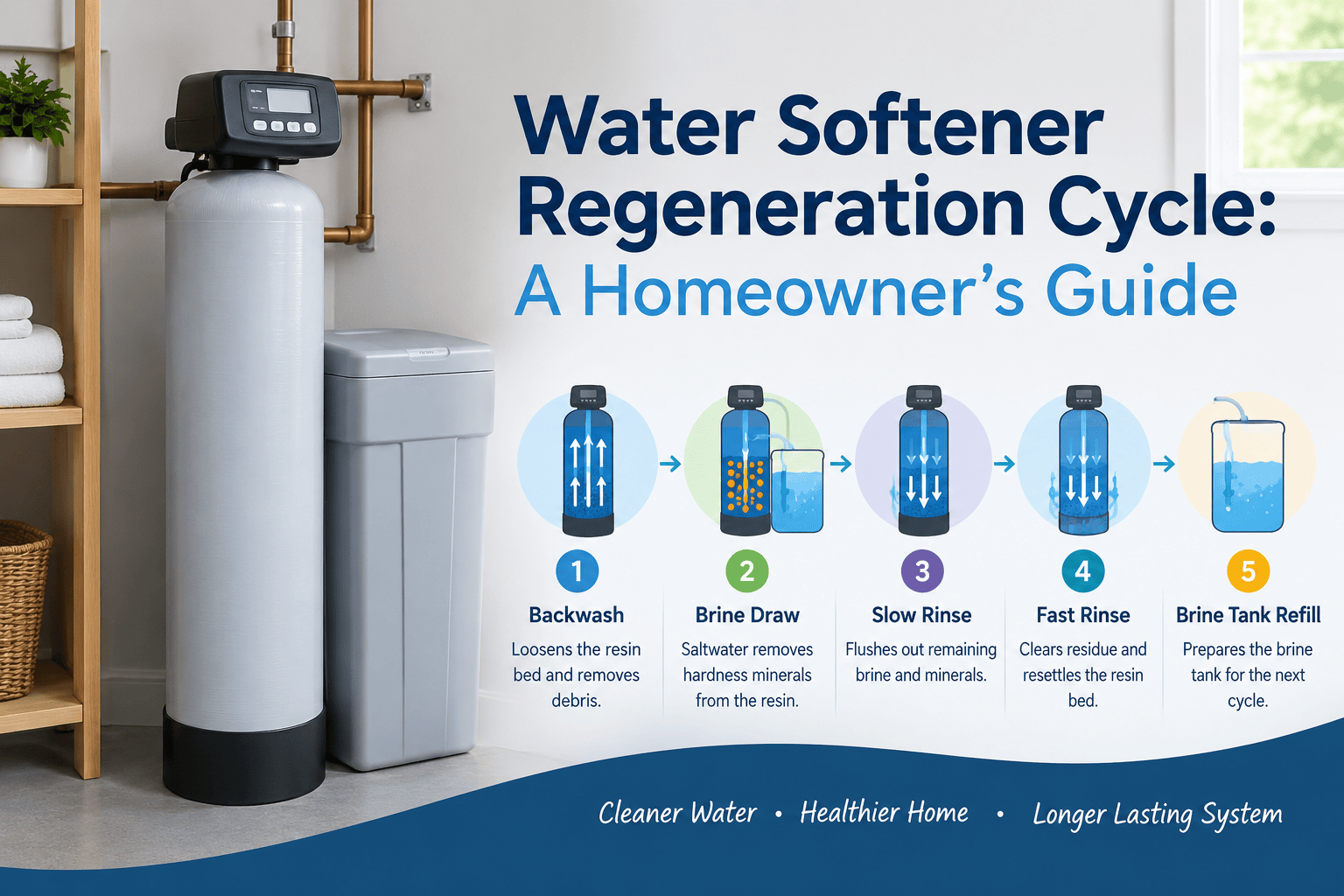
What Is a Water Softener Regeneration Cycle?
A water softener regeneration cycle is the process that restores the softening resin inside a salt-based water treatment system.
During normal operation, hard water flows through a tank filled with small resin beads. These beads attract calcium and magnesium, the minerals that cause most household water hardness.
As water continues passing through the tank, the resin gradually becomes loaded with these minerals. Once its available capacity is largely used, the resin needs to be cleaned and restored.
The regeneration process uses a concentrated saltwater solution, commonly called brine, to remove the accumulated hardness minerals from the resin.
After the resin has been cleaned and rinsed, the softener returns to normal operation.
In simple terms:
The resin collects hardness minerals → the softener regenerates → the resin is restored → softened water production continues.
Why Does a Water Softener Need to Regenerate?
The resin inside a water softener has a limited capacity.
Every gallon of hard water that passes through the system adds more calcium and magnesium to the resin. Eventually, enough of the resin's exchange capacity is used that it can no longer effectively soften incoming water.
Regeneration restores that capacity.
Without regeneration, the system would eventually begin allowing more hardness minerals through.
You might then notice:
- White spots on faucets
- Mineral deposits around fixtures
- Soap scum in showers and sinks
- Poor soap lather
- Scale inside plumbing
- Hard-feeling water
- Spots on dishes and glassware
Regular regeneration is what allows the resin to keep performing its job.
How Does the Water Softener Regeneration Cycle Work?
Although the exact programming differs between models, most salt-based water softeners follow a similar series of steps.
The process generally involves backwashing the resin, introducing brine, rinsing the resin, and preparing the brine tank for the next cycle.
Step 1: Backwash
The regeneration process commonly begins with a backwash.
During normal operation, water flows through the resin bed in one direction. During backwash, the flow direction is reversed.
This helps loosen the resin and flush out accumulated sediment and debris.
Backwashing also prepares the resin bed for the next stage of regeneration.
Step 2: Brine Draw
The brine draw stage is central to the regeneration process.
The control valve draws concentrated saltwater from the brine tank and sends it through the resin tank.
The brine helps remove calcium and magnesium that have accumulated on the resin beads.
Those hardness minerals are then carried away with the wastewater.
If the system cannot draw enough brine, the resin may not regenerate properly even though the softener appears to be running through its normal cycle.
Step 3: Slow Rinse
After the brine has passed through the resin, the system moves into a slow rinse.
Fresh water continues flowing through the resin bed at a controlled rate.
This helps move the remaining brine and displaced hardness minerals out of the tank.
The slower flow gives the water enough contact time to complete this part of the process.
Step 4: Fast Rinse
The softener then performs a faster rinse.
Fresh water flows through the resin at a higher rate to remove remaining brine and mineral residue.
This stage also helps settle the resin bed so it is ready for normal service.
Step 5: Brine Tank Refill
The system must also prepare the brine tank for the next regeneration.
Depending on the softener design, water is added to the brine tank during a programmed refill stage.
That water will eventually dissolve some of the salt and create the brine required for a future regeneration cycle.
The exact order and timing of these stages can vary between softener models.
How Long Does a Water Softener Regeneration Cycle Take?
A typical residential regeneration cycle can take around an hour or longer, although some systems may take several hours depending on their design and programming.
The total time can be influenced by:
- Softener size
- Resin capacity
- Control valve
- Water pressure
- Brine settings
- Rinse settings
- System programming
- Water quality
There is no universal regeneration time for every water softener.
If your system has always taken approximately the same amount of time, that is generally a better reference point than comparing it with another homeowner's softener.
A sudden change in cycle duration, particularly if the system becomes stuck in one stage, may indicate a problem.
How Often Should a Water Softener Regenerate?
The ideal regeneration frequency depends on how much water your household uses and how much hardness the softener needs to remove.
A few important factors determine how frequently regeneration occurs.
Water Hardness
Homes with very hard water generally use up resin capacity faster than homes with moderately hard water.
The harder the water entering the system, the more calcium and magnesium the resin must capture.
Household Water Consumption
A larger household usually consumes more water.
Showers, laundry, dishwashing, cleaning, and other everyday activities all contribute to water usage.
Higher consumption can result in more frequent regeneration.
Softener Size
The size of the softener also matters.
A properly sized system should have enough resin capacity to handle the household's normal water demand without regenerating unnecessarily often.
An undersized softener may need to regenerate much more frequently.
Control Settings
The softener's hardness setting, capacity, reserve settings, and regeneration schedule all influence when regeneration occurs.
Incorrect programming can cause the system to regenerate too often or allow hard water to return before regeneration.
Why Does My Water Softener Regenerate at Night?
Many water softeners regenerate during the overnight hours.
There is a simple reason for this.
Regeneration uses water and sends wastewater toward a drain. Depending on the system, the softener may also temporarily provide untreated water while the cycle is taking place.
Scheduling regeneration at night helps reduce interference with normal household water use.
By morning, the cycle is usually finished and the softener is ready to return to normal operation.
So if you hear your water softener running at two or three in the morning, it does not necessarily mean something is wrong.
What Is the Difference Between Timed and Metered Regeneration?
The way a softener decides when to regenerate depends on its control system.
Two common approaches are timed regeneration and metered regeneration.
Timed Regeneration
A timed softener regenerates according to a preset schedule.
For example, it may be programmed to regenerate after a specific number of days.
This approach is straightforward, but the system may regenerate even when the household has not used enough water to consume most of the available softening capacity.
Metered Regeneration
A metered softener tracks water usage.
Instead of relying only on a calendar, it monitors how much water has passed through the system and uses that information to determine when regeneration is needed.
This can make regeneration more responsive to actual household demand.
For homes where water consumption changes from week to week, a demand-based approach can be particularly useful.
How Much Salt Does Regeneration Use?
Salt consumption depends on the individual water softener.
The amount can be affected by:
- Water hardness
- Resin capacity
- Household water usage
- Salt dosage
- System settings
- Softener efficiency
More salt does not automatically mean better water treatment.
A properly adjusted system should use an appropriate amount of salt for its capacity and the water conditions in the home.
If your softener suddenly begins consuming much more salt than usual, the issue may involve programming, water usage, equipment performance, or another problem.
Does a Water Softener Use Water During Regeneration?
Yes.
Water is required during several parts of the regeneration process.
It is used for backwashing, rinsing, brine preparation, and flushing the displaced hardness minerals toward the drain.
The amount of water used varies by system.
A properly sized and maintained softener should use the amount of water necessary to complete its programmed regeneration without repeatedly running unnecessary cycles.
If you notice your softener regenerating much more often than expected, that is worth investigating.
What Happens If a Water Softener Does Not Regenerate?
A softener that does not regenerate correctly will eventually lose its ability to provide consistently softened water.
The first signs may be subtle.
You might notice that your water feels different or that mineral spots are beginning to appear again.
As the problem continues, hard water may become increasingly noticeable.
Hard Water Returns
One of the clearest signs is hard water shortly after the system should have regenerated.
If hardness returns immediately after a regeneration cycle, something may be preventing the resin from being properly restored.
Salt Level Does Not Change Normally
If the softener seems to use little or no salt over an extended period, the system may not be drawing brine correctly.
However, salt consumption can vary, so this symptom should be considered alongside other signs.
The System Gets Stuck During Regeneration
A malfunctioning control valve, restricted water flow, or another mechanical issue can cause a softener to remain in one stage.
If water continues flowing to the drain for an unusually long period, the system may need attention.
What Can Cause Regeneration Problems?
Several issues can interfere with a regeneration cycle.
Salt Bridge
A salt bridge is a hardened layer of salt that can form inside the brine tank.
It may create the appearance of a full salt tank while preventing water from properly reaching and dissolving the salt underneath.
Without enough brine, regeneration may not be effective.
Clogged Injector
The injector plays an important role in drawing brine from the tank.
Sediment or mineral buildup can restrict the injector and interfere with proper brine flow.
Blocked Brine Line
The brine line needs to remain clear so the saltwater solution can move between the brine tank and control valve.
A blockage, leak, or damaged connection can interfere with the regeneration process.
Drain Line Problems
Regeneration produces wastewater that must leave the system.
A kinked, restricted, or blocked drain line can prevent the softener from completing its cycle properly.
Incorrect Settings
Incorrect hardness or capacity settings can also affect regeneration.
If the softener is programmed for water conditions that do not match your actual home, it may regenerate too often or not often enough.
Why Is My Water Still Hard After Regeneration?
If you have completed a regeneration cycle and your water is still hard, adding more salt may not solve the problem.
Several possibilities should be considered.
The system may not have drawn enough brine. The hardness setting may be incorrect. The resin may be exhausted or damaged. A control valve may not be functioning correctly.
There could also be a problem with the home's water supply or another component of the treatment system.
Testing the water hardness before and after regeneration can provide useful information about whether the softener is actually reducing hardness.
What Should You Do If Your Softener Regenerates Too Often?
Frequent regeneration can increase salt and water consumption.
If your softener appears to regenerate far more often than expected, start by considering whether household water usage has increased.
A leaking toilet, dripping fixture, additional household occupants, or increased laundry can significantly change water consumption.
If water usage has not changed, possible causes include:
- Incorrect programming
- An undersized softener
- Incorrect hardness settings
- A malfunctioning water meter
- Resin problems
- High levels of certain contaminants
- Control valve issues
The goal should not simply be to reduce the number of regeneration cycles. The system still needs to regenerate often enough to prevent hard water from passing through.
How Can You Maintain a Water Softener?
Routine attention can help keep the regeneration cycle working properly.
Check the salt level regularly and watch for unusual buildup inside the brine tank.
Keep an eye on changes in water quality. If you begin seeing scale or white spots again, don't automatically assume the solution is adding more salt.
It is also helpful to pay attention to the softener's regeneration behavior.
If the system suddenly starts regenerating much more frequently, takes significantly longer to complete a cycle, or stops regenerating altogether, investigate the change rather than ignoring it.
Professional maintenance may also be worthwhile for older systems or equipment that has developed recurring problems.
When Should You Have Your Water Softener Inspected?
Not every unusual sound or change means your softener needs professional service.
However, an inspection can be useful when:
- Hard water continues after regeneration
- The system repeatedly regenerates
- The brine tank is overflowing
- The softener becomes stuck during a cycle
- Salt consumption changes dramatically
- Water continuously flows toward the drain
- The control valve is malfunctioning
- The system displays an error
- The water develops an unusual salty taste
A qualified water treatment professional can evaluate the control valve, resin tank, brine system, drain connections, and programming to identify the underlying problem.
Frequently Asked Questions About Water Softener Regeneration
How often should a water softener regenerate?
Regeneration frequency depends on water hardness, household water consumption, softener size, resin capacity, and system programming. Some systems regenerate based on a schedule, while others use measured water consumption.
How long does a regeneration cycle take?
Many residential systems take around an hour or more, but the exact time depends on the equipment and its programmed settings.
Is it normal for a softener to regenerate at night?
Yes. Many systems are programmed to regenerate overnight because household water usage is typically lower during those hours.
Can I use water while the softener is regenerating?
It depends on the system. Some softeners provide untreated water during regeneration, while others may have different operating arrangements. Check the instructions for your specific model.
Why does my softener have water in the salt tank?
Some water in the brine tank is normal because water is needed to create the saltwater solution used during regeneration. An unusually high water level, however, can indicate a problem.
Does adding more salt improve regeneration?
Not necessarily. The system needs the appropriate amount of salt based on its design and settings. Adding excessive salt will not automatically make the softener perform better.
What happens if the softener runs out of salt?
Without sufficient salt, the system cannot prepare the brine needed for normal regeneration. As the resin becomes exhausted, hard water can eventually begin passing through the system.
Final Thoughts
The water softener regeneration cycle is what allows a salt-based water softener to continue removing hardness minerals from your household water.
The process may happen quietly in the middle of the night, but several important things are taking place inside the system. The resin is cleaned, hardness minerals are removed, the resin is rinsed, and the system is prepared for another round of water treatment.
How frequently regeneration occurs depends on your water hardness, household usage, system capacity, and programming. When everything is properly sized and adjusted, the process should happen automatically without requiring much attention from you.
If your softener starts regenerating too frequently, stops regenerating, uses an unusual amount of salt, or leaves you with hard water after a cycle, the problem deserves investigation.
A little attention to the regeneration process can go a long way toward keeping your water softener reliable and your home's water quality consistent.