A water softener can make a noticeable difference in a home with hard water. It helps reduce calcium and magnesium, which are responsible for scale buildup, water spots, soap scum, and other common hard-water problems.
But installing a water softener is only the beginning.
Like any home water-treatment system, a softener needs regular attention to keep working properly. Checking the salt level, cleaning the brine tank, monitoring regeneration, and watching for changes in water quality can help prevent small problems from becoming expensive repairs.
The good news is that water softener maintenance does not have to be complicated. With a simple routine and occasional professional service, you can help your system operate efficiently for years.
Why Is Water Softener Maintenance Important?
A traditional water softener uses ion exchange to remove calcium and magnesium from hard water. Over time, the system needs to regenerate its resin so it can continue treating incoming water.
If maintenance is neglected, several problems can develop.
You may begin noticing:
- Hard-water spots on dishes and glassware
- White scale around faucets
- Soap that does not lather properly
- Dry-feeling skin after showers
- Salt buildup inside the brine tank
- Frequent regeneration
- Changes in water quality
- Reduced softening performance
- Higher salt or water consumption
The U.S. Environmental Protection Agency recommends regular maintenance of water softeners, including checking salt levels, cleaning the brine tank annually, and having the system professionally serviced once a year.
How Does a Water Softener Work?
Before getting into maintenance, it helps to understand what is happening inside the system.
A conventional water softener typically contains two main components:
- A mineral tank containing ion-exchange resin
- A brine tank containing salt and water
When hard water enters the mineral tank, the resin captures calcium and magnesium ions. In exchange, sodium or potassium ions are released into the water.
What Happens During Regeneration?
Eventually, the resin becomes loaded with calcium and magnesium and needs to be regenerated.
During regeneration, the system uses a brine solution to remove the accumulated hardness minerals from the resin. The system then rinses the resin before returning to normal operation.
Because regeneration uses water and salt, proper programming is important. EPA recommends demand-initiated regeneration based on water use and/or incoming water hardness rather than simply regenerating on a fixed schedule.
How Often Should You Maintain a Water Softener?
There isn't one maintenance schedule that works for every household.
Your ideal schedule depends on:
- Water hardness
- Household water usage
- System size
- Softener technology
- Salt consumption
- Water chemistry
- Manufacturer recommendations
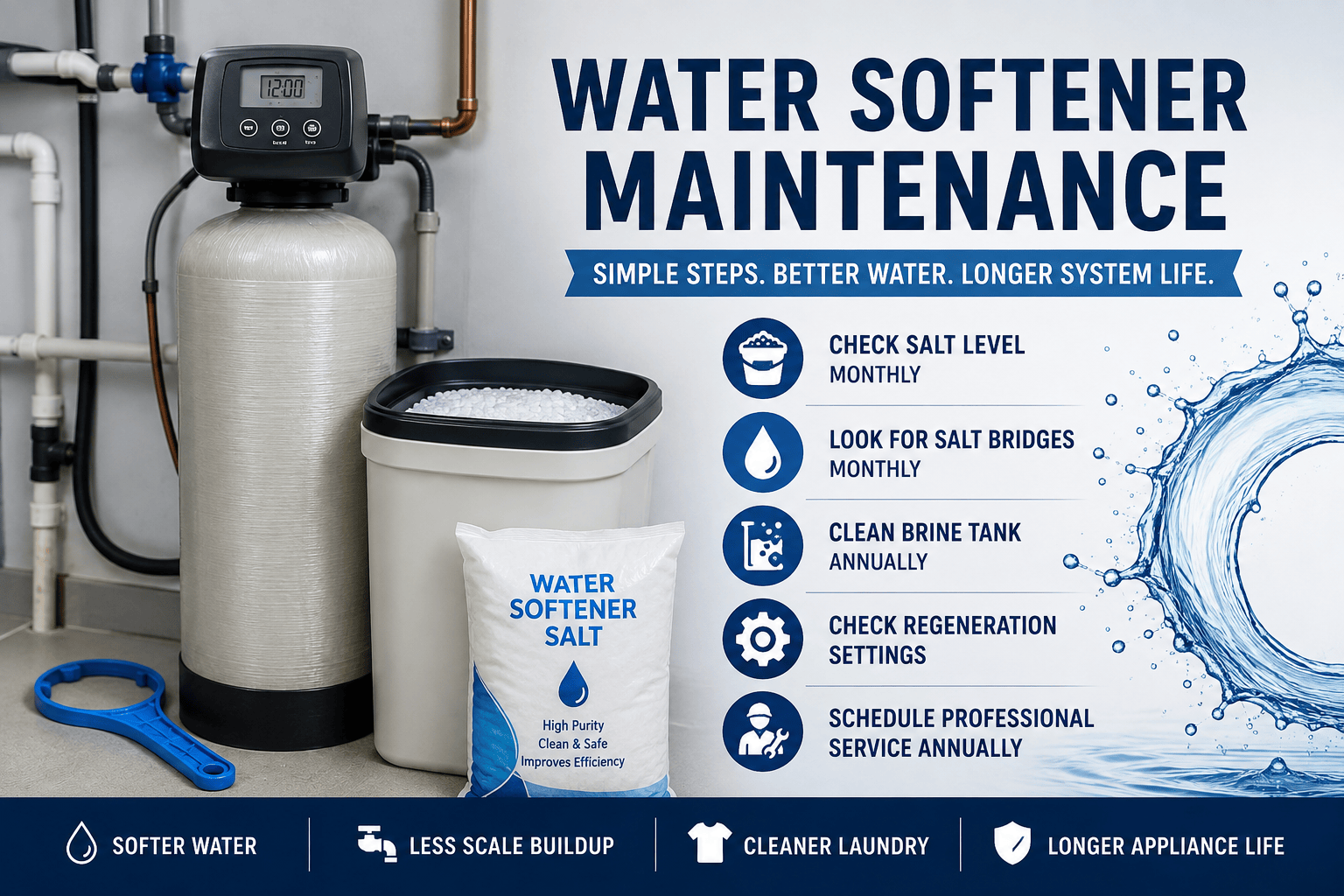
A simple maintenance routine can look like this:
| Maintenance Task | Suggested Frequency |
|---|---|
| Check salt level | About once a month |
| Look for salt bridging | Monthly |
| Inspect system for leaks | Monthly |
| Check regeneration settings | Periodically |
| Clean brine tank | About once a year |
| Professional inspection/service | Once a year |
| Check overall water quality | Periodically or when problems appear |
Always follow the maintenance instructions provided by your particular softener manufacturer.
Check the Salt Level Regularly
One of the easiest parts of water softener maintenance is checking the salt level.
You don't want the brine tank to run completely out of salt because the system may no longer have the brine needed for regeneration.
How Much Salt Should You Keep in the Tank?
There is no universal fill level for every water softener.
Instead of completely filling the tank, follow your manufacturer's recommended level.
As a general habit, check the salt level about once a month and add salt when necessary. EPA specifically recommends periodically checking salt levels and watching for salt bridges.
Avoid constantly topping off the tank without checking how much salt is already there. You want to know whether the system is actually consuming salt as expected.
Watch for Salt Bridges
A salt bridge occurs when the salt forms a hard layer or crust inside the brine tank.
The tank may appear to contain plenty of salt, but the salt underneath the bridge may not dissolve properly. As a result, the system may not produce enough brine for effective regeneration.
How Can You Check for a Salt Bridge?
If you suspect a salt bridge:
- Turn off or bypass the system if recommended by the manufacturer.
- Carefully check the salt surface.
- Use an appropriate rigid tool to gently break up the bridge.
- Avoid damaging the tank or internal components.
- Follow the manufacturer's instructions before returning the system to normal operation.
EPA also recommends breaking up salt bridges when they occur.
Do not aggressively poke around inside the tank or use tools that could damage the equipment.
Clean the Brine Tank
The brine tank is one of the most important areas to keep clean.
Over time, the tank can accumulate:
- Salt residue
- Sediment
- Sludge
- Dirt
- Other debris
EPA recommends cleaning the water softener's brine tank once a year.
When Should You Clean the Brine Tank?
An annual cleaning is a useful general guideline, but your system may need attention sooner if you notice unusual buildup or performance problems.
If you have well water containing elevated levels of iron, manganese, sediment, or other materials, ask a water-treatment professional whether your maintenance schedule should be different.
Check the Water Softener for Leaks
A quick visual inspection can help you catch problems before they become serious.
Look around:
- The inlet and outlet connections
- Drain line
- Brine tank
- Control valve
- Nearby plumbing
- Floor underneath the equipment
Even a small leak can eventually cause water damage or affect system performance.
What Should You Look For?
Watch for:
- Standing water
- Damp connections
- Dripping fittings
- Cracked tubing
- Loose connections
- Unusual sounds during operation
If you discover a significant leak, shut off the water supply if it is safe to do so and contact a qualified professional.
Check the Regeneration Settings
Regeneration is essential for a traditional water softener, but unnecessary regeneration can waste water and salt.
The system should be programmed according to factors such as:
- Incoming water hardness
- Household water consumption
- Softener capacity
- Household size
EPA recommends programming regeneration based on incoming water hardness and/or water flow rather than using a simple fixed schedule.
Why Does Regeneration Frequency Matter?
If regeneration happens too often, you may use more:
- Water
- Salt
- Electricity
If regeneration happens too infrequently, the system may not provide consistently softened water.
The goal is to find the appropriate balance for your household and equipment.
Keep an Eye on Your Water Quality
Your water can tell you a lot about how your softener is performing.
If you suddenly notice signs of hard water returning, don't ignore them.
Signs Your Softener May Not Be Working Properly
Look for:
- New white deposits on faucets
- More spots on dishes
- Soap becoming harder to rinse
- Changes in water feel
- Scale returning inside fixtures
- Increased salt consumption
- Unexpected changes in regeneration
- Water that no longer seems as soft as before
These symptoms do not always mean the softener itself has failed. The cause could be incorrect settings, a salt bridge, resin problems, water chemistry changes, or another component issue.
Inspect the Brine and Drain Lines
The brine and drain lines are important to the regeneration process.
A blocked, kinked, disconnected, or damaged line can interfere with proper operation.
Check for These Problems
During a visual inspection, look for:
- Kinks
- Cracks
- Loose connections
- Blockages
- Unusual positioning
- Signs of leakage
Don't modify plumbing or drain connections unless you understand the manufacturer's requirements and applicable local plumbing rules.
Keep the Area Around the Softener Clean
Water softeners are often installed in garages, basements, utility rooms, or mechanical spaces.
Keeping the area around the equipment clean and accessible makes maintenance easier.
Avoid storing heavy objects directly against the system or placing items where they could damage the brine tank, control head, tubing, or electrical components.
A clean installation area also makes it easier to notice leaks.
Use the Right Type of Salt
Not every type of salt is equally appropriate for every water softener.
Check your manufacturer's recommendations before purchasing salt.
Common types include:
- Solar salt
- Evaporated salt
- Rock salt
- Potassium chloride
Why Does Salt Quality Matter?
Lower-quality salt can sometimes contribute to greater residue or buildup in the brine tank.
Using a product recommended for your system can help keep the equipment operating properly.
Never assume that the most expensive salt is automatically the best choice. Follow your manufacturer's specifications.
Should You Clean the Resin?
The resin inside the mineral tank is responsible for the ion-exchange process.
In some situations, resin can become fouled by substances present in the incoming water. Iron, sediment, and other water-quality issues may affect performance.
However, homeowners should not automatically open the mineral tank or attempt to remove the resin themselves.
When Might Resin Treatment Be Necessary?
If your softener is properly supplied with salt and appears to regenerate normally but is still producing hard water, the resin or another internal component could be part of the problem.
A professional can evaluate:
- Resin condition
- Control valve operation
- Water hardness
- Iron levels
- Sediment
- Regeneration performance
- Overall system capacity
This is especially important for private well systems because well-water chemistry can vary considerably.
Don't Ignore Changes in Your Water
A water softener can continue running even when something isn't working correctly.
That is why homeowners should pay attention to changes rather than relying only on whether the system appears to be operating.
For example, if you normally get soft water but suddenly start seeing scale on your showerhead, that change deserves attention.
Check These Things First
If you notice hard water returning, check:
- Is there enough salt in the brine tank?
- Is there a salt bridge?
- Is the system in bypass mode?
- Are the regeneration settings correct?
- Is the system showing an error code?
- Are the inlet and outlet valves operating correctly?
- Has your water chemistry changed?
If the problem continues, professional troubleshooting may be necessary.
When Should You Call a Professional?
Some maintenance tasks are simple enough for homeowners, but others are better left to a qualified water-treatment professional.
Consider professional service if you notice:
- Persistent hard water
- Frequent regeneration
- Unusual salt consumption
- Water leaks
- Control valve problems
- Electrical issues
- Significant salt bridging
- Poor regeneration
- Changes in water pressure
- Unusual noises
- Problems that continue after basic maintenance
EPA recommends having a water softener professionally serviced once a year to help ensure proper performance and water efficiency.
Water Softener Maintenance for Well Water
Homes supplied by private wells may require additional attention.
Well water can contain hardness along with other naturally occurring substances such as iron and manganese.
Why Well Water Can Be Different
A water softener that works well with one home's water may not perform the same way with another home's well water.
Changes in:
- Iron
- Manganese
- Sediment
- pH
- Hardness
- Water usage
can affect treatment performance.
If you have a private well, periodic water testing can help identify changes before they turn into larger treatment problems.
How to Make Your Water Softener More Efficient
Proper maintenance isn't only about preventing breakdowns. It can also help your system operate more efficiently.
EPA recommends demand-initiated regeneration rather than fixed-schedule regeneration and encourages homeowners to consider both water and salt efficiency when selecting and operating a softener.
Practical Ways to Improve Efficiency
You can:
- Keep the salt level appropriate
- Break up salt bridges promptly
- Keep the brine tank clean
- Check regeneration settings
- Avoid unnecessary regeneration
- Use the recommended salt
- Monitor water consumption
- Have the system professionally serviced
- Replace worn components when necessary
A properly configured system can help avoid unnecessary water and salt consumption.
Common Water Softener Maintenance Mistakes
Even homeowners who regularly maintain their systems can make a few common mistakes.
Letting the Salt Run Out
A completely empty brine tank can prevent the system from regenerating properly.
Ignoring Salt Bridges
A salt bridge can make it appear as though there is plenty of salt when the system actually cannot produce enough brine.
Regenerating Too Often
An improperly programmed system may regenerate more frequently than necessary, increasing water and salt use.
Never Cleaning the Brine Tank
Salt and debris can accumulate over time. Annual cleaning is recommended by EPA.
Ignoring Returning Hard Water
If scale and hard-water symptoms return, investigate the problem rather than simply adding more salt.
Frequently Asked Questions
How often should a water softener be serviced?
A professional inspection or service once a year is a good general guideline. Homeowners should also perform simple checks throughout the year, including checking salt levels and inspecting the system for obvious problems.
How often should I add salt to my water softener?
It depends on household water usage, water hardness, system size, and regeneration settings. Check the salt level regularly rather than relying on a fixed refill schedule.
How often should I clean my water softener brine tank?
EPA recommends cleaning the brine tank once a year.
Why is my water softener using so much salt?
High salt consumption can be related to water hardness, household usage, system capacity, regeneration settings, or equipment problems. Incorrect programming can cause unnecessary regeneration.
How do I know if my water softener is working?
Signs of proper operation include reduced scale, better soap lathering, fewer mineral spots, and water hardness levels consistent with the system's expected performance.
Can I maintain my water softener myself?
Some basic tasks, such as checking salt levels and looking for leaks, can generally be handled by homeowners. More complicated repairs, internal component service, and troubleshooting are better handled by a qualified professional.
How long does a water softener last?
The lifespan varies depending on water quality, system design, household usage, maintenance, and component quality. Regular maintenance can help identify worn parts and performance problems before they become major issues.
Final Thoughts
Regular water softener maintenance is one of the simplest ways to protect your investment and keep your home's water treatment system performing properly.
Start with the basics: check the salt level, watch for salt bridges, keep the brine tank clean, inspect for leaks, and make sure regeneration settings match your household's actual water use. If you notice persistent hard water, unusual salt consumption, or other performance problems, professional service can help identify the cause.
A water softener doesn't have to be difficult to maintain. A little attention throughout the year can help your system work more efficiently, reduce unnecessary water and salt use, and continue protecting your plumbing and appliances from the effects of hard water.