If you have hard water in your home, you may have heard the terms water conditioner and water softener used almost interchangeably. While both are designed to address problems associated with hard water, they do not necessarily work in the same way.
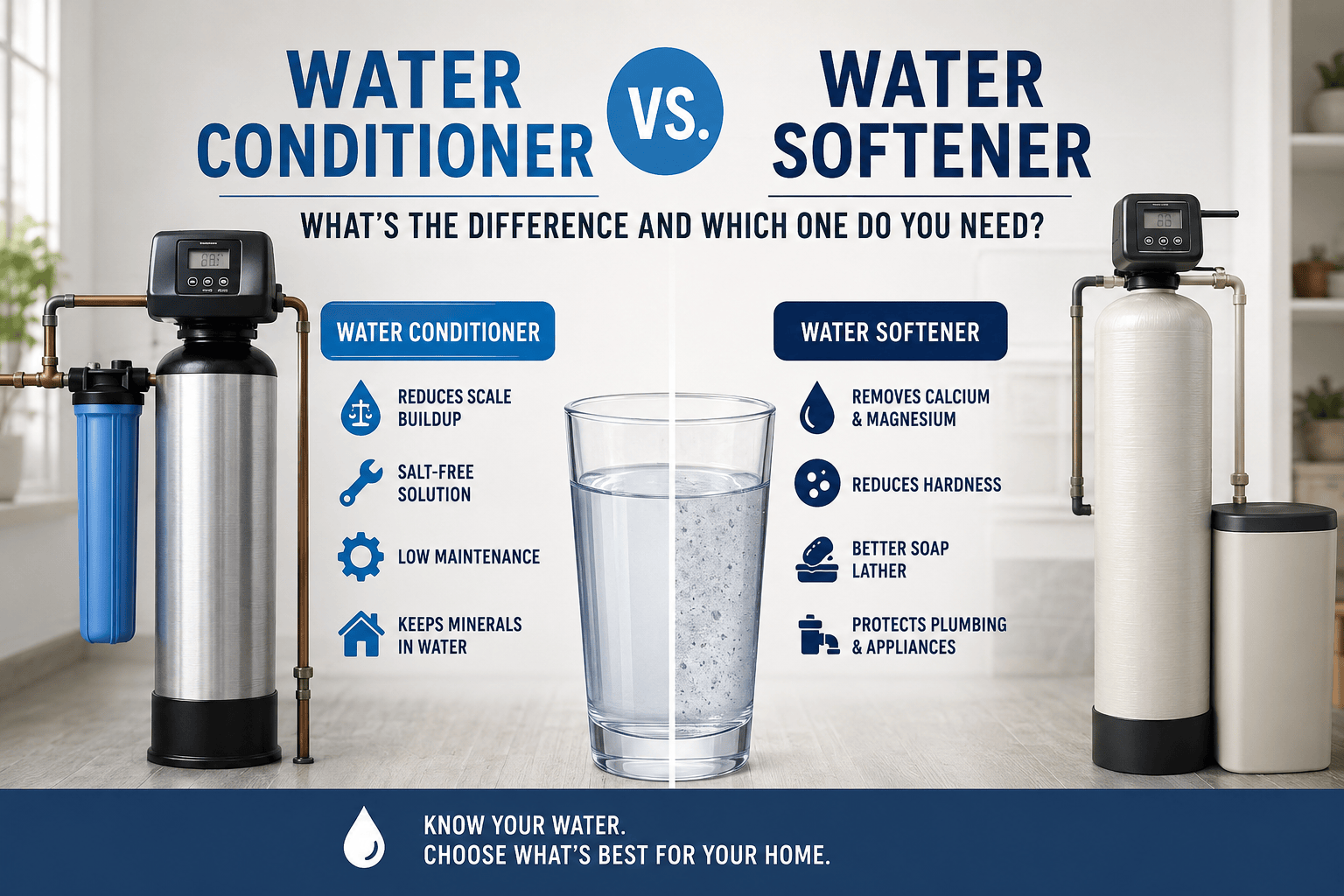
A water softener is designed to remove hardness minerals such as calcium and magnesium from water. A water conditioner, on the other hand, is a broader term that can describe systems designed to manage the effects of hard water, such as scale buildup, without necessarily removing those minerals.
Understanding the difference can help you choose the right water treatment system for your home instead of paying for equipment that does not address your specific water-quality problem.
What Is Hard Water?
Hard water contains elevated levels of naturally occurring minerals, primarily calcium and magnesium. As groundwater moves through soil and rock, it can dissolve these minerals and carry them into a private well or water supply.
Hard water is generally not considered a health concern, but it can create frustrating problems around the house.
Common signs of hard water include:
- White or chalky deposits around faucets
- Spots on dishes and glassware
- Soap that does not lather easily
- Mineral buildup on showerheads
- Scale inside plumbing
- Dry-feeling skin after bathing
- Buildup inside water-using appliances
- Reduced efficiency of water heaters
The harder the water, the more noticeable these problems can become.
What Is a Water Softener?
A water softener is a treatment system specifically designed to reduce water hardness.
Most traditional residential water softeners use a process called ion exchange. Water passes through a tank containing special resin beads. Calcium and magnesium ions are captured by the resin and exchanged for sodium or potassium ions.
How Does a Water Softener Work?
The basic process looks like this:
Hard water → Ion-exchange resin → Calcium and magnesium captured → Softened water
Over time, the resin becomes loaded with hardness minerals. The system then needs to regenerate the resin using a concentrated salt solution.
Traditional water softeners therefore require periodic maintenance, including monitoring the salt supply and ensuring the system regenerates properly.
What Does a Water Softener Remove?
A conventional ion-exchange softener primarily targets:
- Calcium
- Magnesium
- Water hardness
However, a water softener is not a complete water purification system. It should not be expected to remove every possible contaminant found in well or municipal water.
If your water has iron, manganese, sulfur odors, sediment, bacteria, or other water-quality problems, additional treatment may be necessary.
What Is a Water Conditioner?
The term water conditioner is broader than the term water softener.
Different manufacturers may use “water conditioner” to describe different treatment technologies. Some conditioners are designed to reduce the tendency of calcium minerals to form hard scale on plumbing, fixtures, and appliances.
Instead of removing calcium and magnesium from the water, certain conditioning technologies attempt to change how these minerals behave.
Does a Water Conditioner Remove Hardness?
Usually, no.
This is one of the most important differences between a conditioner and a traditional softener.
A conditioner may help manage the effects of hard water, particularly scale, while leaving calcium and magnesium in the water.
That means the water can still technically be considered hard even if the system reduces visible scale.
What Problems Can a Water Conditioner Address?
Depending on the technology, a water conditioner may help with:
- Scale formation
- Mineral deposits
- Water spots
- Plumbing buildup
- Appliance scale
The actual performance depends on the specific conditioning technology and the water chemistry in your home.
Water Conditioner vs. Water Softener: The Key Differences
The simplest way to compare the two is to look at what happens to the hardness minerals.
A traditional water softener removes calcium and magnesium from the water.
A water conditioner generally manages the effects of those minerals without removing them.
Quick Comparison
| Feature | Water Softener | Water Conditioner |
|---|---|---|
| Primary purpose | Reduce water hardness | Manage effects of hard water |
| Removes calcium | Yes, with ion exchange | Usually no |
| Removes magnesium | Yes, with ion exchange | Usually no |
| Reduces actual hardness | Yes | Usually no |
| Scale management | Yes | Often the primary goal |
| Salt required | Traditional systems generally use salt or potassium chloride | Many systems are salt-free |
| Regeneration | Traditional systems regenerate | Usually not required, depending on technology |
| Maintenance | Moderate | Often lower, depending on system |
| Best suited for | Homes needing hardness reduction | Homes primarily concerned with scale |
Is a Salt-Free Water Conditioner the Same as a Water Softener?
Not necessarily.
This is one of the most confusing areas of water treatment.
Products may be marketed using terms such as:
- Salt-free water softener
- Salt-free water conditioner
- Scale prevention system
- No-salt water treatment system
However, a salt-free conditioning system generally does not perform the same ion-exchange process as a traditional water softener.
Why Does This Difference Matter?
If you want to reduce the actual hardness level of your water, you need to understand whether the system truly removes calcium and magnesium.
If your primary goal is to reduce scale without using salt, a conditioning system may be worth considering.
The name on the product is less important than the actual treatment process.
How Does a Traditional Water Softener Regenerate?
Traditional ion-exchange softeners eventually become saturated with calcium and magnesium.
The system then enters a regeneration cycle.
During regeneration, a concentrated salt solution is passed through the resin. This helps remove the accumulated hardness minerals and restores the resin's ability to treat incoming water.
Does Regeneration Use Water?
Yes.
Traditional softeners use water during the regeneration process and discharge wastewater containing the removed minerals and salt.
Modern, efficient systems can use demand-based regeneration. Instead of regenerating at a fixed time regardless of household consumption, the system can regenerate based on actual water usage.
This can help reduce unnecessary water and salt consumption.
Do Water Conditioners Need Salt?
Many water conditioning systems are designed to operate without traditional softener salt.
This can be attractive to homeowners who want to avoid:
- Carrying bags of salt
- Maintaining a brine tank
- Salt-based regeneration
- Regeneration wastewater
However, “salt-free” does not automatically mean “better.”
The right system depends on what you want the treatment equipment to accomplish.
Which Is Better: Water Conditioner or Water Softener?
There is no single answer for every household.
The better choice depends on your water quality and your goals.
A Water Softener May Be Better If:
A traditional water softener may be appropriate if your home has significant water hardness and you want to actually reduce calcium and magnesium.
Consider a softener if you are experiencing:
- Heavy scale buildup
- Persistent hard-water spots
- Difficulty getting soap to lather
- Mineral deposits throughout the home
- Hard-water problems affecting appliances
- Significant water hardness confirmed by testing
A properly sized softener can directly address the hardness itself.
A Water Conditioner May Be Better If:
A conditioner may make more sense when your main concern is scale management rather than removing hardness minerals.
It may be appealing if you prefer:
- A salt-free system
- Less routine maintenance
- No traditional regeneration cycle
- A simpler approach to scale management
However, performance varies between different conditioning technologies, so it is important to understand exactly what the system is designed to do.
Which Is Better for Well Water?
If you have a private well, choosing between a water conditioner and a water softener requires a little more consideration.
Well water can contain several different water-quality issues at the same time.
Common Well Water Problems
Depending on your location and well conditions, you may encounter:
- Hard water
- Iron
- Manganese
- Sulfur odors
- Sediment
- Low pH
- Bacteria
- Other naturally occurring contaminants
A water softener can address hardness, but it is not designed to solve every well-water problem.
For example, if your well water contains significant iron or manganese, you may need a treatment system specifically designed for those contaminants.
Why Water Testing Matters
Testing your water before buying equipment can help you understand exactly what you are dealing with.
Instead of choosing a system because it is advertised as the “best water softener” or “best water conditioner,” base your decision on your actual water-quality results.
Water Conditioner vs. Water Softener Maintenance
Maintenance is another factor homeowners should consider.
Traditional water softeners generally require:
- Regular salt replenishment
- Periodic regeneration
- System cleaning or servicing
- Occasional inspection
- Monitoring of water usage and system performance
Water conditioners can have different maintenance requirements depending on their technology.
Some require very little routine attention, while others may use replaceable media or components.
Questions to Ask Before Buying
Before purchasing a system, ask:
1. Does the system actually remove hardness?
If reducing calcium and magnesium is your goal, make sure the system is designed to do that.
2. Does it require salt?
Find out whether the system uses sodium chloride, potassium chloride, or no salt at all.
3. Does it require regeneration?
Traditional ion-exchange softeners generally do. Many conditioners do not.
4. What maintenance is required?
Ask about replacement parts, cleaning, servicing, and expected system life.
5. Has the system been independently tested?
Look for credible certifications or performance information rather than relying solely on marketing claims.
How to Choose the Right System for Your Home
Choosing between a water conditioner and a water softener should start with your water, not the product brochure.
Follow these basic steps:
Step 1: Test Your Water
Determine the hardness level and check for other potential water-quality issues.
Step 2: Identify Your Main Problem
Are you primarily dealing with scale, or do you want to reduce the actual hardness of the water?
Step 3: Consider Your Maintenance Preferences
Think about whether you are comfortable maintaining a salt-based softener or would prefer a lower-maintenance conditioning system.
Step 4: Consider Your Household Water Usage
The size and type of system you need can depend on household size and daily water consumption.
Step 5: Compare the Treatment Technology
Do not compare systems based only on names such as “conditioner” or “softener.” Find out exactly how each system treats the water.
Step 6: Consider Long-Term Costs
Look beyond the purchase price.
Consider:
- Installation
- Salt or media
- Replacement parts
- Water consumption
- Maintenance
- Repairs
- Expected system lifespan
A system that costs less initially may not necessarily be the least expensive option over several years.
Frequently Asked Questions
Is a water conditioner the same as a water softener?
No. A traditional water softener removes calcium and magnesium through ion exchange. A water conditioner generally focuses on managing the effects of hard water, such as scale, without necessarily removing the hardness minerals.
Does a water conditioner make hard water soft?
Usually, no. Many conditioning systems reduce scale formation but leave calcium and magnesium in the water. Therefore, the water may remain chemically hard.
Does a water softener remove calcium and magnesium?
Yes. A conventional ion-exchange water softener is specifically designed to remove calcium and magnesium that cause water hardness.
Is a salt-free water conditioner better than a water softener?
It depends on your needs. A salt-free conditioner may be a good option if your primary goal is scale management and you prefer to avoid salt. A traditional softener may be more appropriate if you want to reduce actual water hardness.
Do water conditioners work?
Some conditioning technologies can help reduce scale formation, but results depend on the specific technology, water chemistry, and system design. It is important to evaluate independently supported performance claims.
Do I need a water softener if I have well water?
Not necessarily. Some wells have hard water, while others may have different water-quality concerns. Testing your well water is the best way to determine whether a softener is appropriate.
Can a water softener remove all contaminants?
No. A water softener primarily addresses hardness minerals. Other contaminants may require separate treatment technologies.
Final Thoughts
When comparing water conditioner vs. water softener, the most important thing to understand is what each system is designed to accomplish.
A traditional water softener is designed to remove calcium and magnesium and reduce the actual hardness of water. A water conditioner generally takes a different approach, often focusing on scale management without removing the hardness minerals.
If your biggest concern is hard water itself, a properly sized softener may be the better choice. If you mainly want to control scale and prefer a salt-free approach, a suitable water conditioner may be worth exploring.
Rather than choosing based on product names or marketing claims, start with a professional water test. Once you know your water chemistry and understand the problem you are trying to solve, it becomes much easier to select a treatment system that fits your home, budget, and long-term needs.