Hard water is a common concern for homeowners who rely on private wells or municipal water supplies. If you have noticed white mineral spots on glassware, scale buildup around faucets, stiff laundry, or soap that does not lather easily, excess calcium and magnesium in your water may be responsible.
Installing a water softener can help address these problems by reducing the minerals responsible for water hardness. However, purchasing the right equipment is only the beginning. Understanding how your system operates and following a regular maintenance routine can help maintain its performance, reduce avoidable problems, and extend its service life.
Learning how to use and maintain a water softener does not require advanced plumbing knowledge. Most homeowners can handle basic tasks such as checking salt levels, inspecting the brine tank, and monitoring system performance. Other issues, including persistent water pressure changes, control valve failures, and resin problems, may require professional assistance.
In this guide, Spring Rain, Inc. explains how residential water softeners work, how to add salt properly, which maintenance tasks deserve attention, and when to contact a water treatment professional.
How Does a Water Softener Work?
Before learning how to maintain a water softener, it helps to understand what happens inside the system.
A conventional salt-based water softener uses a process called ion exchange to reduce water hardness. Hard water contains dissolved minerals, primarily calcium and magnesium, that can leave scale deposits on plumbing fixtures, water heaters, and appliances.
A typical water softener contains two main components: a mineral tank filled with resin beads and a brine tank that stores the salt used during regeneration.
Understanding the Ion Exchange Process
As hard water flows through the mineral tank, calcium and magnesium ions attach to the resin beads. The resin releases sodium or, in some systems, potassium ions in exchange for the hardness minerals.
The treated water then flows into your home's plumbing system.
Over time, the resin beads accumulate hardness minerals and need to be regenerated. During this process, the softener uses a concentrated salt solution from the brine tank to recharge the resin beads.
The system then rinses away the displaced minerals and excess brine through a drain line before returning to normal operation.
Benefits of Proper Water Softener Maintenance
A well-maintained water softener can help homeowners:
- Reduce mineral scale on faucets, showerheads, and plumbing fixtures.
- Limit hardness-related deposits inside water-using appliances.
- Improve soap lathering and reduce soap scum.
- Make laundry feel less stiff when hardness is a contributing factor.
- Maintain consistent softening performance.
- Reduce the likelihood of preventable equipment problems.
Routine maintenance also helps you recognize small issues before they become more disruptive.
How to Use a Water Softener Correctly
Most modern water softeners operate automatically once they have been installed and programmed. Your main responsibility is to monitor the system, replenish the salt when needed, and watch for changes in water quality.
1. Understand Your System's Settings
Your water softener may have a digital control head that manages regeneration, water usage, and other operating settings.
Review the manufacturer's instructions to understand the display, regeneration schedule, and any alerts your model provides.
Important settings may include:
- Water hardness level.
- Household water usage or regeneration demand.
- Regeneration time.
- Salt dosage or regeneration capacity.
- Time of day and other operating parameters.
Incorrect settings can contribute to inadequate softening, excessive salt consumption, or unnecessary regeneration cycles.
If your water hardness changes or your household's water usage increases significantly, a qualified technician can help determine whether the settings need adjustment.
2. Check the Salt Level Regularly
Salt is an important part of the regeneration process in conventional salt-based water softeners.
Check the brine tank approximately once a month, or more frequently if your household uses a large amount of water or the manufacturer recommends it.
As a general guideline, maintain enough salt to support normal regeneration without filling the tank unnecessarily. Many systems operate well when the salt level stays above the water level, but the correct level depends on the tank design and manufacturer's instructions.
Look inside the brine tank for the following:
- A salt supply that is not running too low.
- Hard crusts or unusual clumping.
- Excessive moisture or a persistent sludge-like layer.
- Unusual water levels or visible signs of damage.
Avoid adding salt simply because the tank appears partly empty. Follow the recommended operating range for your particular system.
3. Use the Correct Type of Water Softener Salt
Water softener salt is available in several forms, including pellets, crystals, and certain block-style products designed for compatible systems.
High-purity salt pellets are a common choice for residential water softeners because they generally contain fewer insoluble impurities than lower-purity alternatives.
When selecting salt, check the following:
- Compatibility: Confirm that the product is suitable for your softener model.
- Purity: Choose a product appropriate for residential water softening.
- Dissolution: Follow the manufacturer's recommendations for the type of salt used.
- Storage: Keep unused salt dry to reduce clumping and handling problems.
Do not use ordinary table salt, rock salt intended for unrelated applications, or other products unless the manufacturer specifically approves them.
4. Allow the System to Regenerate Properly
Regeneration restores the resin's ability to remove hardness minerals. Depending on your softener, regeneration may occur automatically based on water consumption, a programmed schedule, or a combination of settings.
Many systems regenerate during periods of low water use, often overnight.
Avoid changing the regeneration settings without understanding how they affect the system. If your softener regenerates too frequently, uses an unusual amount of salt, or consistently produces hard water, the settings or equipment may need inspection.
How to Add Salt to a Water Softener
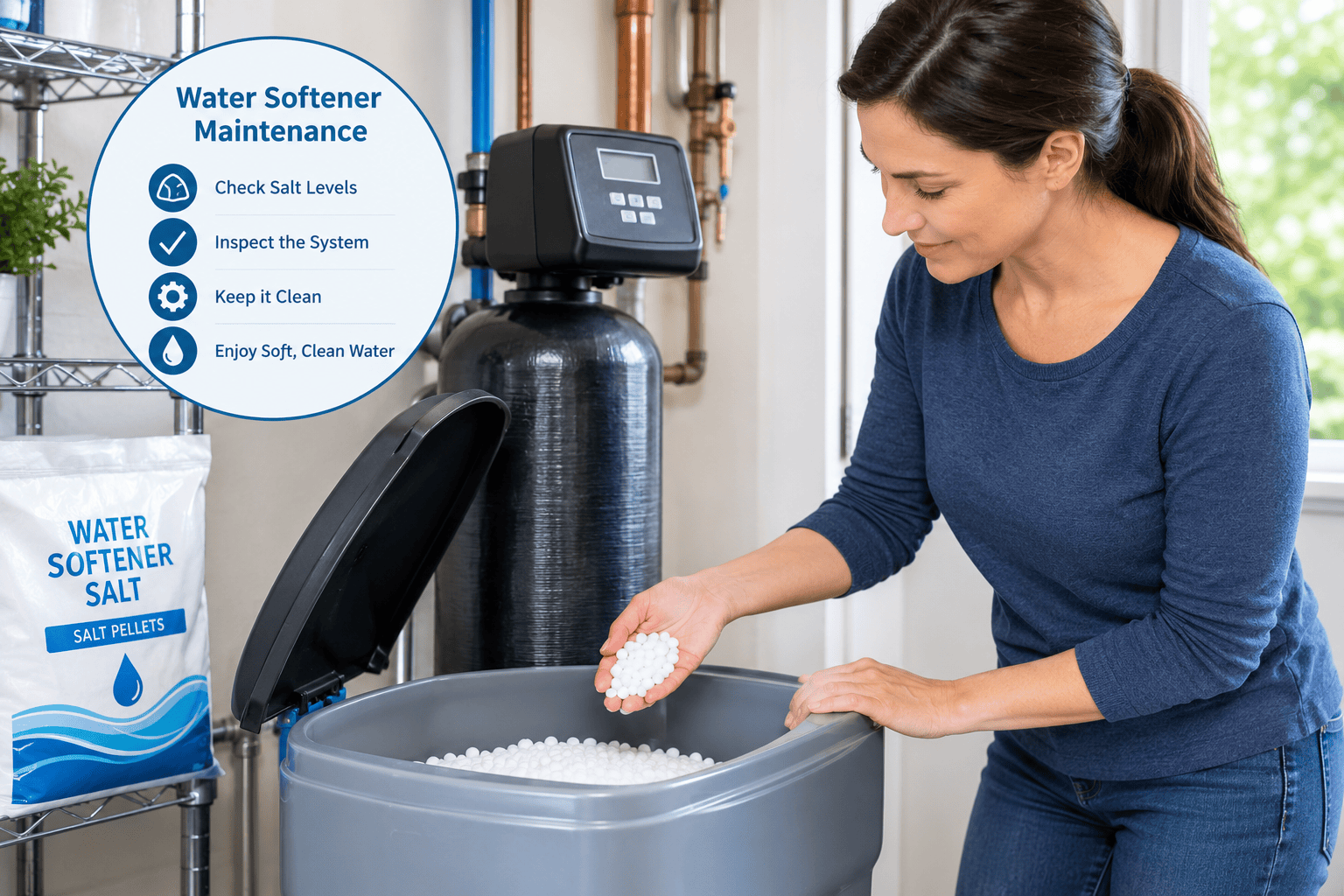
Adding salt is one of the simplest maintenance tasks homeowners can perform. However, doing it correctly helps avoid unnecessary mess, blockages, and salt-related operating problems.
Step 1: Check the Brine Tank
Open the brine tank lid and inspect the salt supply.
If the salt level is low, determine how much salt the tank needs based on the manufacturer's recommendations. Look for hard crusts, unusual deposits, or other signs that the salt is not dissolving properly.
Step 2: Add the Recommended Salt
Pour the appropriate water softener salt into the brine tank. Avoid spilling salt into the control valve or other equipment components.
Do not fill the tank beyond its recommended capacity. Leave enough room for the lid to close correctly and for normal system operation.
Step 3: Close the Lid and Check the System
Secure the lid and make sure the system remains in its normal operating mode.
Most automatic softeners do not need to be manually regenerated every time salt is added. Follow your model's instructions if a regeneration cycle or other action is required.
Step 4: Record Your Salt Usage
Pay attention to how quickly the salt supply decreases between checks.
Salt consumption depends on factors such as water hardness, household water usage, system capacity, and regeneration settings.
A sudden increase or decrease in salt consumption may indicate a change in water use, incorrect settings, or an equipment issue that deserves further investigation.
How to Prevent Salt Bridges and Salt Mushing
Two common problems inside a water softener's brine tank are salt bridging and salt mushing. Both can interfere with the system's ability to prepare brine for regeneration.
What Is a Salt Bridge?
A salt bridge forms when the salt hardens into a crust above the water in the brine tank. This creates an empty space underneath the crust, preventing the salt from dissolving as intended.
The tank may appear full even though the system cannot access enough dissolved salt to regenerate properly.
Possible warning signs include:
- The salt level appears unchanged for an unusually long time.
- Water hardness returns despite an apparently full tank.
- A hollow space forms beneath a hardened salt layer.
If you suspect a salt bridge, follow the manufacturer's instructions for safely breaking it up. Avoid sharp tools that could damage the tank or its components.
What Is Salt Mushing?
Salt mushing occurs when dissolved salt and insoluble material accumulate into a dense layer near the bottom of the brine tank.
This buildup may interfere with the movement of brine and prevent normal regeneration.
If you notice a persistent sludge-like layer or repeated salt buildup, consult your equipment manual or a water treatment professional. Cleaning procedures vary by system, and improper handling may damage internal components.
Essential Water Softener Maintenance Tasks
A regular inspection routine helps you identify changes in system performance before they become serious problems.
Monthly Maintenance Checklist
Once a month, consider performing these basic checks:
- Inspect the salt level in the brine tank.
- Look for crusted salt, clumping, or unusual deposits.
- Check the control panel for warnings or error messages.
- Look for visible leaks around the tank and nearby plumbing.
- Confirm that the bypass valve is in the normal service position.
- Monitor whether water hardness symptoms are returning.
These checks should take only a few minutes for most homeowners.
Inspect the Bypass Valve
A bypass valve allows water to flow around the softener when maintenance or repairs are necessary.
If the valve is accidentally left in the bypass position, untreated water can enter your home's plumbing even though the softener itself is operating correctly.
Check the valve position using the instructions for your particular model. If you are unsure how the valve operates, consult the installation manual rather than forcing the handle.
Monitor Regeneration
Check the control panel periodically to verify that the system is operating as expected.
Unusually frequent regeneration may increase water and salt consumption, while insufficient regeneration can allow hardness minerals to pass through the system.
If the schedule seems incorrect, have the settings reviewed in relation to your water hardness and household usage.
Keep the Area Around the Softener Clean
Keep the area around the equipment dry and free from unnecessary clutter.
Check for damp flooring, visible corrosion, damaged hoses, and loose connections. Address leaks promptly, and avoid placing chemicals or heavy objects where they could damage the tank or interfere with access.
Follow the Manufacturer's Cleaning Recommendations
Some systems benefit from periodic cleaning of the brine tank or other components, while others require less frequent intervention.
Follow the manufacturer's maintenance schedule and use only approved cleaning products. Do not pour household cleaners or unapproved chemicals into the brine tank.
How to Tell If Your Water Softener Is Working
A water softener can appear to operate normally while still delivering water that is harder than expected. For that reason, it helps to monitor actual water quality rather than relying entirely on the control panel.
Look for Returning Hard Water Symptoms
Common signs that your softener may not be working correctly include:
- White mineral deposits returning on faucets and showerheads.
- Increased soap scum on bathroom surfaces.
- Mineral spots appearing more frequently on glassware.
- Changes in how soap lathers.
- Hardness measurements that remain elevated after treatment.
These symptoms can have other causes, so they should be treated as clues rather than proof of equipment failure.
Test the Treated Water
A water hardness test provides a more reliable way to assess softening performance than a visual inspection alone.
You can use a suitable water hardness test kit or arrange professional testing. Compare the results with the system's intended performance and the manufacturer's recommendations.
If the water remains hard, the problem may involve salt supply, regeneration settings, a blocked brine line, resin deterioration, or another mechanical issue.
Warning Signs That Require Professional Water Softener Service
Some problems are beyond routine homeowner maintenance. Knowing when to request professional assistance can help prevent equipment damage and unnecessary water waste.
1. Water Pressure Drops Suddenly
A noticeable pressure reduction may result from plumbing restrictions, sediment, a clogged component, or another problem within the water supply system.
Although a softener can sometimes contribute to flow restrictions, low pressure should not automatically be blamed on the unit.
A technician can inspect the softener and surrounding plumbing to identify the source.
2. The System Continuously Drains Water
Water softeners use a drain during regeneration, but water should not normally flow continuously down the drain outside the expected operating cycle.
A stuck control valve, damaged seal, or other mechanical problem may cause excessive drainage.
If continuous draining occurs, consult the manufacturer's troubleshooting instructions and contact a qualified service professional. Follow the manual's guidance on isolating the equipment if necessary.
3. Water Tastes Unusually Salty
Unusual salty-tasting water may indicate a regeneration, rinsing, brine draw, or control valve problem.
However, taste alone cannot confirm the cause.
If the issue persists, stop guessing at the settings and arrange an inspection. A professional can evaluate the system's operation and test the treated water as needed.
4. The Brine Tank Water Level Changes Unexpectedly
Some water softeners maintain a variable water level as part of their normal operating cycle. Others use different brine management arrangements.
An unusually high water level, overflowing tank, or repeated failure to draw brine may indicate a problem with the float assembly, injector, drain line, or control valve.
Because system designs differ, use the manufacturer's troubleshooting guidance and seek professional help if the problem continues.
5. Resin Beads Appear in Household Plumbing
Small resin beads appearing in faucet aerators or other fixtures may indicate damage to the resin tank's internal distributor or related components.
This is not a normal part of water softener operation. Have the system inspected to determine whether repair or replacement is necessary.
6. The Softener Uses Too Much Salt
Higher-than-normal salt consumption may result from changes in household water usage, excessive regeneration, incorrect settings, or a mechanical issue.
Compare consumption with previous months and consider whether your water usage has changed. If the increase remains unexplained, a technician can review the system settings and operating performance.
How Often Should a Water Softener Be Serviced?
The ideal service schedule depends on the system's design, water quality, household usage, and manufacturer recommendations.
For many homeowners, checking the salt level monthly and watching for changes in water quality provides a useful starting point. More comprehensive inspections may be appropriate annually or at the interval recommended by the equipment manufacturer.
A professional inspection may include:
- Reviewing regeneration settings and operating history.
- Checking the brine tank and associated components.
- Inspecting the control valve and drain line.
- Evaluating water hardness before and after treatment.
- Assessing resin performance when indicated.
- Identifying leaks, corrosion, or other equipment concerns.
Routine service is especially useful when the system treats very hard water or when the household has experienced recurring problems.
Should You Repair or Replace Your Water Softener?
A water softener may need repair when a component fails, but replacement can become a better option when the system is old, undersized, inefficient, or experiencing repeated breakdowns.
Consider the following factors before making a decision:
- Age and condition: Older equipment may have worn components or declining resin performance.
- Repair costs: Compare the cost of repair with the expected reliability of the system afterward.
- Water quality: Persistent hardness may indicate that the system is no longer suitable for your water conditions.
- Household demand: A growing household may require greater treatment capacity.
- Salt and water consumption: Excessive consumption may indicate inefficient operation or incorrect sizing.
A qualified water treatment professional can help determine whether maintenance, repair, or replacement is the most practical option.
Choosing the Right Water Softener for Your Pennsylvania Home
Pennsylvania homes can have different water hardness levels depending on local geology, groundwater conditions, and municipal water sources.
Homes supplied by private wells may also have additional water quality concerns, such as iron, manganese, sediment, or other dissolved substances. These conditions can influence how a water softener should be selected and maintained.
Before purchasing a new system or replacing existing equipment, consider having your water tested and evaluating your household's daily water consumption.
A properly selected system should account for:
- Water hardness.
- Household size and water usage.
- Peak flow requirements.
- Iron and manganese levels where relevant.
- Existing plumbing and available installation space.
- Maintenance requirements and operating costs.
Spring Rain, Inc. provides customized water treatment solutions for Pennsylvania homeowners seeking to improve household water quality.
Explore our water softener systems to learn more about residential options for managing hard water.
Frequently Asked Questions About Water Softener Maintenance
How often should I add salt to my water softener?
Check the brine tank about once a month as a starting point. How often you need to add salt depends on water hardness, household usage, system capacity, and regeneration settings.
Can I put too much salt in my water softener?
Yes. Overfilling can make inspection and maintenance more difficult and may contribute to operating problems in some systems. Follow the recommended salt level for your specific model instead of filling the tank to the top.
Why is my water still hard even though the salt tank is full?
A full salt tank does not guarantee proper operation. A salt bridge, blocked brine line, incorrect settings, insufficient regeneration, or a mechanical issue may prevent effective softening.
Should I clean my water softener brine tank?
Cleaning may be necessary if the tank contains accumulated sediment, salt mushing, or other deposits. Follow the manufacturer's instructions because cleaning requirements vary by system.
Does a water softener need professional maintenance?
Basic checks can be performed by most homeowners, but professional maintenance can help identify valve problems, regeneration issues, leaks, and declining system performance. Follow the service schedule recommended for your equipment.
How long does a residential water softener last?
Service life varies according to equipment quality, maintenance, water chemistry, and household usage. Proper maintenance can help extend useful life, but no single lifespan applies to every system.
Keep Your Water Softener Running Efficiently With Spring Rain, Inc.
A water softener can help reduce the effects of hard water throughout your home, but its performance depends on appropriate settings, a reliable salt supply, and regular maintenance.
By checking the brine tank, using compatible salt, monitoring regeneration, and recognizing warning signs, you can help keep your system operating as intended.
When problems persist, professional evaluation can help identify the cause and prevent unnecessary repairs or wasted resources.
Spring Rain, Inc. offers customized water treatment solutions for Pennsylvania homes, including options for managing hard water and improving household water quality.
If you are experiencing recurring hard water problems, considering a new system, or need guidance on maintaining your existing equipment, visit Spring Rain, Inc. to explore your options.
Better water starts with the right system and proper maintenance.