When you are looking for cleaner, better-tasting drinking water, two terms often come up: reverse osmosis and distilled water. Both methods can significantly reduce substances found in ordinary water, but they work in very different ways.
So, when comparing reverse osmosis vs distilled water, which one is better?
The answer depends on what you want from your water treatment system. Reverse osmosis uses pressure and a semipermeable membrane to separate contaminants from water, while distillation uses heat to turn water into vapor and then condenses that vapor back into liquid. Both approaches can produce highly treated water, but they differ in efficiency, maintenance, water usage, mineral removal, and practical use in a home.
Understanding these differences can help you choose the right option instead of assuming that one treatment method is automatically better than the other.
What Is Reverse Osmosis?
Reverse osmosis, commonly called RO, is a water treatment process that uses pressure to push water through a semipermeable membrane.
The membrane acts as a barrier. Water molecules can pass through, while many dissolved substances and contaminants are rejected and carried away in a separate wastewater stream.
According to the U.S. Environmental Protection Agency, RO can be used to reduce a broad range of contaminants, including dissolved solids, salts, certain inorganic substances, radionuclides, and some synthetic organic chemicals.
How Does Reverse Osmosis Work?
A typical household RO system may contain several stages of treatment.
- Pre-filtration helps protect the system by reducing sediment and certain chemicals.
- Carbon filtration can improve taste and reduce chlorine and other substances.
- The RO membrane performs the primary separation of dissolved contaminants.
- Post-filtration can further improve taste before the water reaches the faucet.
- A storage tank may hold treated water in many residential systems.
The exact configuration varies depending on the system and the quality of the incoming water.
What Does Reverse Osmosis Remove?
A properly designed and certified RO system can reduce many dissolved contaminants. Depending on the specific system, this may include substances such as:
- Lead
- Sodium
- Nitrates
- Fluoride
- Arsenic
- Certain PFAS
- Dissolved salts
- Some volatile organic compounds
- Certain microorganisms
However, not every RO system removes every contaminant. Performance depends on the membrane, system design, incoming water chemistry, pretreatment, and certification.
That is why homeowners should identify what is actually in their water before choosing a treatment system.
What Is Distilled Water?
Distilled water is produced through a completely different process.
Instead of forcing water through a membrane, distillation heats water until it boils. The resulting steam is collected and cooled so it condenses back into water.
Many contaminants remain behind in the original water because they do not vaporize under the conditions used in the distillation process.
The EPA describes distillation as heating water to its boiling point, producing water vapor, and then collecting that vapor separately as it condenses.
How Does Water Distillation Work?
The basic process looks like this:
Water → Heating → Steam → Condensation → Distilled Water
During this process, many dissolved minerals and other substances are left behind in the boiling chamber.
Distillation can therefore produce water with very low mineral content.
What Does Distillation Remove?
Distillation can remove many substances that do not travel with the water vapor. This can include:
- Many dissolved minerals
- Salts
- Hardness minerals
- Certain heavy metals
- Many microorganisms
- Many dissolved inorganic contaminants
However, distillation is not a universal solution for every possible contaminant. Some volatile substances can potentially move with the steam and require appropriate system design or additional treatment.
For that reason, the quality of the finished water depends on the equipment and the characteristics of the source water.
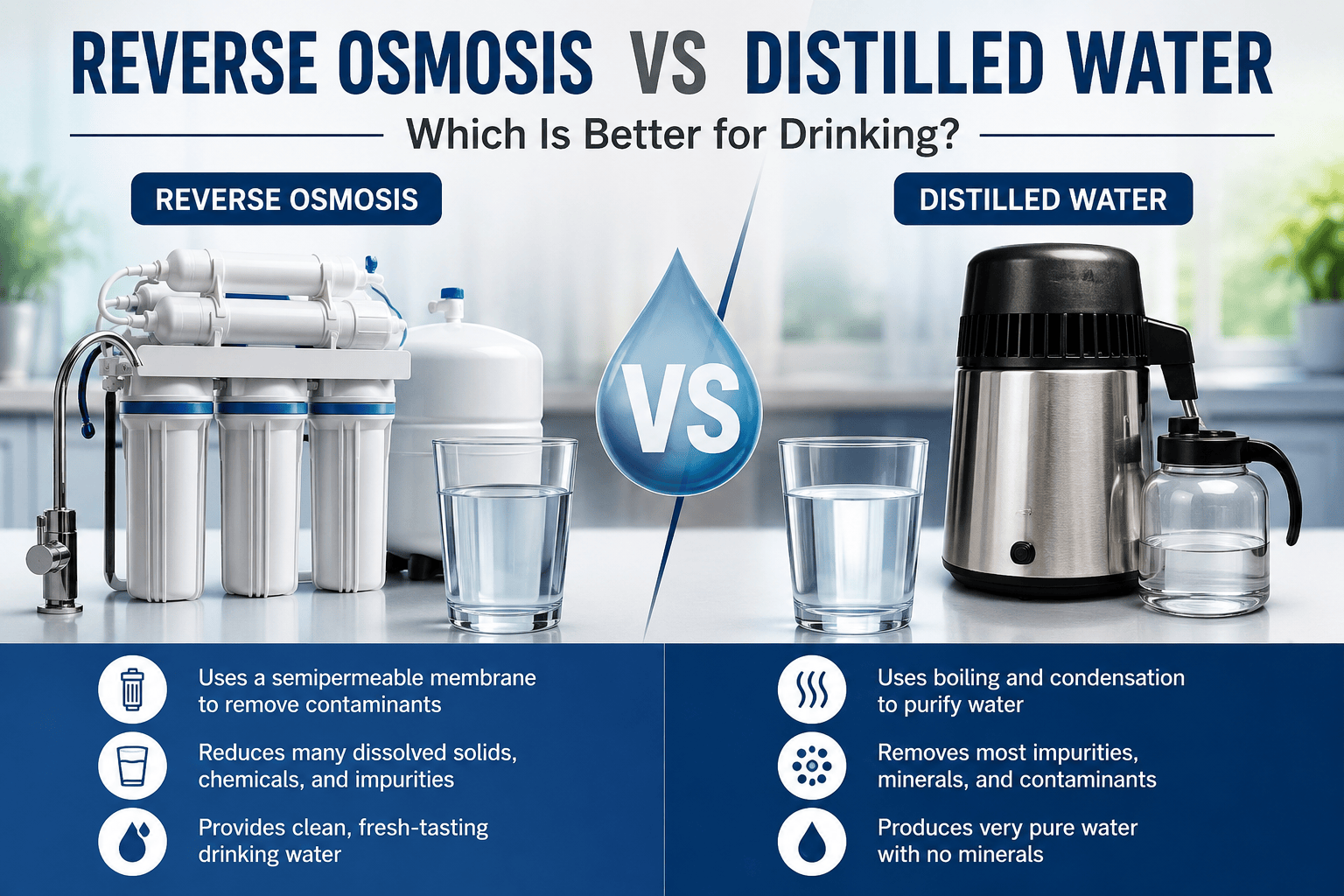
Reverse Osmosis vs Distilled Water: The Main Difference
The simplest way to understand the difference is to look at the treatment method.
| Feature | Reverse Osmosis | Distilled Water |
|---|---|---|
| Treatment method | Semipermeable membrane | Boiling and condensation |
| Uses pressure | Yes | No |
| Uses heat | No | Yes |
| Removes dissolved minerals | Yes, substantially | Yes, very effectively |
| Produces reject water | Yes | Yes, depending on system |
| Electricity required | Usually | Usually |
| Common household use | Drinking and cooking | Drinking, appliances, specialty uses |
| Mineral content | Very low, but varies | Typically extremely low |
| Maintenance | Filters and membrane | Cleaning and component maintenance |
| Treatment speed | Generally faster for household demand | Generally slower |
| Best suited for | Convenient point-of-use drinking water | Very low-mineral water |
The important point is that RO and distillation are not the same technology, even though both can produce highly treated water.
Which Removes More Minerals: RO or Distillation?
If your primary goal is removing minerals, distillation generally has the advantage.
Distillation is specifically designed to separate water from many dissolved substances by converting the water into vapor and then collecting the condensed vapor.
RO also removes a large amount of dissolved material, including minerals, but the final mineral content can vary depending on the membrane and system performance.
The EPA notes that distillation is particularly effective at removing minerals, while RO also removes most minerals but may leave somewhat more mineral content than distilled water.
That does not automatically make distilled water the better choice for drinking, though.
The best treatment method depends on what contaminants you need to reduce and how you plan to use the water.
Is Reverse Osmosis Water Better Than Distilled Water?
There is no universal winner.
For many households, reverse osmosis is more practical because it can provide treated drinking water directly at the kitchen faucet without requiring the household to repeatedly boil and cool batches of water.
RO systems can also be designed to target a broad range of contaminants.
The EPA identifies RO as a technology capable of removing or reducing numerous contaminants from drinking water, while also noting that RO systems produce a reject-water stream.
Distilled water may make more sense when extremely low mineral content is the main priority.
In other words:
Choose based on your water quality goals—not simply on which process sounds more powerful.
Is Distilled Water Safer Than Reverse Osmosis Water?
Not necessarily.
Both treatment methods can produce highly treated water when the equipment is properly designed, maintained, and used for the intended water conditions.
The bigger question is whether the system has been selected to address the contaminants actually present in your water.
For example, if a homeowner has a specific concern about arsenic, nitrate, PFAS, lead, or another contaminant, the treatment system should be evaluated according to its tested reduction performance for that contaminant.
A treatment method should never be selected solely because it removes "more stuff."
Water Testing Should Come First
If you're dealing with private well water, testing is especially important.
A water test can reveal whether you have concerns involving:
- Hardness
- Iron
- Manganese
- Nitrate
- Arsenic
- pH
- Bacteria
- Total dissolved solids
- Other contaminants
Once you understand the water chemistry, you can choose treatment based on actual needs rather than guesswork.
Reverse Osmosis vs Distilled Water for Drinking
For everyday household drinking water, reverse osmosis is often the more convenient option.
An under-sink RO system can continuously treat water as needed and provide it through a dedicated drinking-water faucet. Many residential systems are designed specifically for point-of-use drinking water.
Distillation, on the other hand, generally involves heating water, collecting the vapor, and allowing it to condense. That process can take longer and requires energy to produce heat.
For someone who wants a convenient source of treated drinking water at home, RO can therefore be a more practical solution.
Reverse Osmosis vs Distilled Water for Cooking
Both can be used for cooking, but the choice depends on your preferences and the food being prepared.
RO water can reduce the dissolved substances that influence taste, odor, and water chemistry.
Distilled water contains very little mineral content, which can make it useful for certain specialty applications where mineral buildup is undesirable.
For everyday cooking, however, most households do not necessarily need water that has been stripped of virtually all minerals.
The right choice depends on the quality of your incoming water and the purpose of treatment.
Which Is More Energy Efficient?
This is another area where the two systems differ.
Distillation requires heat to boil water. Producing that heat takes energy.
RO uses pressure to push water through a membrane. It does not need to boil the water, although the system still requires pressure and may use electricity depending on the equipment.
Energy use varies substantially between systems, so there is no single number that applies to every household setup.
Does Reverse Osmosis Waste Water?
Yes.
This is one of the biggest disadvantages of traditional residential RO systems.
During RO treatment, some incoming water becomes a concentrated reject stream rather than treated drinking water. The EPA says typical point-of-use RO systems can send five gallons or more down the drain for every gallon of treated water produced, although more efficient WaterSense-labeled systems are required to meet a much lower reject-water threshold.
This makes system efficiency an important consideration when shopping for an RO system.
How Can You Reduce RO Water Waste?
Look for:
- High-efficiency RO systems
- WaterSense-labeled models
- Systems with higher recovery rates
- Properly sized equipment
- Regular membrane maintenance
A more efficient RO system can significantly reduce the amount of water lost during treatment.
Does Distillation Waste Water?
Distillation also does not convert every drop of incoming water into finished product water.
Some water remains behind with concentrated contaminants and minerals, while additional water may be required depending on the equipment used for cooling or other parts of the process.
The amount of water and energy used depends heavily on the design of the distiller.
So, neither technology should automatically be considered completely waste-free.
Which System Is Easier to Maintain?
Both require maintenance, but the maintenance is different.
Reverse Osmosis Maintenance
RO systems commonly require replacement of:
- Sediment filters
- Carbon filters
- RO membranes
- Post-filters
The replacement schedule depends on water quality, usage, and the manufacturer's recommendations.
A neglected RO system may produce poorer-quality water and can experience reduced flow.
Distiller Maintenance
Distillation systems generally require cleaning because minerals and other substances accumulate inside the boiling chamber.
Depending on the design, other components may also need periodic inspection or replacement.
Regular cleaning is particularly important because mineral deposits can affect the system's performance.
Reverse Osmosis vs Distilled Water: Which Is Better for Your Home?
For most homeowners, the decision comes down to three questions:
1. What Is in Your Water?
Start with a water test.
If you don't know what contaminants you're dealing with, it's difficult to choose the right treatment technology.
2. How Much Water Do You Need?
If you need treated water throughout the home, an under-sink RO system may not be the appropriate solution by itself.
RO is commonly used as a point-of-use treatment technology for drinking and cooking water.
Other water treatment technologies may be more appropriate for whole-house concerns.
3. What Is Your Main Goal?
If you want convenient drinking water with substantial reduction of dissolved contaminants, RO may be a strong choice.
If your primary goal is water with extremely low mineral content, distillation may be more appropriate.
Can You Use Both Reverse Osmosis and Distillation?
Technically, yes.
Some applications use multiple treatment technologies when a particular water quality requirement calls for it.
However, combining treatment methods is not automatically better.
Every additional treatment stage adds equipment, maintenance, operating costs, and complexity. A properly designed system should address the actual water-quality problem rather than simply adding technologies without a clear purpose.
Common Misconceptions About RO and Distilled Water
Myth 1: Distilled Water Is Always Better
Not necessarily.
Distillation can produce extremely low-mineral water, but that does not mean it is the best treatment choice for every home.
Myth 2: Reverse Osmosis Removes Everything
No treatment system removes every possible contaminant.
RO performance depends on the membrane, system design, operating conditions, and the substances being treated.
Myth 3: RO Water Contains No Minerals
RO can remove a substantial amount of dissolved minerals, but the final mineral content is not necessarily zero.
Myth 4: Boiling Water Is the Same as Distillation
It isn't.
Boiling water and collecting the resulting vapor through condensation is what creates distilled water. Simply boiling water and drinking it does not remove dissolved minerals and many chemical contaminants.
Myth 5: The Best Water Treatment Is the Same for Every Home
Every water supply is different.
Municipal water, private well water, and different geographic areas can have very different water-quality characteristics.
How to Choose Between Reverse Osmosis and Distilled Water
A simple decision process can make the choice easier.
Choose reverse osmosis when:
- You want convenient drinking water at home.
- You want substantial reduction of dissolved contaminants.
- You prefer a system connected directly to your water supply.
- You want treated water available whenever you need it.
- You are comfortable replacing filters and membranes periodically.
Consider distillation when:
- Very low mineral content is your primary goal.
- You need distilled water for a specific application.
- You don't mind the slower production process.
- Energy use is acceptable for your intended application.
- You are prepared to clean the distillation equipment regularly.
The Bottom Line: Reverse Osmosis vs Distilled Water
When comparing reverse osmosis vs distilled water, neither technology wins in every category.
Reverse osmosis uses a semipermeable membrane and pressure to separate many contaminants from water. It is widely used for residential drinking-water treatment and can provide a convenient source of treated water at the tap.
Distillation uses heat and condensation to produce water with very low mineral content. It can be especially useful when minimizing dissolved minerals is the primary objective.
For most homeowners, the smartest approach is to test the water first, identify the contaminants that matter, and then choose a treatment system designed for those conditions.
If you're unsure whether reverse osmosis, distillation, filtration, softening, or a combination of treatments is right for your home, Spring Rain, Inc. can help you evaluate your water quality and determine which treatment approach makes sense for your specific needs.
Frequently Asked Questions
Is reverse osmosis the same as distilled water?
No. Reverse osmosis uses pressure and a semipermeable membrane, while distillation uses boiling and condensation. Both can produce highly treated water, but they use different processes.
Which is purer, RO water or distilled water?
Distilled water generally has very low mineral content. RO water can also have very low dissolved-solids levels, but the final result varies according to the system and incoming water.
Is RO water good for drinking?
A properly designed and maintained RO system can provide high-quality drinking water and reduce many contaminants. The system should be selected based on the source-water quality and the contaminants you want to reduce.
Does distilled water remove more minerals than reverse osmosis?
Generally, yes. Distillation is highly effective at removing minerals, while RO also substantially reduces dissolved minerals.
Does reverse osmosis waste water?
Yes. Traditional RO systems produce a reject-water stream. More efficient systems can substantially reduce this waste. EPA's WaterSense program now provides efficiency criteria for point-of-use RO systems.
Should I choose RO or distilled water for my home?
For everyday drinking-water treatment, RO is often the more convenient option. Distillation can be preferable when extremely low mineral content is the primary objective. A water test can help determine which approach is appropriate for your home.