Few household problems are more stressful than turning on a faucet and discovering that little or no water is coming out. If your home relies on a private well, an unexpected loss of water can affect everything from showering and cooking to laundry and cleaning.
If you have been asking, "Why is my well running out of water?", the cause may be related to falling groundwater levels, excessive water usage, a low-yielding well, or a problem with your well pump and plumbing equipment.
Sometimes, a well temporarily struggles to keep up with household demand and recovers after water use stops. In other situations, the water supply may be declining because of drought, changes in groundwater conditions, or a developing mechanical problem.
The important thing is to identify the underlying cause before deciding on a solution. A well that produces less water than usual does not necessarily need to be drilled deeper, and a pump problem can sometimes look like a water shortage.
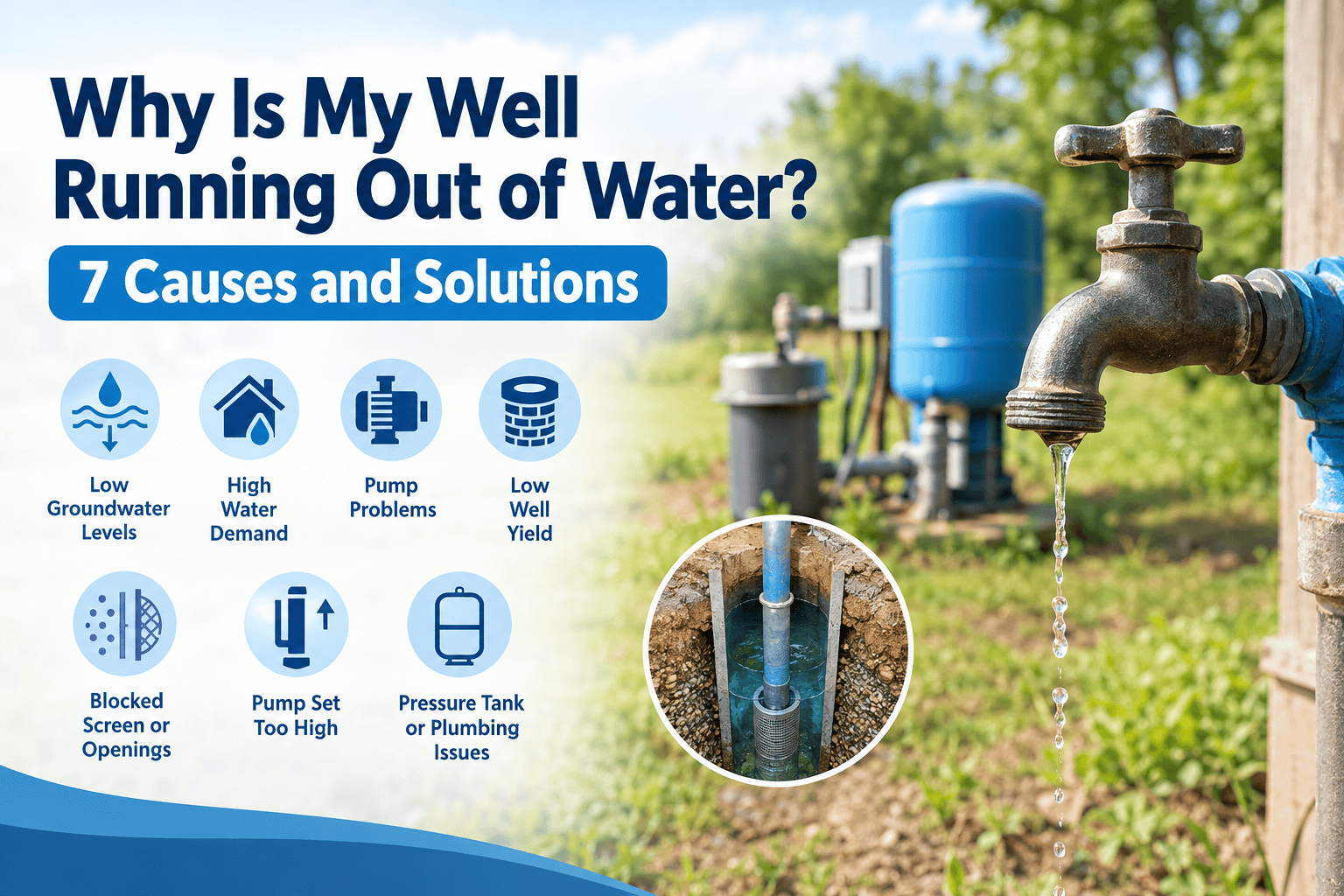
In this guide, Spring Rain, Inc. explains seven common reasons a well may run low, the warning signs homeowners should recognize, and the steps you can take to help restore a reliable water supply.
What Does It Mean When a Well Runs Out of Water?
A well is considered dry when its water level falls below the point where the pump can draw water effectively. However, some wells that appear to be running dry are actually experiencing temporary low yield or equipment problems.
Groundwater enters a well from surrounding soil, sand, gravel, or fractured rock. The amount of water available depends on the geology, groundwater recharge, well construction, and how quickly water is being pumped.
If your household uses water faster than the well can replenish it, the water level may fall during pumping. Once water use decreases, the well may recover gradually.
This is different from a failed pump, a blocked well screen, or a damaged pressure tank, all of which can interrupt water delivery even when sufficient groundwater is available.
Understanding this distinction is the first step toward finding the right solution.
7 Reasons Your Well May Be Running Out of Water
1. Low Groundwater Levels or Drought
One of the most common reasons a well produces less water is a decline in groundwater levels.
Groundwater is replenished as precipitation infiltrates the ground and moves through water-bearing soil and rock formations. During extended periods of limited rainfall, groundwater recharge may decrease while household, agricultural, and other water demands continue.
Shallow wells and certain wells that depend on relatively shallow water-bearing formations can be particularly sensitive to these changes.
Warning signs include:
- Your well produces less water during dry weather.
- Faucets sputter after extended water use.
- The water supply improves after the well has rested.
- Your neighbors using private wells report similar problems.
How to Address Low Groundwater Levels
Start by reducing unnecessary water consumption and spreading out activities that use large amounts of water.
For example, avoid running the washing machine, dishwasher, and other water-intensive appliances simultaneously when your well has limited production capacity.
A qualified well professional can measure water levels, evaluate the well's yield, and determine whether the problem is seasonal or requires a longer-term solution.
Rainfall alone does not guarantee immediate recovery. Groundwater recharge depends on local geology, precipitation patterns, and other environmental conditions.
2. Your Household Is Using Water Faster Than the Well Can Refill
A well does not necessarily store enough water to meet unlimited demand at any given moment.
Even a well that provides an adequate daily supply may struggle when several fixtures operate simultaneously. Morning showers, laundry, dishwashing, irrigation, and other activities can create short periods of unusually high demand.
This problem is especially noticeable in homes with low-yielding wells.
How to Reduce Excessive Water Demand
Try adjusting your household's water usage:
- Space out laundry and dishwasher cycles.
- Avoid watering lawns or gardens during periods of low well production.
- Repair leaking faucets and running toilets.
- Install appropriate water-efficient fixtures.
- Reduce simultaneous use of multiple high-demand appliances.
These changes may help a well recover between periods of heavy use.
However, if the problem continues even when household demand is low, a well yield test and system inspection can help determine whether another issue is responsible.
3. Your Well Pump Is Failing
Sometimes, a homeowner believes the well has run dry when the actual problem is a failing pump.
A well pump moves water from the well into the household plumbing system. If the pump becomes worn, damaged, or unable to operate correctly, water delivery may decline or stop completely.
Electrical problems can also prevent the pump from starting or running as intended.
Signs of a Well Pump Problem
Look for symptoms such as:
- No water even though the well may contain water.
- Unusual pump noises.
- A pump that starts and stops frequently.
- A sudden loss of water delivery.
- Electrical breaker trips or other electrical symptoms.
What Should You Do?
Avoid repeatedly resetting a tripped breaker or repeatedly operating a pump that may be running without adequate water.
A qualified well pump technician can inspect the pump, electrical controls, and water delivery system to determine whether repair or replacement is necessary.
If the well itself has sufficient water, correcting the pump problem may restore normal service without requiring the well to be deepened.
4. The Well Has a Low Yield
Well yield describes how much water a well can produce over a given period without the water level dropping below the pump's effective intake.
Some wells naturally produce water more slowly than others because of the surrounding geology and the characteristics of the water-bearing formation.
A well with a low yield may provide enough water for ordinary household use when demand is spread throughout the day but struggle during peak usage periods.
How to Manage a Low-Yielding Well
The first step is to determine the well's actual production capacity and compare it with your household's water requirements.
Depending on the findings, possible options may include:
- Reducing peak household water demand.
- Installing an appropriately sized water storage tank or cistern.
- Adjusting the pumping arrangement where technically appropriate.
- Having the well evaluated for rehabilitation.
- Considering a new or deeper well if a professional determines that it is feasible.
A larger pump is not automatically the answer. Pumping water faster than the well can replenish it may worsen the problem.
5. The Well Screen or Water-Bearing Openings Are Blocked
Over time, mineral deposits, sediment, corrosion, and biological growth can restrict the movement of water into a well.
In a screened well, buildup may reduce the amount of water entering through the screen. In a bedrock well, mineral deposits or other obstructions may affect water-bearing fractures.
As these restrictions develop, the well may take longer to produce the water needed by your household.
Common Warning Signs
- Gradually declining water production.
- Increasing amounts of sediment in the water.
- Reduced flow despite normal pump operation.
- A well that takes longer than usual to recover.
How Can a Blocked Well Be Fixed?
A qualified well professional can evaluate the well's construction, inspect its performance, and determine whether rehabilitation is appropriate.
Depending on the cause, treatment may involve specialized cleaning, removal of deposits, or other approved rehabilitation procedures.
Do not pour household chemicals into a well in an attempt to clear a blockage. The appropriate method depends on the well's construction and the nature of the obstruction.
6. Your Well Pump Is Set Too High for the Current Water Level
The position of the pump intake matters when groundwater levels fluctuate.
If the water level falls below the pump's intake, the pump may no longer be able to draw water effectively, even if some water remains in the well.
This can happen during drought, when a well has a limited yield, or when groundwater levels decline over time.
What Are the Possible Solutions?
A qualified well contractor can review the well depth, water levels, pump location, and original well records.
Depending on the findings, potential solutions may include adjusting the pump position, changing the pumping rate, improving water storage, or evaluating other water supply options.
Lowering a pump is not appropriate for every well. The available depth, sediment conditions, pump specifications, and water quality must be considered before making changes.
7. The Pressure Tank or Plumbing System Has a Problem
Your well may contain enough water, but a malfunctioning pressure tank, pressure switch, clogged filter, or damaged pipe can interfere with water delivery.
The pressure tank helps maintain consistent pressure and reduces how frequently the pump needs to start. When its components fail, you may experience fluctuating pressure or interruptions in water supply.
Similarly, a clogged sediment filter or plumbing restriction may reduce flow even when the well itself is producing water normally.
Signs of a Pressure or Plumbing Problem
- Water pressure rises and falls unexpectedly.
- The pump switches on and off too frequently.
- Water flow is weak throughout the home.
- Pressure problems occur even after the well has had time to recover.
How to Resolve the Problem
Have a qualified technician inspect the pressure tank, pressure switch, filters, valves, and plumbing system.
The correct repair depends on the specific fault. Replacing the well pump or drilling a new well without checking these components could lead to unnecessary expenses.
Signs Your Well Is Going Dry
Recognizing early warning signs can help you respond before a complete loss of water occurs.
Pay attention to these changes:
- Water sputtering from faucets: Air may be entering the water delivery system, although plumbing problems can also cause sputtering.
- Declining water pressure after extended use: The well may be struggling to keep up with demand, or a mechanical problem may be developing.
- Water flow stops and later returns: This may indicate temporary drawdown or a pump or control issue.
- New sediment or cloudy water: A falling water level or other well problem may be allowing more sediment into the system.
- Longer recovery periods: Your well may be taking longer to replenish after heavy water use.
- Recurring water shortages during dry weather: Groundwater levels or the well's production capacity may be contributing to the problem.
These symptoms are useful clues, but none of them alone proves that the well is dry.
If you notice a sudden change in water supply, arrange an inspection rather than assuming the problem will resolve itself.
What to Do When Your Well Runs Out of Water
If your well suddenly stops supplying water, a few immediate precautions can help protect your equipment and household.
Step 1: Reduce Water Use
Stop unnecessary water-consuming activities and allow the well time to recover if temporary over-pumping is suspected.
Avoid repeatedly running faucets to see whether water has returned.
Step 2: Protect the Well Pump
If the pump appears to be drawing air, runs unusually long, or repeatedly fails to deliver water, stop using it and seek professional advice.
Operating a pump without an adequate water supply can damage certain pump systems. A properly installed low-water protection device may help prevent damage in appropriate applications.
Step 3: Check for an Obvious Plumbing Issue
Look for visible leaks or signs of a malfunctioning pressure system.
You can also check whether the problem affects the entire house or only one faucet. A single affected fixture may point to a localized plumbing restriction rather than a well supply problem.
Do not open electrical equipment or attempt repairs on pressurized components unless you are qualified to do so.
Step 4: Contact a Well Professional
If water does not return, the pump behaves abnormally, or the problem keeps recurring, arrange an evaluation by a qualified well driller or pump technician.
The technician may measure water levels, perform a yield test, inspect the pump, and review the well's construction records.
Step 5: Test the Water if Its Appearance Changes
If water becomes cloudy, contains unusual sediment, or develops a new taste or odor after a water shortage, arrange appropriate water quality testing.
A change in water appearance does not identify the contaminant, and clear water is not proof of safety.
For private wells, periodic testing is important even when no obvious symptoms are present.
How Long Does It Take for a Well to Refill?
There is no single recovery time that applies to every well.
Some wells recover relatively quickly after pumping stops. Others need several hours or longer, depending on the aquifer, the well's yield, groundwater levels, and the amount of water removed.
A well that repeatedly runs low after ordinary household use may have a capacity problem that cannot be solved simply by waiting longer.
A professional yield test can help determine how quickly the well produces water and whether that supply is adequate for your household.
Avoid relying on a fixed waiting period as proof that the well has recovered. The underlying cause matters more than the amount of time that has passed.
Can a Well That Runs Dry Recover?
Yes, some wells that temporarily stop producing water can recover when groundwater levels rise or pumping demand decreases.
However, recovery is not guaranteed.
If the problem is caused by a temporary decline in groundwater levels or excessive pumping, the water level may return when conditions improve.
If the cause is a failed pump, a blocked well screen, or a more persistent decline in well production, additional work may be required.
A qualified well professional can help distinguish between a temporary shortage and a longer-term water supply problem.
How to Prevent Your Well From Running Out of Water
Although homeowners cannot control rainfall or groundwater conditions, several practices can help reduce avoidable water shortages.
Monitor Your Household Water Use
Pay attention to how your well responds during busy periods. If water delivery declines after several appliances run at once, spread those activities throughout the day.
Repair Leaks Promptly
Leaking fixtures, damaged pipes, and running toilets can waste substantial amounts of water over time.
Fixing leaks reduces unnecessary demand on your well.
Maintain Your Well and Pump
Periodic inspections can help identify declining performance, equipment wear, corrosion, and other problems before they cause a complete interruption.
Keep records of pump repairs, well depth, previous yield tests, and water level measurements when available.
Consider Water Storage for Low-Yielding Wells
In some situations, a properly sized storage tank or cistern can help balance a low-yielding well's production with the home's peak water demand.
The well fills the storage tank over time, and a separate delivery arrangement supplies the home when demand is higher.
This solution must be designed around the well's production rate, household demand, storage capacity, and appropriate water quality protections.
Install Suitable Pump Protection
Depending on the equipment, a low-water cutoff or pump protection device may help prevent the pump from operating under unsafe conditions.
Ask a qualified installer which protection method is appropriate for your pump and well.
When Should You Consider Drilling a Deeper Well?
Drilling a deeper well may be an option when a professional determines that the existing well cannot provide sufficient water and that a suitable deeper water-bearing formation may be available.
However, drilling deeper is not a guaranteed solution.
The geology may not provide a better water supply at greater depth, and the water may have different quality characteristics. Costs, local requirements, and the condition of the existing well should also be considered.
Before making this investment, have a qualified well contractor evaluate alternatives such as well rehabilitation, pump adjustments, water storage, and demand management.
A decision based on water level measurements, yield testing, and the well's construction history is more reliable than guessing at the cause.
Why Choose Spring Rain, Inc. for Your Home's Water Quality Needs?
When a private well begins running out of water, determining the source of the problem is essential. A water treatment system alone cannot correct every well production or pump issue, so the first step is identifying whether the problem involves water availability, mechanical equipment, or water quality.
Spring Rain, Inc. provides customized water treatment solutions for Pennsylvania homeowners who want to improve their household water quality.
If your well water supply has changed, it may also be worth evaluating whether sediment, iron, manganese, hardness, or other water quality concerns require treatment.
Explore our services to learn more about:
For problems involving a well that repeatedly runs low, a failing pump, or a suspected dry well, consult a qualified well professional who can assess the well's production and mechanical condition.
Frequently Asked Questions About Wells Running Out of Water
Why is my well running out of water all of a sudden?
A sudden loss of water may be caused by temporary over-pumping, a declining groundwater level, a failed pump, an electrical problem, or a pressure system malfunction. An inspection can help identify the actual cause.
How do I know if my well is dry or my pump is broken?
A dry or low-yielding well may recover after water use stops, while a failed pump may prevent water delivery even when the well contains water. Water level measurements and equipment testing can help distinguish between the two.
Can running the washing machine make my well run dry?
If your well has a low production rate, running the washing machine alongside showers and other high-demand fixtures may temporarily exceed the available supply. Spreading out water use can help reduce peak demand.
Will rain make my well fill back up?
Rainfall can contribute to groundwater recharge, but the effect depends on local geology, the amount of precipitation, and how quickly water reaches the aquifer. A well may not recover immediately after rain.
Should I install a bigger well pump?
Not necessarily. A larger pump can draw water faster than a low-yielding well can replenish it. Have the well's production capacity assessed before changing pump size.
Can a water storage tank help if my well has low yield?
Yes, in suitable situations. A properly designed storage tank can collect water gradually and help meet periods of higher household demand. The design should account for water production, storage capacity, and water safety.
Restore Confidence in Your Home's Water Supply
When a well begins running out of water, the cause may range from temporary overuse to a more serious problem with groundwater availability, well construction, or pumping equipment.
Reducing water demand can help in some situations, but recurring shortages deserve professional attention. Measuring the well's water level, testing its yield, and inspecting the pump and pressure system can help identify the most appropriate next step.
Spring Rain, Inc. helps Pennsylvania homeowners explore water treatment options for improving household water quality. If your water supply has changed and you are concerned about sediment, hardness, or other water quality issues, visit Spring Rain, Inc. to learn more about our services.
A reliable water supply starts with understanding your well, identifying the problem, and choosing the right solution.