If you're thinking about installing a private well, one of your first questions is probably simple: How much does it cost to drill a water well?
The answer depends on several factors, including the depth of the well, the geology beneath your property, the equipment required, and the work needed to bring water into your home. A well in an area with favorable drilling conditions may cost considerably less than one that must pass through deep layers of hard rock.
For homeowners, the total expense can also extend beyond drilling itself. A complete water supply system may require casing, a pump, a pressure tank, electrical connections, plumbing, permits, and water quality testing.
Understanding these expenses before starting a project can help you establish a realistic budget and avoid unexpected costs.
In this guide, Spring Rain, Inc. explains the factors that influence water well drilling cost in 2026, the additional expenses to consider, and the options available when an existing well does not provide enough water for your household.
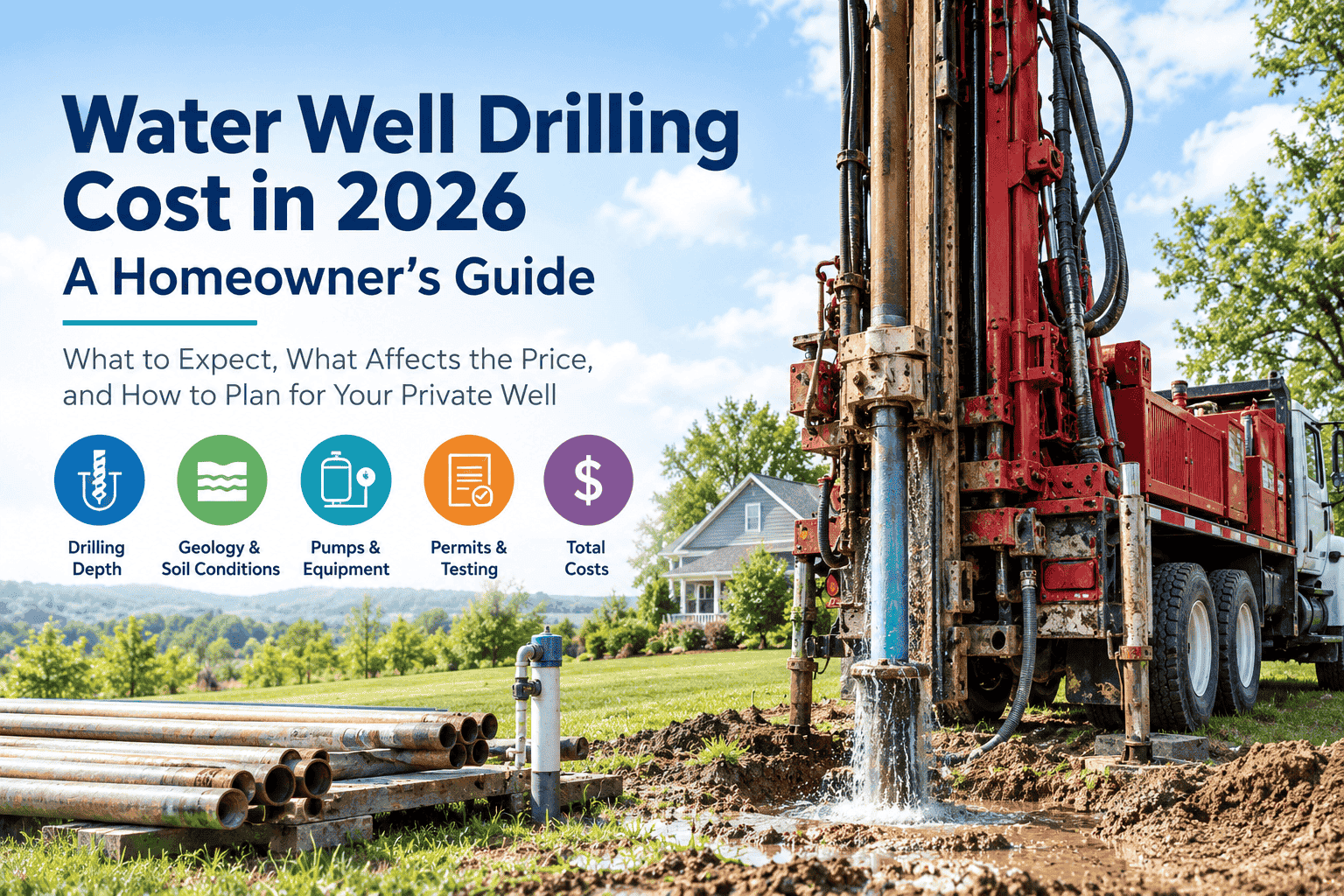
How Much Does It Cost to Drill a Water Well in 2026?
The cost of drilling a residential water well varies significantly by location and project requirements. For initial budgeting, homeowners may encounter estimates ranging from several thousand dollars to $15,000 or more for a complete residential well system. Difficult drilling conditions, unusually deep wells, and extensive installation work can push the total higher.
These figures are general planning estimates, not guaranteed prices for your property. Local contractor quotes and site conditions ultimately determine the actual cost.
Average Water Well Drilling Costs
The following ranges can help you understand how different parts of a residential well project contribute to the overall expense.
| Well-related expense | Illustrative cost range |
|---|---|
| Drilling and basic well construction | $15–$40 per foot |
| Complete well system installation | $25–$65 per foot |
| Residential well pump | $300–$2,000 |
| Pressure tank | $300–$1,500 |
| Permits and inspections | $50–$500 |
| Water quality testing | $100–$500 |
| Additional plumbing and electrical work | $500–$3,000+ |
These are broad budgeting ranges, not verified 2026 market averages. Costs vary by region, equipment specifications, contractor pricing, and the scope of work. Some quoted installation prices already include components listed separately, so do not add every figure together without checking what the contractor's estimate covers.
What Is Included in the Total Cost?
A complete water well installation generally involves more than drilling a borehole.
Depending on the property, the project may include:
- Drilling to a suitable water-bearing formation.
- Installing casing and a sanitary well cap.
- Developing the well and evaluating its production.
- Installing a pump and necessary controls.
- Connecting a pressure tank and plumbing lines.
- Providing electrical service to the pumping equipment.
- Obtaining applicable permits and completing required inspections.
- Testing the water for relevant contaminants.
Before accepting a quote, ask for an itemized breakdown. Knowing exactly what is included makes it easier to compare contractors and identify expenses that may arise after drilling is complete.
7 Factors That Affect Water Well Drilling Cost
Two neighboring properties can have very different well installation costs. The reason is that the amount of work required depends on conditions both above and below ground.
Here are seven important factors to consider when estimating your project budget.
1. Well Depth
Well depth is one of the most important influences on drilling cost.
A shallow well generally requires less drilling time and fewer materials than a deeper well. However, a shallow well is only suitable when local groundwater conditions can provide an adequate and dependable supply.
In many areas, residential wells extend hundreds of feet below the surface. The required depth depends on local geology, groundwater availability, neighboring well records, and the amount of water the household needs.
How Depth Affects Your Budget
A deeper well may require additional drilling time, more casing, different equipment, and a pump capable of lifting water from a greater depth.
For example, a contractor may quote a substantially different price for a 100-foot well than for a 300-foot well, even if both properties are in the same county.
Before drilling begins, ask whether the estimate includes a fixed depth allowance, a per-foot rate, and any additional charges if the well must be drilled deeper to obtain a suitable water supply.
2. Soil Conditions and Local Geology
The ground beneath your property plays a major role in determining how easily a well can be drilled.
Loose soil, sand, gravel, clay, and solid bedrock each present different construction challenges. Some formations can be drilled relatively efficiently, while others require specialized equipment, additional casing, or more time.
In parts of Pennsylvania, groundwater may be found in fractures within bedrock rather than in a continuous underground reservoir. A nearby well's depth and production can provide useful background information, but they cannot guarantee the same result on your property.
Why a Site Evaluation Matters
A local well contractor can review nearby well records, assess access to the drilling location, and consider the geology expected beneath the site.
This information helps establish a more realistic budget and reduces the risk of relying on a depth estimate that does not match actual ground conditions.
3. Well Casing and Construction Materials
Well casing is the pipe installed in a well to help maintain the integrity of the borehole and protect the water supply from certain sources of contamination.
The amount and type of casing required depend on the well's design, ground conditions, and applicable construction standards.
What Determines Casing Costs?
The main considerations include:
- The depth of casing required.
- The material selected for the well.
- The diameter of the casing.
- The stability of the surrounding formation.
- Local construction and sanitary protection requirements.
Although it may be tempting to focus on the least expensive materials, proper well construction is essential to protecting the water supply and supporting long-term performance.
Ask your contractor which materials are appropriate for your property and whether casing is included in the quoted drilling price.
4. Well Pump and Pressure System
Drilling provides access to groundwater, but a pumping system is usually necessary to deliver that water to your home.
The pump must be appropriate for the well's depth, water level, production capacity, and expected household demand.
A shallow-well system may use a different pump arrangement than a deep residential well. Many deeper wells use submersible pumps installed below the water level.
Additional Equipment to Consider
A complete installation may require a pump, pressure tank, pressure switch, electrical controls, check valves, and related plumbing.
The total cost depends on the equipment selected and the complexity of installation.
Choosing a larger pump is not necessarily an improvement. If the well cannot replenish water as quickly as the pump removes it, excessive pumping can cause the water level to fall and interrupt the supply.
A properly sized system should match the well's measured production rather than simply maximize pumping capacity.
5. Permits, Regulations, and Water Testing
Before drilling, homeowners should determine which local and state requirements apply to their property.
Depending on the location, requirements may cover permits, well placement, separation from potential contamination sources, construction standards, and inspections.
Water testing is another important expense. Even newly drilled wells can contain naturally occurring minerals or contaminants that require attention.
Which Water Tests May Be Necessary?
Testing requirements vary, but private well owners commonly consider analysis for bacteria, nitrate, and other contaminants relevant to local conditions.
Additional testing may be appropriate when the water has unusual color, odor, taste, or staining characteristics.
The cost depends on the laboratory, the number of parameters tested, and whether specialized analysis is needed. Ask your local health department or a qualified water testing laboratory which tests are appropriate for your area.
6. Property Access and Installation Location
The location of the proposed well can affect labor, equipment access, and the cost of connecting the water supply to your home.
A drilling rig needs a suitable route to the work area. Steep slopes, narrow driveways, landscaping, existing structures, and underground utilities can complicate the project.
The distance between the well and the house can also influence trenching, water line installation, and electrical work.
How to Reduce Avoidable Site Costs
Before requesting quotes, identify possible drilling locations and discuss access requirements with your contractor.
However, the cheapest location is not always the best one. Well placement must account for applicable setbacks, contamination risks, site conditions, and the practicality of maintaining the system.
A well professional can help identify a location that balances installation costs with long-term safety and accessibility.
7. Water Treatment and Additional Plumbing
Drilling a well does not automatically mean the water is ready for every household use.
The water may contain iron, manganese, hardness minerals, sediment, or other substances that affect its appearance, taste, odor, or suitability for use.
Treatment requirements depend on laboratory results and the specific characteristics of the water.
Common Water Treatment Expenses
Depending on the water quality, homeowners may consider sediment filtration, water softening, iron removal, or other treatment technologies.
Reverse osmosis may also be appropriate for certain drinking water applications.
The cost depends on the contaminant, treatment capacity, plumbing configuration, and maintenance requirements. A system should be selected based on test results rather than assumptions about what well water contains.
Spring Rain, Inc. helps Pennsylvania homeowners explore customized water treatment options for their household needs.
Water Well Drilling Costs in Pennsylvania
Pennsylvania homeowners should pay particular attention to local geology when planning a private well.
Groundwater conditions vary across the state. Some properties may obtain sufficient water at relatively modest depths, while others require deeper drilling or additional work to establish an adequate supply.
As a result, a statewide price range cannot accurately predict the cost of every project.
What Pennsylvania Homeowners Should Budget For
When requesting a residential well estimate, ask your contractor to explain the expected cost of:
- Drilling and well construction.
- Casing and other required materials.
- Pump and pressure tank installation.
- Water line and electrical connections.
- Permits and inspections.
- Well development and yield testing.
- Initial water quality testing.
Also ask what happens if the well produces less water than expected. Some contracts specify charges for additional drilling, while others address unsuccessful wells and related expenses differently.
Review these terms before work begins.
Does a Deeper Well Always Produce More Water?
No. A deeper well may reach a productive water-bearing formation, but depth alone does not guarantee a higher yield.
Water availability depends on local geological conditions and the characteristics of the formations encountered during drilling.
A professional evaluation of nearby wells, water levels, and actual production can provide more useful information than depth alone.
Is It Better to Drill a New Well or Improve an Existing One?
Homeowners sometimes consider drilling a replacement well when an existing well begins producing less water.
However, new drilling is not always the most practical first step.
The right decision depends on whether the existing well has a mechanical problem, reduced production, restricted water entry, or a more persistent groundwater shortage.
When a New Well May Be Worth Considering
A replacement or additional well may be appropriate when the existing well cannot meet household requirements and a professional determines that another location or water-bearing formation offers a reasonable prospect of improvement.
The assessment should consider drilling costs, site conditions, water quality, permits, and the likelihood of obtaining an adequate supply.
Alternatives for Low-Producing Wells
Depending on the cause, possible alternatives include:
- Repairing or replacing a malfunctioning pump.
- Rehabilitating a well with restricted water entry.
- Adjusting the pumping arrangement where appropriate.
- Reducing peak household water consumption.
- Installing a properly designed storage tank or cistern.
- Evaluating specialized systems designed for low-yield wells.
A storage system can be particularly useful when a well produces water steadily but too slowly to satisfy periods of peak demand. Water accumulates over time and is then available when the household needs more than the well can immediately supply.
However, storage does not create additional groundwater. The system must be designed around the well's actual production, household demand, and appropriate water quality protections.
How to Keep Water Well Installation Costs Under Control
Although some project expenses cannot be avoided, careful planning can help you make better decisions and reduce unnecessary costs.
Get Multiple Detailed Quotes
Request estimates from qualified local well contractors. Compare the proposed depth, casing, pump specifications, installation work, testing, and exclusions rather than choosing solely on the lowest price.
A less expensive quote may omit important components that another contractor includes.
Understand the Contract Before Drilling
Ask how additional drilling, difficult ground conditions, unsuccessful wells, and unexpected installation requirements will affect the final bill.
Clear pricing terms help you understand the financial risks before equipment arrives on your property.
Choose Equipment Based on Actual Requirements
Pump capacity, pressure tank size, and related components should match the well's production and the household's water needs.
Oversized equipment can increase costs without improving the available water supply.
Plan for Long-Term Maintenance
A well requires ongoing attention even after installation is complete.
Routine inspections, appropriate water testing, and timely repairs can help identify problems before they become more expensive to resolve.
Keep records of well depth, pump installation, yield measurements, maintenance, and water test results. These records can be useful if performance changes later.
The Long-Term Cost of Owning a Private Well
The initial drilling expense is only one part of the financial picture.
Over time, homeowners may need to budget for electricity, pump repairs, pressure tank replacement, plumbing maintenance, water testing, and treatment equipment.
Actual expenses depend on the well's condition, water quality, household consumption, and the equipment installed.
What Ongoing Expenses Should You Expect?
Pump and pressure system maintenance: Pumps, switches, tanks, and other components may eventually need repair or replacement.
Water quality testing: Periodic testing helps identify contaminants that may not be visible, tasteable, or detectable by smell.
Water treatment maintenance: Filters and other treatment equipment may require replacement media, cartridges, servicing, or periodic adjustments.
Unexpected well problems: Changes in water levels, reduced production, and mechanical failures can result in additional expenses.
A well can provide years of service, but its long-term value depends on proper construction, appropriate equipment, and ongoing maintenance.
How Spring Rain, Inc. Can Help With Your Well Water Needs
Installing a private well and maintaining good water quality are two related but distinct responsibilities.
A well contractor evaluates drilling, production, pumping equipment, and the physical condition of the well. A water treatment professional helps determine how to address specific water quality concerns.
At Spring Rain, Inc., we help Pennsylvania homeowners explore water treatment solutions based on their household needs and water quality concerns.
Depending on your test results, potential options may include:
- Whole-house water filtration systems for appropriate filtration needs.
- Residential water softener systems to address hard water.
- Reverse osmosis systems for selected drinking water treatment applications.
The appropriate solution depends on the results of your water analysis and the performance requirements of your home.
If your well has stopped producing enough water, do not assume a filtration system will correct the problem. A qualified well professional should first determine whether the cause involves groundwater availability, well yield, or mechanical equipment.
Once the water supply is functioning properly, testing can help establish whether additional treatment is necessary.
Visit Spring Rain, Inc. to explore water treatment options for your home.
Frequently Asked Questions About Water Well Drilling Cost
How much does it cost to drill a water well in 2026?
The cost varies according to depth, geology, equipment, and location. For initial planning, a complete residential well system may cost several thousand dollars to $15,000 or more, with difficult sites and deeper wells potentially costing more. Obtain local, itemized estimates for a reliable project budget.
How much does it cost to drill a well per foot?
Illustrative estimates may range from $15 to $40 per foot for drilling and basic construction, while broader installed-system estimates can be higher. These figures are not universal rates, and the final cost depends on what the contractor includes in the quote.
How much does it cost to drill a well in Pennsylvania?
Pennsylvania well costs depend on the county, drilling depth, local geology, equipment, and site access. A contractor familiar with your area can provide a more useful estimate after reviewing the property and expected groundwater conditions.
Does a well pump come with the drilling cost?
Not always. Some contractors quote drilling separately from the pump, pressure tank, plumbing, and electrical installation. Ask for an itemized estimate to determine which components are included.
Is drilling a deeper well always the best solution?
No. A deeper well may not produce more water, and it can increase project costs without solving the underlying problem. Before drilling deeper, have a professional assess the existing well's water level, production rate, pump, and construction.
Can a low-yield well be improved without drilling a new one?
Sometimes. Depending on the cause, pump adjustments, well rehabilitation, demand management, or a properly designed storage system may help. The best option depends on the well's measured production and the household's water requirements.
Does well water need to be treated?
Not every well requires the same treatment. Testing helps determine whether the water contains bacteria, minerals, or other contaminants that require attention. Treatment should be selected according to the results rather than simply because the water comes from a well.
How often should private well water be tested?
Testing frequency depends on local guidance, well conditions, and household circumstances. Many public health authorities recommend testing private well water at least annually for total coliform bacteria and nitrate, with additional testing based on local risks or changes in water quality. Follow your local health department's recommendations.
Make a Better-Informed Decision About Your Well
Understanding water well drilling cost in 2026 can help you plan your budget, compare contractor estimates, and prepare for the ongoing responsibilities of owning a private well.
The most important step is to evaluate the conditions on your property before committing to a particular solution. Well depth, geology, construction requirements, pump selection, and water quality all influence the overall investment.
If you're dealing with an existing well that produces too little water, a new well is not necessarily the only option. A professional assessment can help determine whether the issue involves the water supply itself, the pumping equipment, or another part of the system.
For Pennsylvania homeowners, Spring Rain, Inc. provides water treatment solutions designed around household water quality needs. With appropriate testing, qualified professional guidance, and regular maintenance, you can make informed decisions about both your well and the water your family uses every day.