Choosing a water filter for your home can feel overwhelming when so many systems promise cleaner, fresher, and better-tasting water. From simple faucet filters to advanced reverse osmosis systems and whole-house filtration equipment, each option is designed to address different water quality concerns.
The challenge is knowing which system is right for your household.
Some homeowners want to improve the taste and smell of their drinking water. Others need help managing hard water, sediment, iron, sulfur odors, or specific contaminants identified through water testing. Since these problems require different treatment methods, choosing a system based only on price, advertising, or product popularity may not deliver the results you expect.
A proper water filter comparison starts with understanding your water quality, identifying your treatment goals, and comparing the technologies that address those needs.
In this guide, Spring Rain, Inc. explains the main types of home water filtration systems, compares their benefits and limitations, and provides practical advice on how to choose the right water treatment solution for your Pennsylvania home.
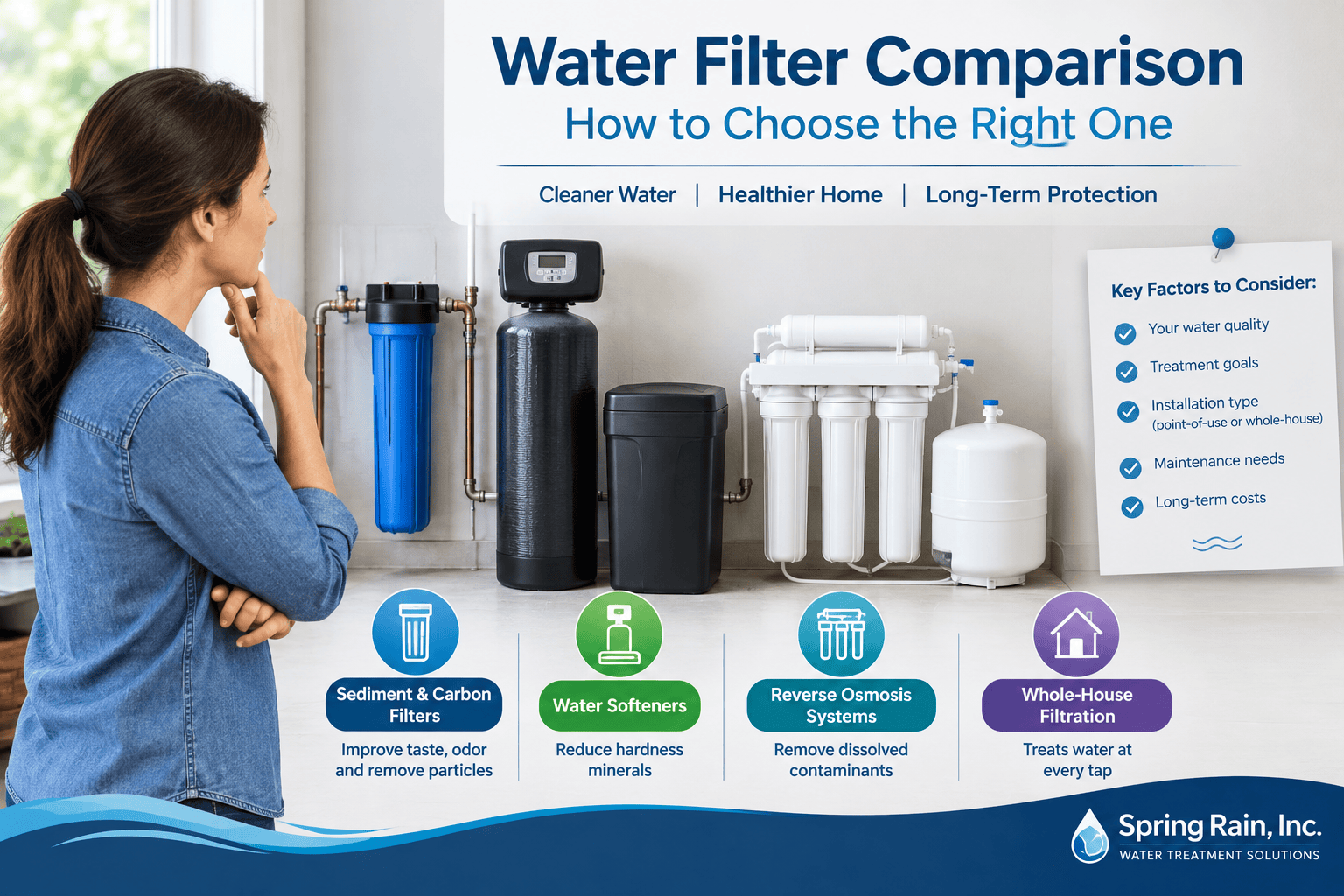
Why Is Comparing Water Filters Important?
Not all water filters perform the same function. A filter that improves the taste of tap water may not reduce hardness minerals, while a water softener designed to control scale may not remove chlorine or other unwanted substances.
Understanding these differences helps you avoid spending money on equipment that does not address your actual water quality concerns.
Different Water Problems Require Different Solutions
Before comparing systems, consider the issue you want to resolve.
- Unpleasant taste or chlorine odor: Activated carbon filtration may help improve taste and odor.
- Sediment or visible particles: A suitable sediment filter can capture suspended particles.
- Hard water and mineral scale: A conventional water softener reduces calcium and magnesium.
- Certain dissolved contaminants: Reverse osmosis or another contaminant-specific treatment may be appropriate.
- Iron, manganese, or sulfur odors: Specialized filtration or oxidation systems may be necessary.
- Microbial contamination: Appropriate disinfection, such as ultraviolet treatment in a properly designed system, may be required.
No single system removes every possible contaminant. The most suitable choice depends on your water source, test results, and the treatment performance of the specific equipment.
Water Filter Comparison: Understanding the Main Types
The easiest way to begin your comparison is to understand what each system is designed to do.
1. Activated Carbon Water Filters
Activated carbon filters are commonly used to improve the taste and odor of drinking water. They contain carbon media with a large surface area that adsorbs certain compounds as water passes through the filter.
These systems are available in pitcher filters, faucet-mounted filters, countertop units, under-sink filters, and some whole-house systems.
Best suited for:
- Reducing chlorine taste and odor when the filter is designed for that purpose.
- Improving the taste of drinking water.
- Reducing certain organic compounds covered by the product's performance claims.
Advantages:
- Available in several sizes and configurations.
- Often relatively simple to install.
- Can be convenient for drinking and cooking water.
- Replacement cartridges are available for many models.
Limitations:
- Ordinary carbon filtration does not reliably remove all dissolved minerals.
- It does not soften hard water.
- It should not be assumed to remove bacteria or every chemical contaminant.
- Filter cartridges require replacement according to the manufacturer's instructions.
Activated carbon may be a practical choice when the primary concern is taste or odor rather than a broader water quality issue.
2. Reverse Osmosis Water Filtration Systems
Reverse osmosis, commonly called RO, uses a semipermeable membrane to reduce many dissolved substances and other contaminants, depending on the system's design and performance.
Residential RO systems are often installed under the kitchen sink to provide treated water for drinking and cooking.
Best suited for:
- Reducing certain dissolved contaminants.
- Addressing specific water quality concerns supported by the system's performance data.
- Providing additional treatment at a dedicated drinking water faucet.
Advantages:
- Can reduce a broad range of dissolved substances.
- Often combines multiple stages of filtration.
- Can be useful when water testing identifies contaminants that the particular RO system is certified or documented to reduce.
Limitations:
- Requires periodic filter and membrane maintenance.
- Some systems produce wastewater during operation.
- Installation may require plumbing modifications.
- It is not automatically necessary for every household.
- Performance varies by model and the contaminants being treated.
Explore reverse osmosis systems from Spring Rain, Inc. to learn more about drinking water treatment options.
3. Whole-House Water Filtration Systems
A whole-house water filtration system is installed where water enters the home. This allows the selected treatment equipment to address its target contaminants before the water reaches different faucets and appliances.
Depending on the system, treatment may involve sediment filtration, activated carbon, oxidation, specialized filter media, or multiple stages.
Best suited for:
- Treating a specific water quality concern affecting multiple fixtures.
- Reducing sediment throughout the home.
- Addressing chlorine taste or odor across multiple water outlets when the system is designed for that purpose.
- Treating certain well water problems using appropriate equipment.
Advantages:
- Treats water supplied to multiple fixtures.
- Can protect plumbing and equipment from certain water quality problems.
- Can be customized to address identified contaminants.
- May combine several treatment stages when necessary.
Limitations:
- Usually requires more installation space than a simple drinking water filter.
- Initial costs and maintenance requirements vary considerably.
- Different filter media target different contaminants.
- Proper sizing is important to maintain adequate household water flow.
If your water quality concerns affect showers, laundry, bathroom faucets, and kitchen fixtures, a whole-house water filtration system may be worth considering.
4. Water Softeners
A water softener is different from a conventional water filter. Most salt-based residential softeners use ion exchange to reduce calcium and magnesium, the minerals primarily responsible for water hardness.
These minerals can contribute to scale buildup, spots on glassware, and soap scum.
Best suited for:
- Hard water.
- Mineral scale on plumbing fixtures.
- Hardness-related deposits in water-using appliances.
- Household problems associated with excessive calcium and magnesium.
Advantages:
- Helps control hardness throughout the home.
- Can reduce mineral scale buildup.
- May improve soap lathering and reduce soap scum.
- Can help protect certain plumbing components and appliances from hardness-related deposits.
Limitations:
- Does not automatically remove chlorine, bacteria, or other contaminants.
- Conventional salt-based systems require salt and periodic regeneration.
- Maintenance and operating costs should be considered.
- The appropriate system capacity depends on water hardness and household usage.
If hard water is your main concern, explore residential water softener systems from Spring Rain, Inc.
5. Sediment Water Filters
Sediment filters are designed to capture suspended particles such as sand, silt, rust flakes, and other physical debris.
They are often installed as a prefiltration stage to protect downstream treatment equipment.
Best suited for:
- Water containing visible particles.
- Certain well water applications.
- Reducing sediment entering plumbing and treatment equipment.
- Protecting other filtration stages from premature clogging.
Advantages:
- Relatively straightforward technology.
- Available in different filtration ratings and configurations.
- Can help protect downstream equipment.
- Useful as part of a larger treatment system.
Limitations:
- Does not generally remove dissolved minerals.
- Does not remove every chemical contaminant.
- Does not automatically make microbiologically unsafe water safe to drink.
- Filter elements need cleaning or replacement.
Sediment filtration is often one part of a larger treatment setup rather than a complete solution for every water quality problem.
6. Specialized Iron and Sulfur Treatment Systems
Some homes, particularly those using private wells, experience problems such as orange or brown staining, metallic tastes, or rotten egg odors.
These problems may be associated with iron, manganese, hydrogen sulfide, or other water chemistry conditions.
Treatment options may include oxidation and filtration, specialized media, aeration, disinfection, or a combination of technologies.
The correct method depends on the concentrations involved and the characteristics of the water.
For example, a system designed to reduce iron may not adequately address hydrogen sulfide at every concentration. Water testing is therefore important before selecting equipment.
Water Filtration System Comparison Chart
The following table summarizes the general differences between common residential water treatment options.
| System type | Primary purpose | Typical installation | Main consideration |
|---|---|---|---|
| Activated carbon filter | Reduces certain taste, odor, and chemical compounds | Pitcher, faucet, under-sink, or whole-house | Check the specific contaminant reduction claims |
| Reverse osmosis | Reduces many dissolved substances and selected contaminants | Usually under the kitchen sink | Requires membrane and filter maintenance |
| Whole-house filtration | Treats selected water quality problems throughout the home | Main incoming water line | Must be matched to the actual water chemistry |
| Water softener | Reduces calcium and magnesium hardness | Main incoming water line | Requires appropriate sizing and maintenance |
| Sediment filter | Captures suspended particles | Main line or point of use | Filter rating and replacement frequency matter |
| Iron or sulfur treatment | Addresses specific iron, manganese, or sulfur problems | Usually at the point of entry | Requires testing and appropriate treatment design |
| UV disinfection | Inactivates susceptible microorganisms | Usually at the point of entry or use | Requires suitable water clarity and ongoing maintenance |
The best option is not necessarily the system with the most treatment stages. It is the system that reliably addresses your identified water quality needs.
How to Choose a Water Filter for Your Home
Once you understand the differences between filtration technologies, you can compare your options using a few practical criteria.
Step 1: Test Your Water Quality
The first step in choosing a water filter is understanding what is actually present in your water.
If your home receives municipal water, review your water utility's available quality report and consider whether your home's plumbing could introduce additional concerns.
If you use a private well, arrange appropriate testing through a qualified laboratory. Private well owners are responsible for monitoring their water quality.
Testing can help identify concerns such as:
- Water hardness.
- Iron and manganese.
- Hydrogen sulfide or related sulfur problems.
- Bacteria and other relevant microbial indicators.
- Nitrate and other dissolved contaminants.
- Additional substances based on local conditions and potential contamination sources.
Do not choose a filtration system based on water appearance alone. Clear water can still contain dissolved contaminants that are not visible.
Step 2: Identify Your Main Treatment Goal
Think about what you want the system to accomplish.
Are you primarily trying to improve drinking water taste? Reduce mineral scale? Address a rotten egg odor? Treat sediment throughout the house?
Each objective may require a different technology.
If your water test identifies multiple concerns, you may need more than one treatment stage.
Step 3: Decide Between Point-of-Use and Whole-House Treatment
Point-of-use systems treat water at a particular outlet, such as the kitchen sink. Pitcher filters, faucet filters, and many reverse osmosis systems fall into this category.
Point-of-entry systems treat water where it enters the home, supplying treated water to multiple fixtures.
Choose the arrangement based on where treatment is needed, the water quality issue, and your household's usage.
For example, an under-sink drinking water system may be sufficient for a specific drinking water concern, while a whole-house system may be more suitable for a water quality issue affecting showers, laundry, and multiple faucets.
Step 4: Check Certifications and Performance Claims
Look beyond general marketing descriptions when comparing products.
Check whether the exact model has been independently certified or has documented performance for the specific contaminant you want to reduce.
Depending on the product and treatment purpose, relevant standards may include NSF/ANSI 42 for certain aesthetic effects, NSF/ANSI 53 for specific health-related contaminant reduction claims, NSF/ANSI 58 for reverse osmosis systems, and NSF/ANSI 44 for residential cation-exchange water softeners.
A certification does not mean that a product removes every contaminant. Review the specific reduction claims and confirm that they match your needs.
Step 5: Compare Installation and Operating Costs
The purchase price is only one part of the total cost of owning a water treatment system.
Consider the following expenses before making your decision:
- Initial equipment cost.
- Professional installation, if needed.
- Replacement cartridges or filter media.
- Reverse osmosis membrane replacement where applicable.
- Water softener salt and regeneration.
- Electricity or other operating requirements, if applicable.
- Periodic inspection and servicing.
A less expensive unit may have higher ongoing costs or may not be suitable for your water quality problem.
Step 6: Consider Maintenance Requirements
Every treatment system requires some level of maintenance to remain effective.
Before buying, check how often filters need replacement, whether the system requires backwashing, whether salt must be replenished, and whether periodic water testing is recommended.
Choose equipment that fits your maintenance preferences and the service support available to you.
Step 7: Make Sure the System Is Properly Sized
A system must be appropriate for your household's water demand.
For whole-house equipment, important considerations include the number of occupants, peak water flow, incoming water pressure, water hardness, and contaminant concentrations.
An undersized system may not provide adequate flow or treatment capacity. An unnecessarily large or complex system may increase costs without providing a meaningful benefit.
A water treatment professional can help evaluate these factors before installation.
Reverse Osmosis vs. Whole-House Filtration: Which Is Better?
Reverse osmosis and whole-house filtration serve different purposes, so neither is automatically better for every household.
Reverse osmosis is commonly used to treat drinking water at a specific faucet. Whole-house filtration is designed to address selected water quality problems throughout the property.
Consider reverse osmosis when you need additional drinking water treatment for contaminants that the chosen system is designed to reduce.
Consider whole-house filtration when an identified concern needs to be addressed at multiple fixtures.
Some households benefit from both. For example, a whole-house system may address sediment or another incoming water quality concern, while a separate reverse osmosis system provides additional drinking water treatment.
The right combination depends on your test results, treatment goals, and budget.
Water Softener vs. Water Filter: Understanding the Difference
A water softener and a water filter are often discussed together, but they do not perform the same job.
A conventional water softener reduces hardness minerals through ion exchange. A water filter uses a particular filtration medium or treatment process to reduce its target substances.
For example, a sediment filter captures particles, while an activated carbon filter can reduce certain taste and odor compounds.
If your main problem is scale buildup, a water softener may be appropriate. If you are concerned about chlorine taste, sediment, or a specific contaminant, a suitable filter may be more relevant.
If your water has multiple problems, combining different treatment technologies may be necessary.
Understanding this distinction is one of the most important parts of comparing water filtration systems.
Common Mistakes to Avoid When Choosing a Water Filter
Choosing a system without understanding its limitations can lead to unnecessary expenses or disappointing results.
Buying Equipment Without Testing the Water
A system that addresses the wrong problem will not provide the results you expect. Start with available water quality information and appropriate testing.
Assuming Every Filter Removes Every Contaminant
Filtration performance depends on the technology, product design, and specific contaminant. Always check the documented reduction claims for the exact model.
Choosing Based Only on Price
A lower purchase price does not necessarily mean lower long-term costs. Compare installation, replacement parts, maintenance, and expected operating expenses.
Ignoring Household Water Demand
A system that is too small may not meet your water usage requirements. Consider peak flow and household size when selecting whole-house equipment.
Forgetting About Maintenance
Filters and membranes can lose effectiveness when neglected. Follow the recommended replacement schedule and arrange servicing when necessary.
Installing a Drinking Water Filter for a Whole-House Problem
A filter connected to one kitchen faucet does not treat the water supplied to your other fixtures. Make sure the installation type matches the area where treatment is required.
Which Water Filtration System Is Right for Pennsylvania Homes?
Pennsylvania homes can experience different water quality conditions depending on local geology, the water source, plumbing, and nearby environmental factors.
Municipal water users may focus on taste, odor, or specific concerns related to their water supply or home plumbing. Private well owners may need to evaluate hardness, sediment, iron, manganese, sulfur odors, and microbial indicators.
There is no single water filtration system that is ideal for every home.
A useful starting point is to identify the water source, review available water quality information, and test for relevant contaminants. The results can then guide the selection of suitable treatment technologies.
Spring Rain, Inc. offers customized water treatment solutions for Pennsylvania homeowners looking to improve their household water quality.
Explore our services to learn more about:
These options can help you compare treatment approaches based on the specific concerns affecting your home.
Frequently Asked Questions About Water Filter Comparisons
What should I compare when choosing a water filter?
Compare the contaminants the system is designed to reduce, its verified performance claims, installation requirements, flow capacity, maintenance schedule, replacement costs, and suitability for your water source.
Which type of water filter is best for home use?
The best system depends on your water quality and treatment goals. Activated carbon may help with certain taste and odor concerns, reverse osmosis may reduce selected dissolved contaminants, and whole-house systems can address specific problems across multiple fixtures.
Is a whole-house water filter better than an under-sink filter?
Neither is universally better. Whole-house systems treat water entering the property, while under-sink systems treat water at a specific outlet. Your needs determine which installation type makes the most sense.
Do I need both a water softener and a water filter?
You may need both if your home has separate problems, such as hard water and a contaminant or taste concern that requires filtration. A water softener alone does not address every water quality issue.
How do I know if my water filter is working?
Follow the manufacturer's maintenance schedule, check the system's operating indicators where available, and arrange appropriate water testing when necessary. Taste and appearance alone cannot confirm that every target contaminant is being reduced.
How often should water filters be replaced?
Replacement frequency varies by filter type, model, incoming water quality, and water usage. Follow the manufacturer's instructions rather than relying on a universal replacement interval.
Make an Informed Water Filtration Choice With Spring Rain, Inc.
Comparing water filters becomes easier when you focus on your water quality rather than choosing equipment based on marketing claims alone.
Start by identifying your main concerns, reviewing available water quality information, and arranging testing where appropriate. Then compare filtration technologies, installation options, performance claims, maintenance needs, and long-term costs.
A well-matched treatment system can help address specific water quality concerns without adding unnecessary equipment or expenses.
Spring Rain, Inc. provides customized water treatment solutions for Pennsylvania homeowners, including options for whole-house filtration, water softening, and reverse osmosis.
If you are unsure which system is right for your home, visit Spring Rain, Inc. to explore available water treatment options.
The right water filter is the one that addresses your actual water quality needs.