If your home depends on a private well, you probably notice when something about your water supply feels different.
Maybe the shower pressure isn't what it used to be. Perhaps the faucet spits air before the water starts flowing. You might notice sediment in a glass, hear the well pump running longer than usual, or suddenly find that the water disappears after several people take showers.
These changes can be frustrating, but they are also useful warning signs.
A well that appears to be running dry does not always mean the groundwater is completely gone. A failing pump, pressure tank problem, clogged filter, electrical issue, or plumbing restriction can create similar symptoms.
That's why it's important to look at the entire well system before assuming the well itself has failed.
In this guide, we'll look at the most common signs your well may be running dry, explain what can cause them, and discuss practical steps you can take when your home's water supply becomes unreliable.
What Does It Mean When a Well Runs Dry?
A private well doesn't usually contain an unlimited underground reservoir of water. Instead, the well draws water from an underground formation called an aquifer.
Water enters the well as groundwater moves through the surrounding soil and rock.
Under normal conditions, the well produces enough water to meet household demand. But the water level can change due to seasonal conditions, drought, groundwater use, changes in the surrounding environment, or the natural characteristics of the well.
There is also an important difference between a temporary low-water condition and a well that consistently cannot produce enough water for the property.
A well may temporarily struggle during a period of unusually high demand and recover later. In another situation, the well may have a long-term production problem that requires a more permanent solution.
Why Would a Private Well Start Producing Less Water?
Several factors can affect well production.
Seasonal Groundwater Changes
Groundwater levels naturally change throughout the year. Extended periods with little rainfall can reduce groundwater recharge.
Drought
Long dry periods can put additional pressure on groundwater resources, particularly when multiple wells are drawing from the same general aquifer.
Increased Household Demand
A growing household, additional bathrooms, irrigation, livestock, or other new water uses can place more demand on a well than it was originally designed to handle.
Well Construction and Depth
The depth and construction of a well influence how much water it can access and how quickly groundwater enters the well.
Pump Problems
A pump that is failing or not operating correctly can make a healthy well appear to have a water shortage.
Well Screen or Formation Problems
Sediment, mineral deposits, or changes around the well can affect the rate at which groundwater enters the system.
Because several problems can produce similar symptoms, diagnosing the source is important.
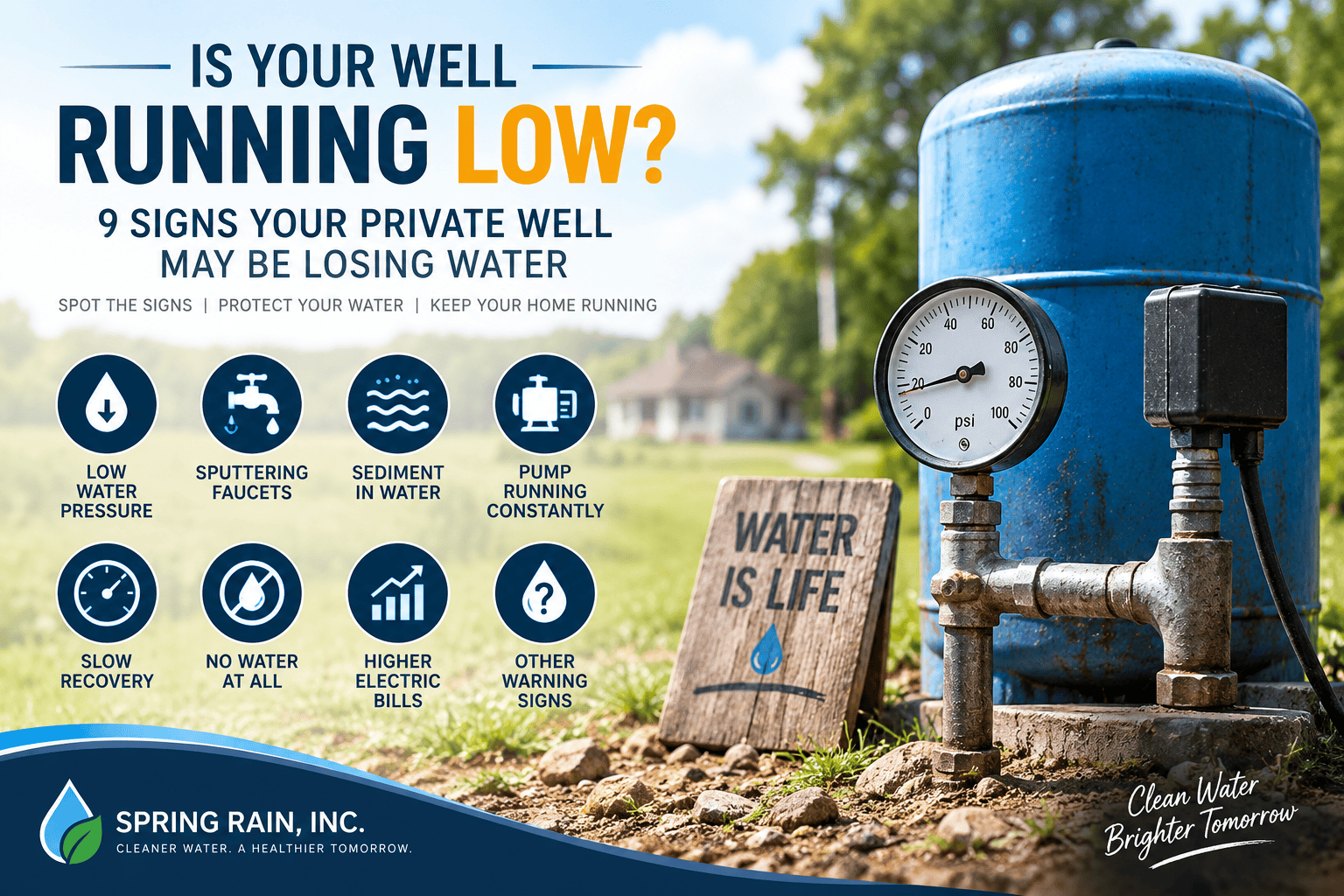
9 Signs Your Well May Be Running Dry
1. Water Pressure Drops After Extended Use
One of the first things homeowners often notice is that the water pressure becomes weaker after the system has been used for a while.
For example, the first person taking a shower may have normal pressure, but the pressure becomes noticeably weaker after several minutes. Running another faucet at the same time may make the problem even more obvious.
This can happen when the well cannot replenish water as quickly as the household is using it.
However, low pressure can also come from a failing pump, pressure tank problems, clogged filters, or plumbing restrictions.
The timing of the pressure loss is important.
If pressure is normal at first but gradually falls during heavy use and improves after the system has had time to recover, well production deserves closer attention.
2. Faucets Start Sputtering or Spitting Air
Does the faucet suddenly cough, spit, or release bursts of air?
That can happen when the water supply entering the pump system becomes inconsistent.
Air in the plumbing can have several causes, so it doesn't automatically prove that your well is dry. But when sputtering occurs together with falling pressure, sediment, or a pump that is struggling to maintain water flow, it should not be ignored.
Repeated air coming from faucets is a good reason to have the well and pump system inspected.
3. You Notice Sand or Sediment in the Water
A sudden increase in sand, grit, or sediment can be a warning that something has changed in the well system.
If the water level falls significantly, the pump may draw water from an area where more sediment is present. Problems with the well structure or pump can also contribute to sediment entering the water.
Sediment isn't something to simply filter out and forget about.
A sudden change in sediment levels can indicate that the well, pump, or water source needs attention.
If you notice cloudy water, grit, or visible particles, stop and investigate the cause rather than assuming it is harmless.
4. The Water Supply Runs Out During Heavy Use
This is one of the clearest signs of a low-yielding well.
You may have enough water for normal morning activities, but the supply becomes inadequate when several water-consuming activities happen close together.
For instance:
- Multiple showers are taken
- A washing machine is running
- The dishwasher is operating
- Outdoor water is being used
- Several faucets are open
- A large amount of water is needed at once
The issue may not be that the well is completely dry. It may simply be unable to produce water quickly enough to meet peak demand.
This distinction matters because the solution could involve changes to the well system, water storage, pump configuration, or household water use rather than immediately drilling another well.
5. The Well Takes Much Longer to Recover
Every well needs time to replenish after water is pumped out.
If your household has always been able to use water normally but the well now needs considerably more time to recover, that change is worth investigating.
You might notice that water pressure remains low for a long time after heavy use or that the system works normally again only after several hours.
A slower recovery rate can be associated with changing groundwater conditions or reduced well production.
It can also indicate that the well is being asked to supply more water than it can reliably produce.
6. The Well Pump Runs for Much Longer Than Normal
Learn what normal pump operation sounds like in your home.
If the pump previously ran for reasonable periods but now seems to operate continuously or for unusually long stretches, something may have changed.
Possible causes include:
- Reduced well water availability
- Pump wear
- Pressure tank problems
- Plumbing leaks
- Pressure control issues
- Changes in household demand
A pump running continuously should not automatically be interpreted as proof of a dry well.
The pump and water level should be evaluated together.
Running a pump without sufficient water can potentially damage the equipment, so persistent abnormal operation deserves prompt attention.
7. Your Water Pressure Changes Dramatically During the Day
A well can behave differently depending on when and how much water is being used.
You may have acceptable pressure early in the morning but experience weak pressure after several people have showered, washed clothes, or used other appliances.
If the system consistently struggles during peak demand and then improves after a long recovery period, your well's production capacity may not be keeping up with household demand.
This can be especially noticeable in larger homes where water consumption is significantly higher than when the well was originally installed.
8. You Suddenly Have No Water
No water coming from the faucets is an urgent situation, but it does not necessarily mean the well has gone completely dry.
Several problems can produce a total loss of water, including:
- A failed well pump
- Electrical problems
- Pressure switch failure
- Control box problems
- A broken water line
- A depleted well
- Severe plumbing restrictions
- Other well equipment failures
Before assuming the groundwater is gone, the entire system should be diagnosed.
If the pump is not operating, the problem could be electrical or mechanical rather than related to the groundwater level.
9. Your Well Problems Keep Returning After Heavy Water Use
One of the most useful clues is a pattern.
If your water supply repeatedly becomes weak after high demand and then returns after the well has had time to recover, the system may have a production problem.
For example, you may notice the same pattern every weekend when guests visit, during summer irrigation, or after several consecutive loads of laundry.
A recurring pattern can tell a well professional much more than a single episode of low pressure.
Keep track of when the problem occurs and how long the water takes to return to normal.
How Can You Tell if the Well Is Dry or the Pump Is Failing?
This is where many homeowners become confused.
A failing pump and a low-producing well can create surprisingly similar symptoms.
| What You Notice | Possible Explanation |
|---|---|
| No water and pump is silent | Electrical, control, pressure switch, or pump problem |
| Water becomes weak after prolonged use | Possible low well production or recovery issue |
| Pump runs continuously | Pump, pressure, leak, or water availability problem |
| Air at faucets | Possible supply or plumbing issue |
| New sediment in water | Well, pump, or groundwater condition may have changed |
| Pressure returns after hours of rest | Possible low-yield or slow-recovery well |
| Pressure is always weak | Could involve pump, tank, plumbing, filtration, or well production |
| Water stops suddenly | Could be pump failure or insufficient water |
This is why replacing a pump immediately is not always the right answer.
A pump may be perfectly capable of moving water, but there may simply not be enough water entering the well fast enough to meet demand.
Likewise, a healthy well cannot help if the pump has failed.
A professional well assessment can help separate these two problems.
What Is a Low-Yielding Well?
A low-yielding well is a well that does not produce water at a rate sufficient for the property's needs.
That does not necessarily mean the well contains no water.
A low-yielding well may produce water slowly but still provide enough for a household if water use is managed appropriately.
The challenge occurs when demand exceeds the rate at which the well can recover.
This can lead to:
- Temporary loss of water
- Long recovery periods
- Weak pressure during peak demand
- Pump cycling or extended pump operation
- Difficulty supplying multiple fixtures
- Increased dependence on water storage
A professional can evaluate the well's production and determine whether the issue is temporary or ongoing.
What Should You Do If You Think Your Well Is Running Dry?
Don't panic, and don't immediately assume that you need a new well.
Start by reducing water consumption.
Reduce Water Use
Avoid unnecessary showers, laundry, outdoor watering, and other high-volume uses until you understand what is happening.
Turn Off Irrigation
If your private well supplies lawn irrigation, temporarily stop watering the landscape.
Outdoor irrigation can consume considerably more water than typical indoor household use.
Check for Obvious Leaks
A hidden plumbing leak can cause a well pump to run more often and can make a water shortage appear worse than it really is.
Check toilets, faucets, exposed pipes, and other accessible plumbing.
Pay Attention to Recovery
After reducing water use, observe how the system behaves.
Does pressure return after several hours?
Does water availability improve overnight?
Does the problem return when normal household usage resumes?
These observations can help a professional understand the situation.
Have the Well System Evaluated
If the problem continues, professional testing is the next step.
A proper assessment may include evaluating water levels, pump operation, pressure, flow, and overall well performance.
Can a Dry or Low-Yield Well Be Fixed?
Sometimes it can.
The appropriate solution depends on why the well is producing less water.
Possible options may include:
Water Conservation
If the well is capable of producing enough water for normal household needs but struggles during peak demand, reducing unnecessary water consumption may solve the practical problem.
Storage Capacity
A properly designed storage system can provide additional water during periods when the well cannot keep up with short-term demand.
Pump or Equipment Service
If the actual problem is mechanical rather than groundwater-related, repairing or replacing the pump or controls may restore normal service.
Well Rehabilitation
In some circumstances, professional well rehabilitation may improve performance when the well has developed production-related problems.
Well Deepening
Depending on local geology and the existing well, deepening may be considered in some situations. It is not appropriate for every property.
New Well
If the existing well cannot reliably provide the necessary water supply, drilling a new well may eventually be considered.
The best solution should be based on an evaluation of the existing well rather than guesswork.
Does a Water Storage Tank Help a Low-Yield Well?
In some situations, yes.
A storage tank or cistern can provide a reserve of water that can be used during periods of high household demand.
Instead of expecting the well to supply every gallon immediately, the well can replenish the storage supply over a longer period.
This approach may be useful for properties where the well produces water slowly but consistently.
However, storage is not a universal solution.
The system needs to be properly designed based on:
- Well production
- Household demand
- Available storage
- Pump capacity
- Plumbing configuration
- Property requirements
A professional can determine whether additional storage makes sense for your situation.
Can a Dry Well Start Producing Water Again?
Yes, a well that temporarily stops producing may recover.
Groundwater conditions can change over time. A well that struggles during an unusually dry period may begin producing again after groundwater levels recover.
However, homeowners should not assume every dry well will recover on its own.
If the problem is caused by a mechanical failure, damaged well components, changes in well performance, or long-term groundwater conditions, waiting may not solve the issue.
Monitoring the water level and well performance can help determine whether the problem is temporary or persistent.
Why You Shouldn't Keep Running a Pump Without Water
A pump needs adequate water to operate properly.
If a pump continues running when the well cannot supply enough water, the equipment can be subjected to abnormal operating conditions.
Depending on the system design, this may result in overheating, premature wear, or pump damage.
If you suspect that your well has run out of water and the pump continues operating, reducing water use and contacting a qualified professional is a sensible precaution.
How Water Quality Can Change When Well Conditions Change
Water quantity isn't the only thing homeowners should watch.
Changes in well conditions can sometimes coincide with changes in water appearance or quality.
You may notice:
- More sediment
- Cloudiness
- Metallic taste
- Unusual odor
- Discoloration
- Changes in staining
These changes do not automatically mean the well is dry.
They can have many causes, including changes in groundwater chemistry, disturbed sediment, plumbing problems, or equipment issues.
If your water looks or tastes different, consider having the water tested rather than relying only on appearance.
How to Protect Your Well During Dry Periods
You cannot control rainfall or groundwater conditions, but you can reduce unnecessary stress on your private well.
Spread Out High-Water Activities
Instead of running multiple water-intensive appliances at once, spread them throughout the day.
Repair Leaking Fixtures
A dripping faucet may seem insignificant, but hidden leaks can waste considerably more water.
Reduce Outdoor Watering
Landscape irrigation can place a substantial demand on a private well during dry conditions.
Use Water-Efficient Fixtures
Low-flow showerheads, faucets, and efficient appliances can reduce household demand.
Avoid Unnecessary Water Use
Simple changes in daily habits can help a low-producing well keep up with household needs.
Monitor Your Well
Knowing how your well normally behaves makes unusual changes easier to identify.
When Should You Call a Well Professional?
Contact a qualified well professional if:
- Your home repeatedly loses water
- Water pressure drops after normal household use
- The pump runs continuously
- You hear unusual pump noises
- Faucets repeatedly sputter air
- You notice new sediment
- The well takes much longer to recover
- You suspect the pump is not working correctly
- Water problems continue after reducing consumption
- You are considering deepening or replacing the well
Prompt diagnosis can help determine whether you're dealing with a water-level issue, pump failure, pressure problem, or another system condition.
What Information Should You Give the Technician?
Before the inspection, write down what you've noticed.
Useful information includes:
- When the problem started
- Whether the issue is constant or intermittent
- How long the water lasts
- What activities cause the pressure to drop
- How long it takes for water to return
- Whether the pump is running continuously
- Whether you see air or sediment
- Whether the problem occurs more often during certain seasons
- Any recent changes in household water use
These details can make troubleshooting much more efficient.
Final Thoughts
A private well rarely gives homeowners a convenient warning that says, "I'm running out of water."
Instead, the clues tend to appear gradually.
Pressure may become weaker after heavy use. Faucets may sputter. Sediment may appear. The pump may run longer. The well may take more time to recover. Eventually, the water supply may disappear altogether.
The important thing is not to assume that every one of these symptoms means the well itself has gone dry.
A well pump problem, pressure tank issue, plumbing restriction, electrical failure, or filtration problem can create similar symptoms. Finding the actual cause is the first step toward choosing the right solution.
Spring Rain, Inc. helps homeowners address private well water and water treatment concerns with solutions tailored to the property and its water needs. If your well is struggling to keep up with household demand, getting the system evaluated early can help you understand whether the problem involves water availability, equipment performance, water quality, or a combination of factors.
FAQs About Wells Running Dry
How can I tell if my well is running dry?
Common clues include water pressure that drops after extended use, faucets sputtering air, new sediment in the water, unusually long pump operation, slow well recovery, and repeated loss of water during periods of high demand. These symptoms can also have mechanical causes, so professional testing is needed to confirm a low-water condition.
Can a well run dry temporarily?
Yes. A well may temporarily produce less water during periods of drought, reduced groundwater recharge, or unusually high demand. In some cases, the water level recovers after the well has had enough time to replenish.
Does low water pressure mean my well is dry?
Not necessarily. Low pressure can be caused by a failing pump, pressure tank problems, clogged filters, plumbing restrictions, pressure controls, or a low-producing well. The complete system should be checked before concluding that groundwater is the problem.
Why is my well pump running continuously?
Continuous pump operation can have several causes. The well may not be supplying enough water, the pump may be failing, there may be a leak, or the pressure system may not be operating correctly. Running the pump continuously without adequate water can damage equipment, so the cause should be investigated promptly.
What does sputtering water mean on a private well?
Sputtering can indicate air entering the water system, but it does not automatically mean the well is dry. If sputtering occurs together with low pressure, sediment, or recurring water loss, the well and pump system should be inspected.
Can a low-yielding well be improved?
In some cases, yes. Depending on the cause, solutions may include water conservation, additional storage, equipment changes, well rehabilitation, or other well modifications. The appropriate option depends on the well's construction, production, groundwater conditions, and household demand.
Should I stop using water if I think my well is dry?
Reducing water use is a sensible first step, particularly if the pump is struggling or the home is experiencing intermittent water loss. Avoid high-volume activities until the system can be evaluated.
Can drilling a deeper well solve a dry-well problem?
It can be an option in some situations, but drilling deeper does not guarantee a better water supply. Local geology, groundwater conditions, existing well construction, regulations, and expected well yield all need to be considered before making that decision.
Would a cistern help if my well doesn't produce enough water?
A properly designed storage system may help a low-producing well meet short periods of higher household demand. The storage capacity and system design should be based on the well's production rate and the property's water requirements.
Why does my well work in the morning but lose pressure later?
If the well has time to recover overnight, it may provide adequate water in the morning but struggle after several hours of household use. This pattern can be associated with a low-yielding or slow-recovery well, although equipment problems can produce similar behavior.
Can a dry well damage the pump?
Operating a pump without an adequate water supply can create abnormal operating conditions and may lead to equipment damage. If you suspect the well has insufficient water, reducing water use and having the system checked is recommended.
Does a dry well affect water quality?
Changes in well conditions can sometimes coincide with changes in water appearance or sediment levels, but a change in water quality does not prove that the well is running dry. Water should be tested if you notice unusual taste, odor, cloudiness, discoloration, or sediment.
How often should a private well be inspected?
There is no single inspection schedule that fits every property. Homes with older wells, recurring water problems, changing water pressure, or unusual water quality may benefit from more frequent evaluation. Routine maintenance and water testing can help identify developing problems before they become major failures.