If you rely on a private well for your home's water supply, you probably expect the water to come out when you turn on the faucet without giving much thought to what happens behind the scenes.
A pressure tank is one of the components that helps make that possible.
The tank works with your well pump and pressure switch to provide water pressure throughout the house while reducing how often the pump needs to start. When everything is operating correctly, the system is easy to overlook.
But when the pressure tank begins having problems, the changes can be noticeable.
You may suddenly experience weak showers, water pressure that rises and falls, a pump that starts repeatedly, strange sounds near the well equipment, or even water around the tank.
These symptoms should not automatically be blamed on the pressure tank. A well pump, pressure switch, clogged filter, plumbing restriction, or water supply issue can produce similar problems.
Understanding the warning signs can help you know when your well pressure tank deserves professional attention.
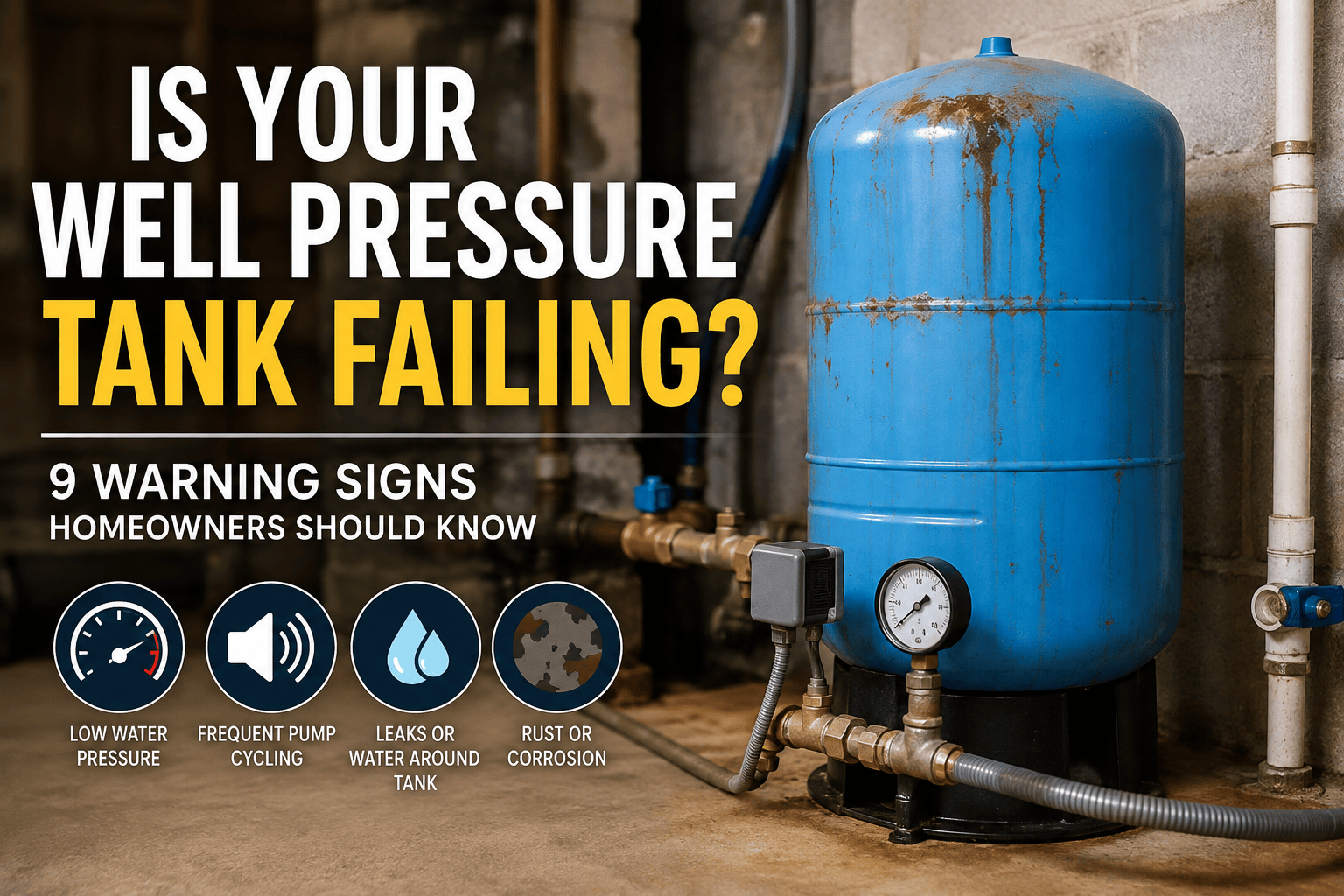
What Is a Well Pressure Tank and Why Is It Important?
A well pressure tank is designed to store pressurized water and work alongside the well pump.
When water is needed inside the home, the pressure tank can supply some of that water without requiring the pump to start immediately. As pressure falls, the pressure switch activates the pump. The pump then sends more water into the system until the pressure reaches its upper operating point.
This cycle allows the pump to operate less frequently than it would if it had to respond to every small water demand.
A properly functioning tank can help:
- Maintain more consistent household water pressure
- Reduce unnecessary pump starts
- Decrease wear on the well pump
- Provide a reserve of pressurized water
- Support proper operation of the pressure switch
- Improve the overall performance of the private well system
The pressure tank is therefore not simply a storage container. It is an important part of the system that controls how your home's well equipment responds to water demand.
How Does a Well Pressure Tank Work?
Many residential systems use a bladder or diaphragm tank.
The tank contains both water and compressed air, separated by an internal flexible barrier. When the pump fills the tank with water, the air becomes compressed. That stored energy helps push water into the home's plumbing when a faucet, shower, toilet, or appliance requires it.
The pressure switch monitors system pressure and tells the pump when to start and stop.
The exact settings depend on the individual well system. Tank size, pump capacity, household demand, plumbing, and pressure settings all need to work together.
That is why changing pressure settings without understanding the entire system can sometimes create additional problems.
9 Warning Signs Your Well Pressure Tank May Be in Trouble
1. Your Shower Pressure Keeps Changing
One of the easiest signs to notice is water pressure that cannot seem to settle down.
You may start a shower with strong water flow, only to feel it weaken a few moments later. The pressure may then increase again as the pump cycles.
This can happen for several reasons, including a pressure tank that is not maintaining the proper air cushion.
However, fluctuating pressure can also result from a weak pump, clogged filtration, pressure switch problems, plumbing restrictions, or insufficient well production.
If the entire home experiences the same pressure changes, the issue deserves a closer look.
2. Your Well Pump Starts More Often Than It Used To
Pay attention to how often you hear your well pump running.
If the pump seems to start every time someone uses a small amount of water, the pressure tank may not be providing the amount of usable storage it should.
This condition can contribute to well pump short cycling, where the pump repeatedly starts and stops within a short period.
Frequent cycling isn't something homeowners should ignore. Repeated motor starts can place additional stress on the pump and electrical controls.
3. The Pump Turns On and Off Within a Short Period
Short cycling is more than an annoying sound.
A pump that runs for a short time, shuts down, and then starts again shortly afterward may indicate a pressure tank issue, incorrect tank air charge, pressure switch problem, or another system fault.
For example, if a pressure tank has lost much of its usable air cushion, there may be less stored water available between pump cycles.
If you notice a pattern of rapid cycling, the system should be evaluated before assuming the pump itself needs to be replaced.
4. Your Home Has Persistent Low Water Pressure
Low water pressure is one of the most common complaints associated with private wells.
But the pressure tank is only one possible cause.
Whole-house low pressure may also be related to:
- A failing well pump
- A clogged sediment filter
- Mineral buildup
- A restricted pipe
- Pressure switch problems
- Low well yield
- Water treatment equipment
- An improperly configured system
A pressure tank inspection should therefore be part of a broader diagnosis rather than an automatic replacement recommendation.
If pressure is strong at certain times and weak at others, that information can also help a technician determine what is happening.
5. The Tank Has Visible Rust or Corrosion
Take a look at the outside of your pressure tank occasionally.
Surface discoloration does not automatically mean the tank has failed, but significant rust, corrosion, bubbling paint, or deterioration deserves attention.
A pressure tank operates under pressure. If the tank body has become severely compromised, continuing to use it can create a serious equipment and water-damage concern.
A tank with significant structural corrosion may be better suited for replacement than repair.
6. You Notice Water Around the Tank
Water around the pressure tank should never simply be dismissed.
The moisture could be coming from a pipe connection, valve, fitting, drain, or another nearby component. But if the tank itself is leaking, the situation is more serious.
A leaking tank may indicate corrosion or structural failure.
Before assuming the entire tank needs replacement, the source of the water should be identified. A professional can determine whether the problem is with the tank itself or with a connected component.
7. The Pressure Switch Keeps Clicking
A pressure switch normally clicks when it activates or deactivates the well pump.
Repeated rapid clicking is different.
If you hear clicking several times in a short period, the system may be experiencing excessive cycling or unstable pressure.
Possible causes include:
- Pressure tank problems
- Incorrect pressure settings
- Pressure switch failure
- Pump problems
- Electrical issues
- Water flow restrictions
The pressure switch should not be adjusted simply because it is clicking. The cause of the cycling should be identified first.
8. Water Comes Out of the Tank's Air Valve
This is an important warning sign for bladder-style pressure tanks.
The air valve is intended to provide access to the tank's air side. If water comes out where only air should be present, the internal bladder or diaphragm may have failed.
When the internal barrier is damaged, the tank cannot operate as intended.
In this situation, pressure tank replacement is often more practical than attempting to restore the failed internal component.
9. Your Water System Behaves Differently When Demand Increases
Does the water pressure remain acceptable when one faucet is running but drop sharply when someone starts the washing machine or takes a shower?
That change can reveal a problem with the capacity or performance of the well system.
The pressure tank may be undersized, the pump may not be producing enough flow, the well may have limited yield, or a filter or treatment system may be restricting water movement.
A professional can measure the system's pressure and flow to determine whether the problem is related to the tank or another part of the well system.
What Causes a Well Pressure Tank to Fail?
There isn't one single reason that pressure tanks stop working properly.
1. Normal Wear
Pressure tanks operate every time water is used. Components inside the tank can eventually wear out.
2. Bladder or Diaphragm Damage
The internal bladder separates water from compressed air. If it ruptures or deteriorates, the tank can lose its ability to maintain the proper pressure balance.
3. Incorrect Air Charge
A pressure tank needs an appropriate air charge for the system's operating pressure. An incorrect charge can contribute to poor performance and frequent cycling.
4. Corrosion
Water chemistry and environmental conditions can contribute to corrosion of the tank and connected plumbing.
5. Improper Tank Sizing
A tank that is too small for the home's demand may result in more frequent pump operation.
6. Pressure Switch Problems
A malfunctioning pressure switch can cause abnormal pump operation even when the pressure tank itself is still usable.
7. Pump Problems
A pump that is worn, damaged, or incorrectly sized can create pressure symptoms that look like a tank failure.
8. Plumbing or Filtration Restrictions
Sediment, mineral deposits, clogged filters, or restricted plumbing can limit flow and create low-pressure complaints.
Is Your Pressure Tank Waterlogged?
The term waterlogged pressure tank is often used when the tank has lost the air cushion needed for proper operation.
A waterlogged or improperly charged tank may be associated with:
- Frequent pump starts
- Rapid cycling
- Unstable pressure
- Reduced usable water storage
- Faster pressure drops
- Longer or unusual pump operation
However, not every pressure problem means the tank is waterlogged.
Modern bladder tanks behave differently from older conventional tanks, and the correct troubleshooting method depends on the type of equipment installed.
If you suspect your tank is waterlogged, having the system tested is safer than repeatedly adjusting valves or pressure controls yourself.
Pressure Tank Repair or Replacement: Which One Do You Need?
Whether a pressure tank can be repaired depends on what has actually failed.
A Repair May Be Possible When:
- The tank air pressure needs correction
- A pressure gauge is faulty
- A pressure switch has failed
- A fitting is leaking
- A valve needs replacement
- A plumbing connection has loosened
- Another external control component is malfunctioning
In these situations, replacing the entire tank may not be necessary.
Replacement May Be the Better Choice When:
- The tank body is leaking
- Severe corrosion is present
- The internal bladder has failed
- Water comes from the air valve
- The tank repeatedly loses pressure
- The tank is incorrectly sized
- The tank has reached the end of its useful service life
- Previous repairs have not resolved the problem
The right decision depends on the condition of the tank and the rest of the well system.
How a Bad Pressure Tank Can Affect Your Well Pump
The relationship between the pressure tank and well pump is important.
If the tank cannot provide adequate pressure storage, the pump may have to start more frequently.
Every motor start creates additional mechanical and electrical stress. Over time, excessive cycling can contribute to premature wear.
This is why homeowners should not treat short cycling as simply an irritating noise.
If your pump has recently started cycling much more often than normal, identifying the cause early may help prevent a more expensive pump problem later.
Does a Bigger Pressure Tank Improve Water Pressure?
Not necessarily.
A larger tank can provide more usable water storage and potentially reduce how frequently the pump cycles, but it does not automatically make the pump produce higher pressure.
Actual household pressure depends on several factors, including:
- Well pump performance
- Pressure switch settings
- Tank configuration
- Well production
- Plumbing size
- Filtration equipment
- Water treatment equipment
- Household demand
Choosing a replacement tank should therefore be based on the complete system rather than simply selecting the largest available tank.
How Water Quality Can Contribute to Well System Problems
Your pressure tank does not remove contaminants from your water, but water quality can influence the equipment connected to your well system.
Depending on the property and local groundwater conditions, private wells may experience problems associated with:
- Hard water
- Iron
- Manganese
- Sediment
- Acidic water
- Mineral buildup
- Corrosion
These conditions can affect pipes, filters, fixtures, water heaters, and treatment equipment.
For example, sediment buildup in a filter can restrict water flow and make a homeowner think the well pump or pressure tank is failing.
If pressure problems occur at the same time as staining, unusual taste, odor, cloudy water, or sediment, testing the water may be just as important as inspecting the pressure equipment.
What Should a Technician Check During a Pressure Tank Inspection?
A proper well pressure tank inspection should not stop at looking at the outside of the tank.
Depending on the symptoms, a professional may evaluate:
- Tank condition
- Tank air pressure
- Bladder or diaphragm condition
- Pressure switch
- Pressure gauge
- Pump operation
- Pump cycling frequency
- Electrical controls
- Plumbing connections
- Tank sizing
- Water flow
- Filtration equipment
- Water treatment equipment
- Well production
This approach helps determine whether the pressure tank is actually responsible for the problem.
It can also prevent unnecessary replacement of expensive well equipment.
How to Prevent Pressure Tank Problems
You cannot prevent every pressure tank failure, but regular attention to the well system can help identify problems earlier.
Pay Attention to Changes
If water pressure suddenly feels different, don't assume it will correct itself.
Watch for Pump Cycling
Learn what normal pump operation sounds like in your home. A noticeable increase in cycling is worth investigating.
Look for Leaks
Occasionally inspect the tank and surrounding connections for moisture or corrosion.
Maintain Filtration Equipment
A clogged filter can restrict flow and place additional strain on the system.
Test Your Well Water
Regular water testing can identify water quality problems that may affect plumbing and treatment equipment.
Schedule Professional Inspections
Routine evaluation can identify developing problems before they turn into an emergency.
When Should You Call a Professional?
You should consider professional service if:
- Your pump is rapidly cycling
- Household water pressure is consistently low
- Pressure repeatedly rises and falls
- Your tank is leaking
- The tank has significant corrosion
- Water comes from the air valve
- You hear unusual sounds from the pressure equipment
- The pressure switch repeatedly clicks
- The pump seems to run much more often
- You have recurring well system problems
Professional diagnosis is especially important when electrical components or pressurized equipment are involved.
What Homeowners Should Know Before Replacing a Pressure Tank
Before purchasing a replacement, gather as much information about your existing system as possible.
Useful information includes:
- Existing tank size
- Pump type
- Pump capacity
- Current pressure settings
- Household size
- Number of bathrooms
- Typical water usage
- Water treatment equipment
- Previous pressure problems
- Age of the existing tank
This information can help determine whether the replacement should simply match the old tank or whether the system would benefit from a different configuration.
Replacing a tank with another tank of the wrong size may leave the underlying cycling or pressure problem unresolved.
Final Thoughts: Don't Ignore Changes in Your Well Water Pressure
A pressure tank may not receive much attention when everything is working properly, but it plays an important role in a private well system.
Changing water pressure, frequent pump cycling, clicking pressure controls, leaks, corrosion, and water from the tank's air valve are all signs that something deserves investigation.
The key is to identify the actual cause before deciding whether you need a well pressure tank repair, pressure tank replacement, pump service, filtration work, or another solution.
Spring Rain, Inc. helps homeowners evaluate their water systems and find practical water treatment solutions based on the needs of their property. If your home has inconsistent well pressure, frequent pump cycling, or other private well concerns, a professional evaluation can help determine what is happening and what should be done next.
Frequently Asked Questions About Well Pressure Tanks
How do I know if my well pressure tank is going bad?
Common warning signs include fluctuating water pressure, frequent pump cycling, repeated clicking from the pressure switch, leaks, corrosion, and water coming from the tank's air valve. These symptoms can also be caused by other well system components, so proper diagnosis is important.
What happens when a well pressure tank fails?
A failed tank may cause unstable water pressure and make the well pump start more frequently. Depending on the type of failure, you may also notice leaks, loss of air pressure, short cycling, or water coming from the air valve.
How often should a pressure tank be replaced?
There is no universal replacement schedule that applies to every pressure tank. Service life depends on equipment quality, system design, water conditions, installation, and usage. A tank showing structural damage or repeated performance problems may need replacement regardless of its age.
Why does my well pump keep cycling?
Frequent pump cycling can be caused by a pressure tank that has lost its proper air cushion, a failed bladder, incorrect pressure settings, a faulty pressure switch, pump problems, or another restriction in the water system. The cause should be identified before replacing equipment.
Can a pressure tank cause low water pressure?
It can contribute to pressure problems, but it is not the only possible cause. Low pressure may also come from the pump, pressure switch, clogged filters, plumbing restrictions, low well yield, or water treatment equipment.
Can I replace a well pressure tank myself?
Pressure tanks are part of a pressurized water system, and the installation may also involve electrical controls and pump equipment. While some homeowners may have the technical ability to perform certain maintenance tasks, professional installation is generally the safer approach, particularly when diagnosing the underlying problem.
What does water coming from the pressure tank air valve mean?
Water coming from the air valve on a bladder-style pressure tank can indicate that the internal bladder or diaphragm has failed. When this occurs, the tank often needs to be replaced.
Does a pressure tank improve water pressure?
A pressure tank helps maintain the pressure behavior of the well system, but it does not independently create water pressure. The pump, pressure controls, well yield, tank, plumbing, and other equipment all contribute to the pressure available inside the home.
Should I replace the pump if my pressure tank is bad?
Not necessarily. A pressure tank problem does not automatically mean the well pump needs replacement. The pump should be tested separately. If the pump is operating properly, replacing only the failed tank may be sufficient.
Why is my water pressure fine sometimes and weak at other times?
Intermittent pressure problems can have several causes. A pressure tank issue, pump performance problem, pressure switch malfunction, clogged filter, low well production, or high household demand can all contribute. Tracking when the pressure changes can provide useful information for diagnosis.
Can hard water damage a pressure tank?
Hard water itself does not necessarily mean a pressure tank will fail, but water chemistry can affect the broader plumbing and water system. Mineral deposits, corrosion, sediment, iron, and other water quality issues can contribute to restrictions and equipment problems.
What is the difference between a pressure tank and a water softener?
A pressure tank is part of the well water delivery system. It stores pressurized water and helps control pump cycling. A water softener is a water treatment device designed primarily to reduce hardness minerals. They perform completely different functions, although both may be installed as part of a private well water system.