Water is something we use every day without giving it much thought. We drink it, cook with it, shower in it, wash our clothes with it, and use it for countless household tasks.
If you get your water from a municipal supply, you may occasionally notice a chlorine-like smell or taste coming from your faucet. That can naturally lead to an important question: Is chlorine in drinking water safe?
The answer isn't as simple as saying chlorine is either "good" or "bad." Chlorine plays an important role in public water treatment because it helps control harmful microorganisms. At the same time, some homeowners don't like the taste or odor it can give their water.
There are also chemical compounds that can form when disinfectants interact with naturally occurring organic matter in water. Understanding the difference between chlorine itself, disinfectant byproducts, and overall water quality can help you make better decisions about water treatment.
If you're unhappy with the taste, smell, or quality of your tap water, there are treatment options that can help.
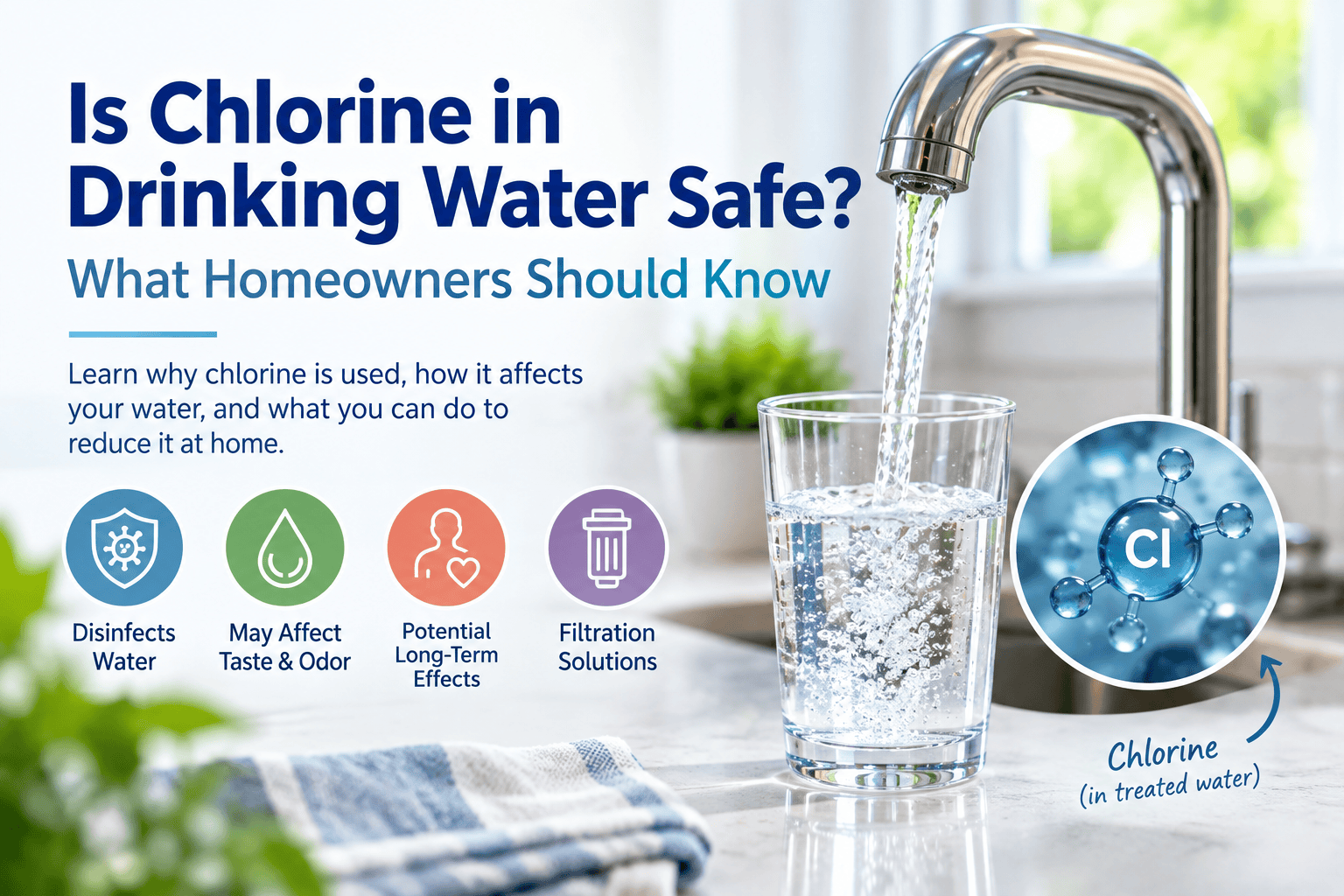
Why Is Chlorine Added to Drinking Water?
Chlorine is commonly used to disinfect public drinking water.
Before treated water reaches your home, it travels through a distribution system that can include treatment facilities, storage tanks, and miles of pipes. Disinfection helps control microorganisms that could otherwise make people sick.
This is one of the main reasons chlorine has become such an important part of municipal water treatment.
Chlorine Helps Control Microorganisms
Untreated water can contain microorganisms that aren't suitable for drinking.
A properly managed disinfection process helps reduce these microorganisms before water reaches consumers.
Why Does Chlorinated Water Have a Strong Smell?
If you've ever filled a glass from the kitchen faucet and noticed a swimming-pool-like smell, chlorine may be responsible.
The noticeable odor doesn't necessarily mean that something has gone wrong with your water supply.
The smell can vary depending on the disinfectant used, water chemistry, and the amount of disinfectant remaining in the water when it reaches your home.
Is Chlorine in Drinking Water Dangerous?
For municipal drinking water, chlorine is used at controlled concentrations for disinfection.
That means the presence of chlorine in your tap water does not automatically mean your water is dangerous to drink.
However, homeowners may still choose to reduce chlorine because of taste, odor, showering preferences, or concerns about disinfection byproducts.
It's also important to understand that chlorine and chlorination byproducts are not the same thing.
Chlorine and Chlorination Byproducts Are Different
When disinfectants interact with naturally occurring organic material in water, chemical compounds called disinfection byproducts can form.
The exact compounds and concentrations depend on several factors, including the source water and treatment process.
Why Water Chemistry Matters
Water isn't simply H₂O.
It contains naturally occurring minerals and other substances, and its chemistry can change depending on the source and treatment process.
That's why two homes in different locations can have noticeably different water even when both receive municipal water.
What Does Chlorine Do to the Taste and Smell of Water?
For many homeowners, taste and odor are the biggest complaints about chlorinated water.
You may notice a distinct smell when you fill a glass, run the kitchen faucet, or take a shower.
Chlorine Taste in Drinking Water
Some people describe chlorinated tap water as having a chemical, medicinal, or swimming-pool-like taste.
Even when the water meets applicable treatment requirements, an unpleasant taste can make people less interested in drinking it.
Chlorine Odor During Showers
You may notice the smell even more strongly while taking a hot shower.
Warm water can make certain volatile compounds more noticeable in the air around the shower.
If the smell bothers you, reducing chlorine at the point where water enters your home can make a noticeable difference in how the water smells.
Can Chlorine Affect Your Skin and Hair?
Chlorinated water can be an annoyance for people who are sensitive to changes in water chemistry.
Some homeowners report that their skin feels dry or their hair feels different after regularly showering in treated water.
However, skin and hair reactions can have many possible causes, including soaps, shampoos, water temperature, weather, and existing skin conditions.
Why Does Skin Sometimes Feel Dry After Showering?
A long, hot shower can remove natural oils from the skin regardless of whether chlorine is present.
Chlorinated water may contribute to the overall experience for some people, particularly when combined with other factors.
Consider Your Entire Water Environment
If you're experiencing persistent skin irritation, don't automatically assume chlorine is the cause.
Consider:
- Shower temperature
- Shower duration
- Soap and body wash
- Laundry detergent
- Indoor humidity
- Water hardness
- Chlorine levels
- Other water-quality characteristics
Water Hardness Can Add Another Layer
Homes with hard water may experience mineral residue and soap-related problems at the same time as chlorine concerns.
If you're dealing with several water-quality issues, treating only chlorine may not solve everything.
Test Before Choosing a System
A water test can help determine which treatment approach makes sense for your home.
How Can You Reduce Chlorine in Your Home's Water?
If your main concern is chlorine taste or odor, filtration can be an effective approach.
Different systems are designed for different purposes, so selecting the right option depends on whether you want to treat drinking water or the entire home's water supply.
Activated Carbon Filtration
Activated carbon is commonly used to reduce chlorine from water.
Carbon works by attracting and retaining certain compounds as water passes through the filter.
It can be incorporated into several types of residential water treatment systems.
Whole-House Carbon Filtration
A whole-house carbon filtration system treats water before it reaches individual fixtures throughout the home.
This means treated water can be available at:
- Kitchen faucets
- Bathroom sinks
- Showers
- Bathtubs
- Washing machines
- Other household fixtures
This type of setup may be useful when chlorine taste and odor are concerns throughout the entire house.
Drinking Water Filtration
If your main concern is the water you drink and cook with, you may not need to treat every gallon entering the home.
A dedicated drinking-water filtration system can provide treated water at a kitchen faucet or another selected point.
Whole-House Filtration vs. Drinking Water Filtration
The right approach depends on what you want to accomplish.
Choose Whole-House Treatment When:
You may consider whole-house filtration if you want to reduce chlorine throughout the home rather than only at one drinking-water faucet.
This can be particularly useful when you notice chlorine odor while showering or when several household fixtures have the same water characteristics.
Choose Drinking Water Treatment When:
A point-of-use system may be more appropriate when your primary goal is improving the taste and quality of water used for:
- Drinking
- Cooking
- Coffee
- Tea
- Food preparation
You May Need More Than Carbon
Carbon is useful for chlorine reduction, but it isn't designed to solve every water-quality problem.
If your water also contains hardness, iron, manganese, sediment, or other concerns, you may need a combination of treatment technologies.
This is why testing the water before purchasing equipment is so important.
What About Chlorine and Private Well Water?
Private wells are different from municipal water supplies.
Most private wells don't receive the same centralized disinfection process used by public water systems.
That doesn't mean well water is automatically safe or unsafe.
Instead, private-well owners are responsible for understanding and monitoring the quality of their own water.
Well Water Should Be Tested Regularly
If you have a private well, testing can help identify changes in water quality and determine whether treatment is necessary.
A well-water evaluation may consider several characteristics rather than focusing on chlorine alone.
Common Well-Water Concerns
Depending on the property, homeowners may encounter issues involving:
- Hard water
- Iron
- Manganese
- Sediment
- Unpleasant odors
- pH
- Bacteria
- Other water-quality concerns
A treatment system should be selected according to the results rather than based on a single symptom.
How to Choose a Chlorine Water Filter
Buying the first filter you see isn't always the best approach.
Before choosing a system, think about what you actually want to improve.
Determine Your Main Water Concern
Are you primarily dealing with:
- Chlorine taste?
- Chlorine odor?
- Whole-house water concerns?
- Drinking-water quality?
- Hardness?
- Multiple water-quality problems?
Your answer can help narrow down the appropriate treatment technology.
Consider Your Water Usage
A household of two people may have very different water requirements from a household of six.
The treatment system should be capable of handling your home's typical water demand.
Consider Whole-House Flow
If you're installing a whole-house system, the equipment needs to accommodate the home's water flow requirements.
A system that is too restrictive or incorrectly sized may not provide the experience you expect.
Look at Maintenance Requirements
Every treatment system requires some form of maintenance.
Before purchasing equipment, understand:
- Filter replacement requirements
- System cleaning
- Expected service intervals
- Operating costs
- Installation requirements
Knowing these details ahead of time can prevent unpleasant surprises later.
Can Spring Rain, Inc. Help With Chlorine and Water Treatment?
Yes. Spring Rain, Inc. provides customized water treatment solutions designed around the specific water-quality needs of homes and businesses.
If chlorine taste or odor is bothering you, the first step should be understanding your water and determining what you actually need to treat.
Depending on your water conditions, a treatment solution may involve carbon filtration, drinking-water filtration, water softening, or a combination of technologies.
The goal isn't simply to install a filter.
The goal is to select a treatment system that makes sense for your home's water source, water chemistry, and daily usage.
Final Thoughts on Chlorine in Drinking Water
Chlorine has an important job in public water treatment: helping control microorganisms and protect drinking-water supplies.
At the same time, homeowners may dislike the taste or smell of chlorinated water, and some may prefer to reduce chlorine for their drinking, bathing, or whole-house water.
The important thing is not to assume that every water problem is caused by chlorine.
If you're noticing a strong chlorine smell, unusual taste, mineral deposits, dry-feeling skin, or other water-quality concerns, testing can help identify what's really happening.
Once you understand your water, you can choose a treatment approach that fits your home instead of relying on guesswork.
Spring Rain, Inc. can help homeowners explore practical water treatment options designed around their individual water-quality needs.
Frequently Asked Questions About Chlorine in Drinking Water
Is chlorine in tap water safe?
Municipal water systems use controlled amounts of disinfectants to help protect drinking water from harmful microorganisms. The presence of chlorine alone does not mean tap water is unsafe.
Why does my tap water smell like chlorine?
A noticeable chlorine smell can occur because disinfectant remains in the water after treatment. The intensity of the smell can vary depending on water chemistry, treatment practices, and other factors.
Can I remove chlorine from drinking water?
Yes. Activated carbon filtration is commonly used to reduce chlorine taste and odor in residential drinking water.
Does boiling water remove chlorine?
Boiling can reduce certain volatile compounds, including some chlorine, but it isn't a complete solution for every water-quality problem. If you want consistent chlorine reduction, an appropriate filtration system may be more practical.
Does a water filter remove chlorine?
Some water filters are specifically designed to reduce chlorine, while others are designed for different contaminants. Check the filtration technology and manufacturer's specifications before choosing a system.
Can chlorine make water taste bad?
Yes. Chlorine can give water a noticeable chemical or swimming-pool-like taste or smell, even when the water is being properly disinfected.
Should I install a whole-house chlorine filter?
It depends on your goals. If you want to reduce chlorine throughout showers, sinks, laundry, and other fixtures, whole-house treatment may be worth considering. If your main concern is drinking water, a point-of-use system may be sufficient.
What is the best way to remove chlorine from home water?
The appropriate solution depends on your water source, chlorine level, household water usage, and other water-quality concerns. Testing your water first can help you select the right treatment approach.