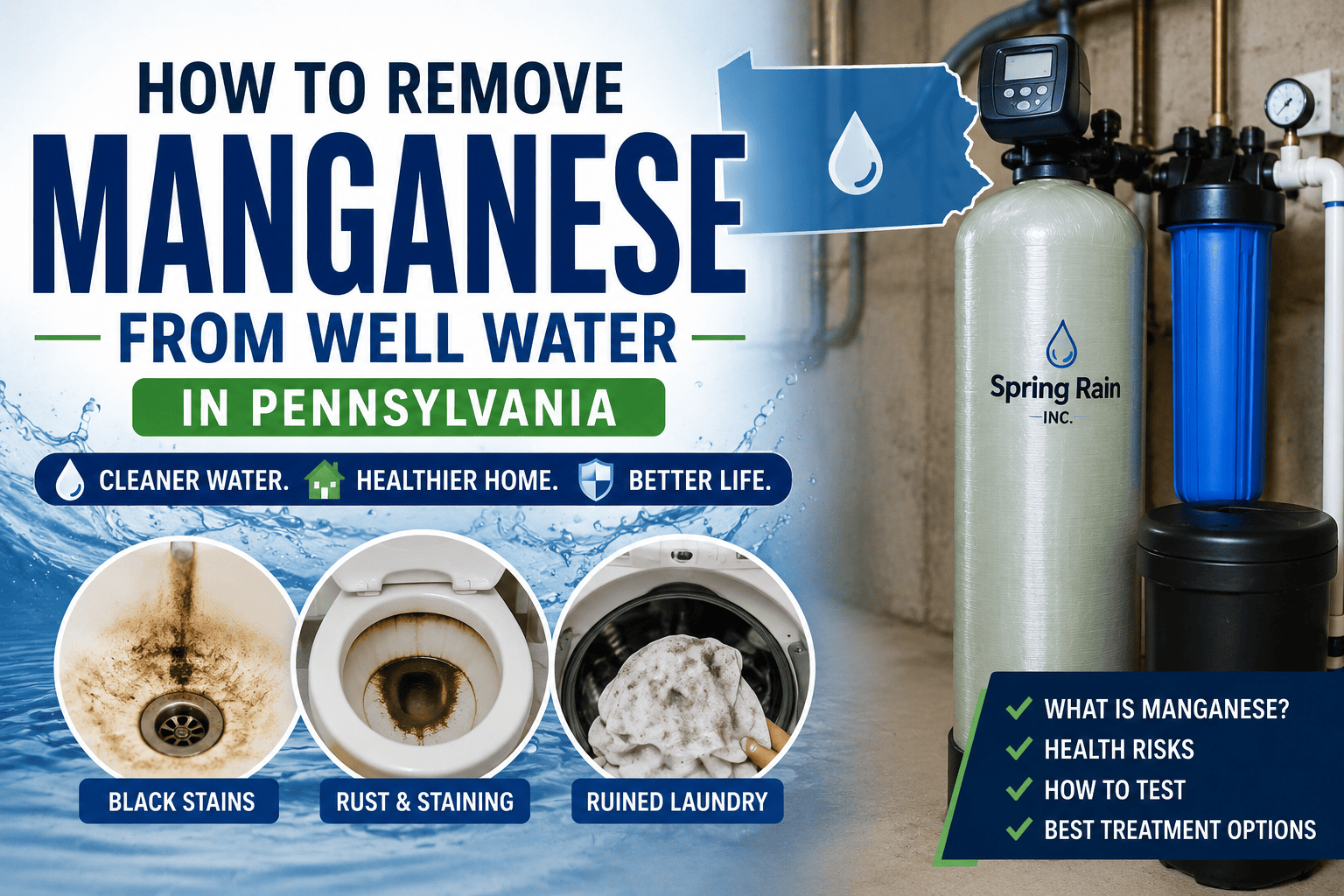
If your well water leaves black stains on toilets, sinks, bathtubs, laundry, or appliances, manganese may be the hidden problem.
Many Pennsylvania homeowners assume these stains are caused by hard water or iron. While those issues are common, manganese is another naturally occurring mineral that can create serious staining, unpleasant water quality, and long-term plumbing problems.
Across Pennsylvania, thousands of homes rely on private wells. Because private wells are not regulated like public water systems, homeowners are responsible for testing and treating their own water supply.
At Spring Rain, Inc., we help Pennsylvania homeowners identify water quality problems through professional testing and customized treatment solutions. Our team evaluates your specific well chemistry to determine the right approach instead of recommending a one-size-fits-all filter.
In this guide, you’ll learn:
- What manganese is and why it appears in Pennsylvania well water
- How manganese affects your home and health
- Signs that manganese may be present
- How to test for manganese correctly
- The most effective ways to remove manganese from well water
What Is Manganese in Well Water?
Manganese is a naturally occurring mineral found in soil, rock formations, and groundwater throughout Pennsylvania.
As groundwater moves through underground formations, it can dissolve minerals and carry them into private wells. Areas with certain geological conditions, including regions with shale, sandstone, and mineral-rich bedrock, may experience higher levels of manganese.
Small amounts of manganese are naturally found in foods and are needed by the body. However, elevated levels in drinking water can create concerns, especially with long-term exposure.
Unlike some water problems that are immediately noticeable, manganese can remain invisible until it reaches levels high enough to cause staining or taste issues.
Why Is Manganese in Well Water a Problem?
1. Black and Brown Stains Throughout Your Home
One of the first signs homeowners notice is staining.
When manganese reacts with oxygen, it can create dark particles that attach to surfaces throughout your home.
Common problems include:
- Black or dark brown stains in toilets and sinks
- Discolored laundry
- Marks on shower walls and tubs
- Sediment buildup in plumbing fixtures
- Reduced efficiency of water heaters and appliances
These stains can be difficult to remove and may continue returning until the manganese source is treated.
2. Changes in Water Taste, Odor, and Appearance
Manganese can affect the overall quality of your drinking water.
Some homeowners notice:
- Metallic taste
- Cloudy or gray-looking water
- Dark particles appearing after water sits
- Sediment collecting in glasses or containers
In some cases, water may appear clear when first poured but develop discoloration after exposure to air.
3. Potential Health Concerns from High Manganese Levels
Manganese is a mineral that the body needs in small amounts. However, drinking water with elevated manganese levels over long periods may be a concern.
Research has shown that infants and young children may be more sensitive to high manganese exposure because their bodies process minerals differently.
The only way to know whether manganese is present in your well water — and at what level — is through laboratory testing.
How Do I Know If My Well Water Has Manganese?
You cannot always identify manganese by appearance alone.
Some wells may contain dissolved manganese that remains invisible until it reacts with oxygen or treatment chemicals.
Common warning signs include:
✔ Black or brown staining
✔ Dark sediment in water
✔ Metallic taste
✔ Recurring toilet stains
✔ Laundry discoloration
✔ Water quality changes after heavy rainfall
However, staining alone does not confirm manganese. It could also be caused by iron, sulfur, hardness minerals, or other water chemistry issues.
Professional water testing is the most accurate way to identify the cause.
Why Home Water Test Kits Often Miss Manganese Problems
Many store-bought water test kits only measure basic conditions such as:
- pH
- Hardness
- Chlorine
- Nitrates
They may not accurately identify manganese concentration or explain how your water chemistry affects treatment.
A proper manganese evaluation should include:
- Certified laboratory analysis
- Correct water sample collection
- Testing for related issues such as iron, hardness, and pH
- Professional interpretation of results
At Spring Rain, Inc., we use water testing results to design treatment systems based on your home's actual needs.
What Level of Manganese Is Considered Too High?
Manganese does not have a federally enforced drinking water limit like some other contaminants. However, health organizations provide recommended guidelines.
| Organization | Recommended Level |
|---|---|
| EPA Secondary Maximum Contaminant Level | 0.05 mg/L (mainly for staining and taste concerns) |
| EPA Lifetime Health Advisory | 0.3 mg/L |
| Higher levels | Treatment is recommended, especially for homes with infants or children |
If your well water contains elevated manganese, treatment options should be considered based on the concentration and your household needs.
Best Ways to Remove Manganese from Pennsylvania Well Water
There is no single manganese filter that works for every home.
The correct treatment depends on:
- Manganese concentration
- Water pH
- Presence of iron
- Water hardness
- Well flow rate
- Household water usage
The most common treatment methods include:
1. Oxidation and Filtration Systems
Oxidation converts dissolved manganese into particles that can be captured by specialized filtration media.
This is one of the most effective solutions for moderate to high manganese levels.
Common systems include:
- Air injection oxidation systems
- Catalytic filtration media
- Greensand filtration
- Specialized manganese removal filters
These systems are designed based on your water chemistry and require proper sizing to work effectively.
2. Water Softeners for Low Manganese Levels
If manganese appears along with hard water minerals, a water softener may help remove small amounts.
However, a traditional softener is not designed to handle high manganese concentrations.
Installing a water softener without testing can lead to poor results and premature equipment problems.
3. Reverse Osmosis Drinking Water Systems
Reverse osmosis is an excellent option for treating drinking and cooking water.
A properly designed RO system can reduce dissolved metals and improve taste at the kitchen faucet.
Many homeowners combine whole-house treatment with reverse osmosis for the highest-quality drinking water.
4. pH Correction Before Manganese Removal
Pennsylvania well water often has multiple water chemistry challenges at the same time.
Manganese may appear alongside:
- Low pH (acidic water)
- Iron
- Hardness
- Sulfur odors
In some situations, pH adjustment must happen before manganese filtration can work properly.
Treating the water in the wrong order can reduce system performance.
Common Mistakes Homeowners Make When Treating Manganese
Avoid these common mistakes:
❌ Buying a generic online filter without testing your water
❌ Assuming all black stains are caused by iron
❌ Installing a water softener without checking manganese levels
❌ Replacing equipment without identifying the actual problem
❌ Ignoring pH and water chemistry balance
The right treatment begins with accurate testing.
Pennsylvania Well Water Challenges and Manganese
Because Pennsylvania has diverse geology, manganese problems can vary significantly from one area to another.
Private wells across the state may encounter manganese along with:
- Iron staining
- Hard water minerals
- Acidic water
- Sediment
- Sulfur odors
A treatment system designed for another home may not perform correctly on your well.
That is why Spring Rain, Inc. focuses on customized water solutions based on laboratory results, household needs, and local well conditions.
The Right Way to Remove Manganese from Your Well Water
Step 1: Test Your Water
The process starts with accurate laboratory testing.
Testing identifies:
- Manganese levels
- Iron concentration
- pH balance
- Hardness
- Other water quality concerns
Step 2: Design the Correct Treatment System
Once your water chemistry is understood, the right solution can be selected.
Your system may include:
- Manganese filtration
- Oxidation equipment
- Water softening
- pH correction
- Reverse osmosis
Step 3: Professional Installation and Maintenance
Proper installation is essential for long-term performance.
Spring Rain, Inc. helps Pennsylvania homeowners maintain reliable water treatment systems through professional installation, service, and ongoing support.
Get Rid of Manganese Stains and Improve Your Well Water Quality
If your Pennsylvania home has black stains, metallic-tasting water, or recurring sediment, manganese may be the cause.
The solution is not guessing or replacing equipment unnecessarily.
A professional water test can reveal exactly what is happening inside your well system and what treatment will work best.
Spring Rain, Inc. provides professional well water testing, filtration solutions, and customized treatment systems for homeowners throughout Pennsylvania.
Get your water tested today and take the first step toward cleaner, clearer, better-tasting water.
Frequently Asked Questions About Manganese in Well Water
Does manganese make well water unsafe?
High levels of manganese may create health concerns with long-term exposure, especially for infants and young children. Testing is the best way to determine your water quality.
Why does manganese turn black?
Manganese reacts with oxygen and forms dark particles that create black or brown staining.
Can a water softener remove manganese?
A softener may remove small amounts of manganese, especially when combined with hardness removal. Higher levels usually require specialized filtration.
How do I test my well water for manganese?
A certified laboratory water test is the most accurate method for measuring manganese levels.
Does every Pennsylvania well have manganese?
No. Manganese levels vary depending on local geology, groundwater conditions, and well location.
Spring Rain, Inc. proudly helps Pennsylvania homeowners solve well water problems with professional testing, filtration, and customized water treatment solutions.