If your home gets its water from a private well, you may have wondered what actually happens after water disappears into the ground and somehow ends up coming out of your kitchen faucet.
The process is more interesting than it may seem.
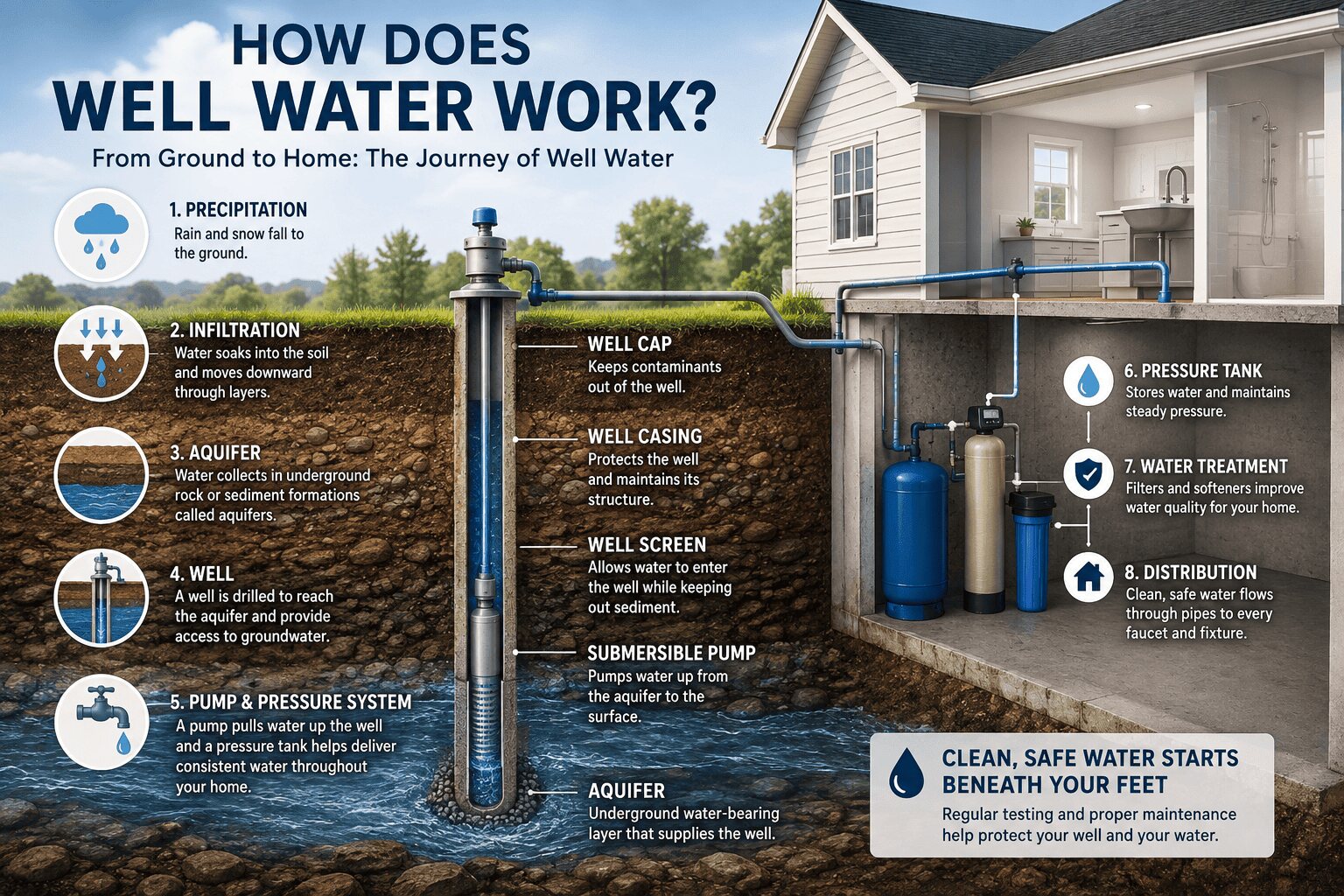
A private well does not create water. Instead, it provides access to groundwater stored beneath the surface of the earth. Rain and snow can seep into the ground, move through soil and rock, and eventually collect in underground formations called aquifers. A well reaches into this water-bearing zone and uses a pump to bring the water to the surface.
But getting water from underground is only part of the story.
The quality of well water depends on the geology around the well, how the well was constructed, surrounding land use, groundwater conditions, and other factors. Unlike public water systems, private wells generally are not regulated by EPA under the Safe Drinking Water Act, so the homeowner is responsible for testing and protecting the water supply.
Understanding how well water works can help you recognize potential problems, maintain your well, and determine when water treatment may be necessary.
What Is Well Water?
Well water is groundwater that is brought to the surface through a constructed well.
Groundwater is found beneath the earth's surface in the spaces and cracks within soil, sand, gravel, and rock. An underground formation that can store and transmit enough groundwater to supply a well is called an aquifer.
When precipitation falls, some water runs across the surface, some evaporates, and some moves downward through the soil. Water that continues to move underground can eventually become part of the groundwater system.
Where Does Well Water Come From?
The basic process looks like this:
Rain and snow → Ground infiltration → Groundwater → Aquifer → Well → Pump → Home
The depth of groundwater can vary significantly from one location to another.
Some wells are relatively shallow, while drilled wells can extend hundreds or even thousands of feet underground depending on local geology and water availability.
How Does a Private Well Work?
A private well is essentially an access point into an underground water supply.
The well is constructed so that water from the surrounding groundwater formation can enter the well while the system helps prevent soil, surface water, and other unwanted materials from entering.
Once water enters the well, a pump moves it toward the home.
Step 1: Groundwater Collects Underground
Water from precipitation gradually moves through the ground.
Some of this water eventually reaches a saturated underground zone where the spaces between soil and rock are filled with water.
This groundwater can move slowly through an aquifer.
Step 2: The Well Reaches the Water-Bearing Formation
A well is drilled or constructed deep enough to reach a usable groundwater source.
The construction method depends on local geology and the type of well being installed.
Step 3: The Pump Moves Water to the Surface
Once the system needs water, a pump moves groundwater through the well piping and toward the home.
The type of pump depends partly on well depth.
EPA notes that submersible pumps are commonly used for deeper private wells, while jet pumps are commonly associated with shallower wells.
Step 4: Water Enters the Home
From the well, water travels through plumbing toward a pressure tank and then into the home's water distribution system.
When you open a faucet, the pressure system helps deliver water to the fixture.
What Are the Main Parts of a Well System?
A private well system consists of more than just a hole in the ground.
Several components work together to provide water to the home.
Well Casing
The casing is the tube-like structure installed inside the well.
It helps maintain the opening of the well and provides a barrier between the well interior and surrounding materials.
Proper casing and grouting also help prevent unwanted surface water and contaminants from entering the well.
Well Cap
The well cap sits at the top of the casing.
Its job is to help keep out:
- Dirt
- Insects
- Debris
- Small animals
- Surface contaminants
A properly installed cap is an important part of protecting the well.
Well Screen
A well screen allows groundwater to enter the well while helping limit the amount of sediment entering the system.
The design of the screen depends on the well construction and surrounding geology.
Pump
The pump is responsible for moving groundwater from the well to the home.
Submersible Pump
A submersible pump is installed inside the well and is commonly used for deeper wells.
Jet Pump
Jet pumps are installed above ground and are commonly used for shallower wells.
Pressure Tank
The pressure tank helps maintain water pressure in the home's plumbing system.
It also reduces the need for the well pump to start every time someone briefly turns on a faucet.
Pipes and Plumbing
Water travels from the well through underground and indoor plumbing before reaching faucets, showers, toilets, appliances, and other fixtures.
What Is an Aquifer?
An aquifer is an underground formation that contains and transmits groundwater.
Aquifers can be made up of different types of geological materials, including:
- Sand
- Gravel
- Sandstone
- Limestone
- Other fractured or permeable rock formations
Not every underground area contains enough usable groundwater to supply a household.
How Does an Aquifer Refill?
Aquifers can receive water through a process called recharge.
Rain and snowmelt can move downward through the soil and replenish groundwater.
However, groundwater recharge does not necessarily happen at the same rate as water is being pumped from a well.
During extended dry periods, groundwater levels can decline, potentially affecting well performance.
Why Does Well Water Taste or Look Different From City Water?
If you have lived in a home with municipal water and then moved to a home with a private well, you may notice differences in taste, odor, appearance, or mineral content.
That is because groundwater naturally interacts with the soil and rock surrounding it.
As water moves underground, it can dissolve naturally occurring minerals.
Common Minerals in Well Water
Depending on local geology, well water may contain minerals such as:
- Calcium
- Magnesium
- Iron
- Manganese
- Sulfur-related compounds
Some of these substances may affect taste, odor, staining, or scale.
For example, calcium and magnesium contribute to hard water, while iron can cause orange or reddish staining.
Is Well Water Safe to Drink?
Well water can be safe to drink, but you should not assume that it is safe simply because it comes from underground.
Private wells do not receive the same centralized monitoring and treatment that public water systems generally provide.
EPA states that private well owners are responsible for ensuring that their drinking water is safe.
Why Can Well Water Become Contaminated?
Groundwater can be affected by both natural sources and human activities.
Potential sources include:
- Septic systems
- Agricultural activities
- Fertilizers
- Pesticides
- Fuel or chemical spills
- Flooding
- Naturally occurring minerals
- Surface water entering a poorly protected well
EPA notes that private wells can be affected by microorganisms, nitrate, naturally occurring contaminants, and other substances depending on local conditions.
How Often Should Well Water Be Tested?
Regular testing is one of the most important responsibilities of owning a private well.
EPA currently recommends testing private wells annually for total coliform bacteria, nitrates, total dissolved solids, and pH. Additional testing may be appropriate depending on local conditions or suspected contaminants.
When Should You Test Your Well Water?
In addition to routine testing, consider testing your water if:
- The taste or odor changes
- The water becomes cloudy
- The color changes
- Your well has been flooded
- You notice a sudden change in water pressure
- Nearby land use changes
- You suspect contamination
- Your treatment equipment begins behaving differently
Use a laboratory certified to perform drinking-water testing.
What Problems Can Occur With Well Water?
Well-water problems can range from relatively minor mineral issues to concerns requiring immediate attention.
Hard Water
Hard water contains elevated levels of calcium and magnesium.
It can cause:
- Scale buildup
- Water spots
- Soap scum
- Poor soap lather
- Mineral deposits
A water softener may be used when testing confirms that hardness is a problem.
Iron
Iron can leave orange, brown, or reddish stains on fixtures, laundry, sinks, and toilets.
Depending on the form and concentration of iron, specialized treatment may be needed.
Manganese
Manganese occurs naturally in some groundwater and can cause staining or other water-quality concerns at elevated levels.
Sulfur Odor
A rotten-egg smell can be associated with hydrogen sulfide or sulfur-reducing bacteria.
The source needs to be identified before selecting treatment.
Sediment
Sand, silt, and other particles can enter some wells and cause cloudy water or damage pumps and treatment equipment.
How Does a Well Water Treatment System Work?
A well itself supplies water, but it does not automatically make that water suitable for every household need.
Treatment should be based on actual water-quality testing.
Common Well Water Treatment Options
Depending on the test results, a home may use:
- Sediment filtration
- Water softening
- Iron filtration
- Manganese treatment
- Activated carbon filtration
- Ultraviolet disinfection
- Reverse osmosis
- Other specialized treatment
The correct solution depends on what is actually present in the water.
EPA notes that treatment options for private wells can include filtration and disinfection, but the appropriate approach depends on the contaminant, its concentration, and the condition of the well.
How Does a Well Pump Know When to Turn On?
Your well pump does not simply run continuously.
The home's pressure system controls when the pump operates.
When you use water, pressure inside the plumbing system decreases. Once the pressure reaches a predetermined level, the pump turns on and moves more water from the well into the system.
As pressure rises again, the pump shuts off.
Why Is the Pressure Tank Important?
The pressure tank stores a quantity of pressurized water.
Without an appropriately functioning pressure tank, the pump may cycle on and off too frequently.
Frequent cycling can place additional stress on the pump and other components.
What Happens During a Power Outage?
A private well generally depends on electricity to operate the pump.
If the power goes out, the pump cannot normally deliver additional groundwater to the house.
You may still have a limited amount of water available in the pressure tank, but once that supply is used, the system generally needs electricity to pump more water.
Can a Well Work Without Electricity?
The answer depends on the specific well system.
Most modern residential well systems rely on an electrically powered pump.
Backup power systems, such as an appropriately sized generator, may help maintain water service during outages.
How Long Does a Private Well Last?
There is no single lifespan that applies to every private well.
The longevity of a well depends on factors such as:
- Construction quality
- Well depth
- Geological conditions
- Pumping rate
- Maintenance
- Water chemistry
- Well components
The well itself and the mechanical components serving it can have very different service lives.
A well may remain usable for many years while its pump, pressure tank, wiring, or other components require replacement sooner.
How Can You Protect Your Well Water?
Protecting the area around the well is just as important as maintaining the equipment.
Keep Contaminants Away From the Well
Avoid activities that could allow chemicals, fuels, waste, or other contaminants to enter the groundwater near the well.
Protect the Wellhead
Make sure the well cap and surrounding area remain in good condition.
EPA recommends that well location and construction help prevent surface water from flowing toward and entering the well.
Maintain Your Septic System
If your home uses a septic system, proper maintenance is important because poorly functioning septic systems can contribute to groundwater contamination.
Test the Water Regularly
Testing is the best way to identify many water-quality problems that cannot be detected by taste, smell, or appearance.
What Should You Do If Your Well Water Suddenly Changes?
A sudden change in well water should not be ignored.
If the water becomes:
- Brown
- Yellow
- Cloudy
- Foamy
- Smelly
- Metallic tasting
start by investigating the cause rather than immediately replacing your treatment equipment.
Check for Recent Changes
Think about whether there has been:
- Heavy rainfall
- Flooding
- Drought
- Well maintenance
- Pump replacement
- Plumbing work
- Changes in nearby land use
- A change in water treatment equipment
If the change is significant or persistent, test the water and contact an appropriate well-water professional.
Frequently Asked Questions
How does well water work?
Well water comes from groundwater stored underground. A private well reaches the groundwater source, and a pump moves the water through plumbing and into the home.
Where does well water come from?
Well water comes from groundwater located beneath the earth's surface, often within an aquifer. Groundwater can be replenished when precipitation infiltrates the soil and reaches underground water-bearing formations.
Is well water groundwater?
Yes. A private well typically uses groundwater as its water source.
Is well water safe to drink?
It can be, but private well water should be tested regularly. Private well owners are responsible for protecting and maintaining their drinking-water supply.
How often should well water be tested?
EPA recommends annual testing for total coliform bacteria, nitrates, total dissolved solids, and pH, with additional testing when local conditions or specific concerns warrant it.
Why does well water have a rotten-egg smell?
A rotten-egg odor can be associated with hydrogen sulfide or sulfur-related activity in the water system. Testing can help identify the source and determine the appropriate treatment.
Why is my well water hard?
Groundwater can dissolve minerals from surrounding soil and rock as it moves underground. Calcium and magnesium are common minerals responsible for water hardness.
Does a water softener make well water safe to drink?
Not by itself. A water softener primarily addresses hardness. Other contaminants may require different treatment technologies.
What happens if my well runs dry?
If groundwater levels fall or the well's supply is inadequate for current demand, water production can decline or stop. A well professional can evaluate the situation and determine whether the issue is related to groundwater levels, the pump, well construction, or another problem.
Final Thoughts
Understanding how well water works starts with understanding groundwater.
Rain and snow can infiltrate the ground, move through soil and rock, and become part of underground water-bearing formations called aquifers. A properly constructed well provides access to that groundwater, while a pump and pressure system deliver it to your home.
But having a well also means taking responsibility for your water supply. Private well owners should regularly test their water, protect the well from potential contamination, maintain the pump and other components, and address changes in water quality promptly.
If your well water has problems such as hardness, iron, manganese, sulfur odors, sediment, or other contaminants, the right treatment should be selected based on water testing rather than guesswork. That approach can help protect your household water supply and ensure your treatment system is designed for the actual conditions in your home.